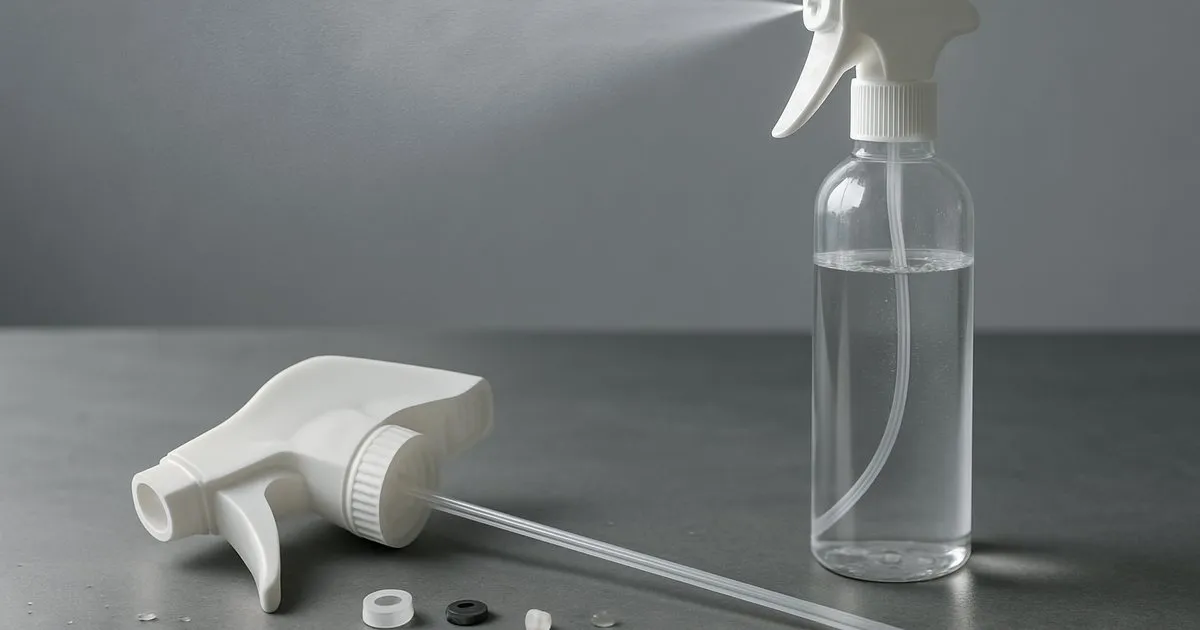
A foaming soap dispenser that is not working is rarely broken. Across the foam pumps we mold and assemble in Yuyao, China, and the complaints that come back from brands and their customers, the large majority trace to one of three things: the soap is too thick for the pump, dried soap has sealed the mesh screens, or liquid has got into the air chamber. All three can be fixed at the sink in under five minutes. A truly defective pump is the exception, and there is a simple test, described below, that tells you which case you have.
Most online advice stops at "rinse it with hot water." That works for one cause out of eight. A foam pump is really two pumps in one, one for liquid and one for air, so it can fail in ways an ordinary lotion pump cannot. This guide works by symptom, explains what is happening inside the head, and ends with the specifications brands should put on a purchase order so the problem never reaches their customers.
Quick Answer: Why Is My Foaming Soap Dispenser Not Working?
- Liquid comes out, but no foam: the soap is too thick or not diluted. Foam pumps need a water-thin liquid. Dilute regular liquid soap about 1 part soap to 3–4 parts water.
- Nothing comes out, or the pump is stiff: dried soap is blocking the mesh screens. Back-flush the head in warm water (method below). If the head won't come up at all or the collar won't unscrew, see how to open a pump bottle that won't twist.
- Watery spurts and spitting: water has got into the air chamber. Turn the pump upside down and pump it dry.
- New dispenser, no foam out of the box: it is not primed yet. Give it 5–10 full strokes.
- Pump head stays down or the bottle caves in: the collar is over-tightened (vacuum) or soap has crystallized around the piston.
How a Foam Pump Makes Foam (and the 3 Things It Needs)
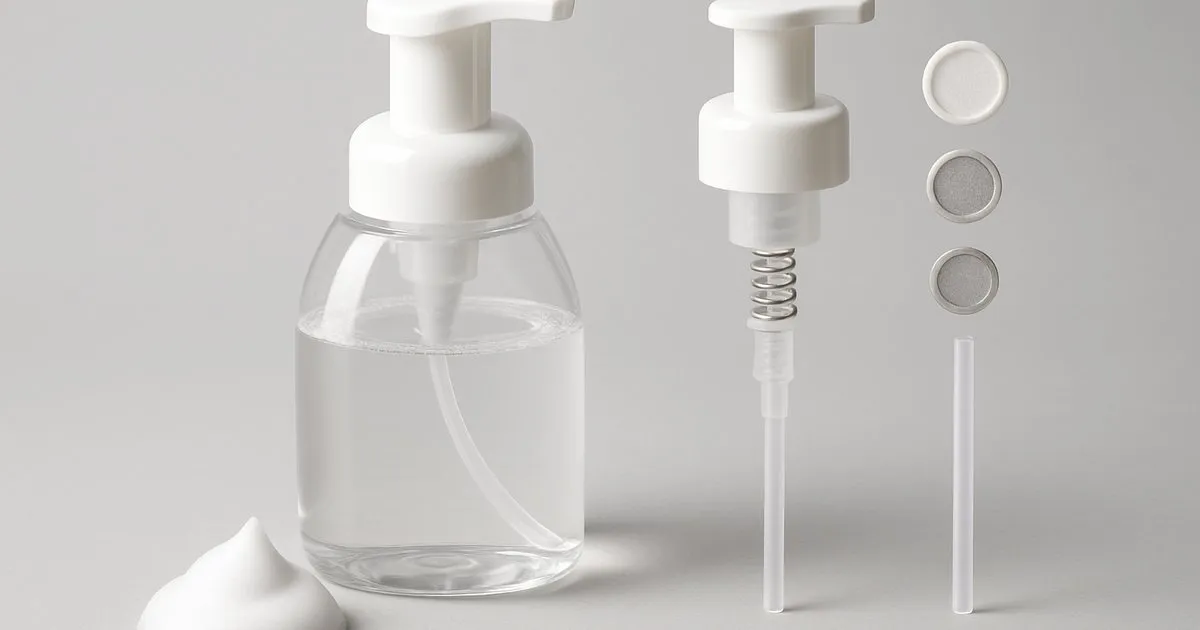
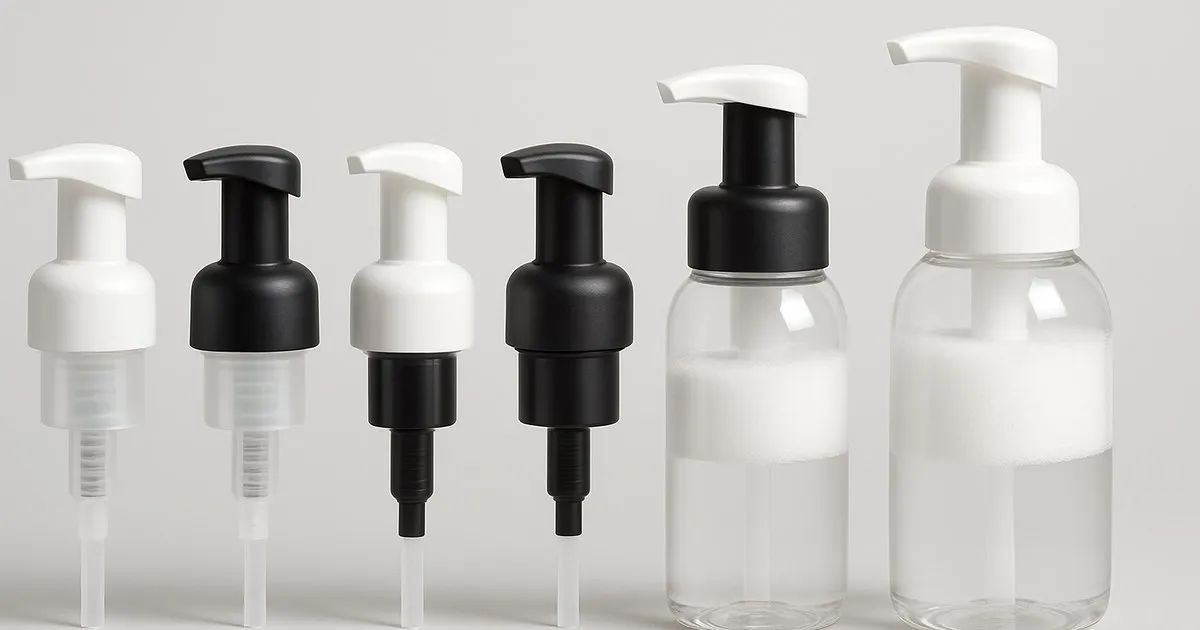
Inside every manual foam pump there are two concentric pistons: a small liquid piston and a much larger air piston. When you press down, both fire together. The liquid piston pushes a measured dose of soap, typically 0.4–0.8 ml per stroke, while the air piston pushes roughly ten times that volume of air into the same mixing chamber. The mix is then forced through one or two fine nylon screens, usually 100–200 mesh (openings of roughly 75–150 µm), which shear it into the 5–10 ml of uniform foam that lands in your hand.
When you let go, the spring lifts both pistons. The liquid chamber refills from the dip tube through a one-way valve, and the air chamber refills with fresh air. That gives three conditions every foam pump depends on:
- A thin, foamable liquid. It has to pass the screens and contain enough surfactant to hold bubbles.
- A dry air chamber. If water gets into it, the pump pushes water instead of air, so there is no foam.
- An airtight liquid path. The dip tube, valve and collar must seal, or the liquid piston pulls air instead of soap.
Every fault in this guide breaks one of those three conditions.
60-Second Diagnosis: Match Your Symptom to the Cause
| What you see | Most likely cause | Fix | Time |
|---|---|---|---|
| Liquid soap comes out, no foam | Soap too thick / undiluted | Dilute 1:3–1:4 with water (Fix 1) | 2 min |
| Thin, runny foam that collapses | Over-diluted, or soap has too little surfactant | Add soap, or change soap (Fix 1) | 2 min |
| Nothing comes out, stiff press | Dried soap sealing the mesh screens | Back-flush in warm water (Fix 2) | 5 min |
| New dispenser, only air or a few drops | Not primed | 5–10 full strokes (Fix 3) | 1 min |
| Spits water, sputters, wet foam | Liquid inside the air chamber | Invert and pump dry (Fix 4) | 3 min + drying |
| Head stays down / springs back slowly | Vacuum, crystallized soap or weak spring | Loosen collar, soak head (Fix 5) | 30 min |
| Bottle walls pull in | Collar over-tightened, vent blocked | Back off 1/4 turn (Fix 5) | 10 sec |
| Pumps air, soap level is fine | Dip tube off, split or too short | Re-seat or replace tube (Fix 6) | 1 min |
| Soap leaks at the collar | Cross-threaded collar, missing gasket | Re-thread, check gasket (Fix 6) | 1 min |
Looking for a reliable spray bottle supplier?
Get free samples and a factory-direct quote within 12 hours.
Get a Free Quote →The Dish Soap Test: Is It the Pump or the Soap?
Before you take anything apart, find out whether the problem is the pump or what is in it. This is the same test our QC line uses on returned pumps.
- Empty the bottle and rinse it.
- Fill it with 1 part ordinary liquid dish soap to 4 parts warm water (for example 60 ml soap + 240 ml water) and swirl gently. Don't shake it, or you will fill the bottle with froth.
- Give it 10 full strokes.
If you get dense foam: the pump is fine and your original soap was the problem. Go to Fix 1.
If you still get no foam: the pump itself is blocked, wet or damaged. Go to Fixes 2–6.
Launching a foaming soap line? Most "defective pump" complaints we investigate are really pump–formula mismatches. Send us a 200 ml sample of your formula and we'll run it on our foam pump bottles for free before you commit to an order. Request samples →
Fix 1: Your Soap Is Too Thick (the #1 Cause)
This is the cause behind most foam complaints. Ordinary liquid hand soap is designed to be thick. Published commercial formulations sit at roughly 1,000–8,000 cPs (BASF-based hand soap formulas specify 4,000–8,000 cPs at 23°C). Water is about 1 cP. A foam pump's mesh and 0.4–0.8 ml liquid piston are tuned for something close to water. Our working rule is that a foamer formula should pour like water, not like syrup.
| Liquid | Typical viscosity | In a foam pump | What to do |
|---|---|---|---|
| Water | ~1 cP | Passes easily, no foam (no surfactant) | — |
| Ready-made foaming hand soap | Water-thin | Ideal | Use as-is |
| Liquid castile soap | Thin | Good once diluted | 1:3–1:5 soap:water |
| Liquid dish soap | Medium | Good once diluted | 1:4–1:5 |
| Regular liquid hand soap | 1,000–8,000 cPs | Clogs, or comes out as liquid | 1:3–1:4, then test |
| Gel soap, body wash with thickeners or pearl | Very high | Often never foams well | Use a lotion pump instead |
| Melted bar soap, cold-process soap, oils, conditioner, scrubs | Varies / particles | Clogs the mesh, can ruin the pump | Don't use |
The salt-thickening trap
Here is something most guides miss. Many hand soaps are thickened with salt (sodium chloride). With this kind of formula, a small amount of extra water can make it thicker before it thins out, because the surfactant system sits on a "salt curve". (The effect is documented in US patent 6,617,293, "thickening on dilution liquid soap.") So if a 1:1 mix looks worse than straight soap, keep going. At 1:3 to 1:4 it will usually drop to water-thin.
Mix soap and water in a jug first, stir gently, then pour. Use distilled or boiled water if your tap water is hard or if the bottle will sit for months, because diluted soap has much less preservative per ml.
Fix 2: Dried Soap Has Sealed the Mesh
If a dispenser sits unused for a few weeks, a soap film dries on the screens and in the nozzle. Even a thin film over 75–150 µm openings is enough to stop it. The symptom is a stiff press with nothing, or a few bubbles, coming out.
Back-flush method (works on 9 out of 10 clogged pumps):
- Fill a bowl with warm water, about 40–50°C. Hand-hot is fine, but avoid boiling water, which can warp PP parts.
- Unscrew the pump. Hold the head upside down and dip the nozzle into the water.
- Point the dip tube away from you and pump 15–20 times. The pump will draw water backwards through the screens and push the dissolved soap out of the tube.
- Then put the dip tube in clean warm water and pump forward 10–15 times until it runs clear.
- Shake out the head, pump it dry with 10 strokes in the air, and refit.
Don't push a pin or toothpick into the nozzle. The screens sit just behind it, and a torn screen cannot be repaired. It means a new pump.
Fix 3: New Dispenser, No Foam Out of the Box
A new foam pump arrives dry, so the liquid piston first has to lift soap up an empty dip tube. Expect 5–10 full strokes before the first proper foam, and press all the way to the stop each time. Quick half-presses move less air than the chamber is designed for, so you get wet, thin foam.
Touchless units work the same way. Xiaomi's support pages, for example, tell owners to dispense more than three times to clear air before foam appears normally. If the unit is still dry after 15 strokes, run the dish soap test. A real factory defect usually shows up here, as a missing ball or a liquid valve that has not seated.
Fix 4: Water Has Got Into the Air Chamber
This is the sneakiest failure, and the one most "rinse it under the tap" advice causes. The air chamber is meant to stay dry. If it fills with water or soap, every press pushes liquid where air should go. You get watery spurts, sputtering or wet, collapsing foam, even with the right soap.
Common ways it happens:
- Overfilling the bottle above the shoulder, so the liquid level reaches the bottom of the pump housing
- Washing the pump under a running tap or submerging the whole head (instead of back-flushing nozzle-first, as above)
- Leaving the bottle in a shower where it gets sprayed, or storing it on its side
Fix: take the pump out, turn it upside down and pump it 15–20 times in the air until no more liquid comes out. Leave it to air-dry, head down, for a few hours or overnight. Then refill to no more than about 80% of the bottle's height. Long exposure to moisture can corrode a carbon-steel spring, which is why pumps that have lived in a shower often never fully recover.
Fix 5: Pump Head Stays Down, or the Bottle Caves In
As soap leaves the bottle, air must get back in. If it can't, the bottle goes into vacuum: soft PET walls pull in, and the pump either stops returning or returns very slowly.
- Over-tightened collar: the most common cause. Tighten collars finger-tight, then back them off a quarter turn to test. If the head pops up and the bottle walls spring out, you have found it. (For brands: this is a capping-torque issue, covered in our capping torque and neck finish guide.)
- Crystallized soap around the piston: soak the whole head in warm water with a drop of dish soap for about 30 minutes, then work the piston up and down until it moves freely.
- Weak or corroded spring: if the head is free but returns sluggishly after cleaning, the spring is done. Replace the pump. On a 43/410 or 40/410 neck, a replacement head costs far less than a new dispenser.
Fix 6: Dip Tube Problems and Leaks
If the pump moves freely but delivers only air while there is plenty of soap, look at the dip tube. It may have popped off the pump stem, have a split near the top, or be cut too short to reach the soap once the level drops. Push it back on firmly. A tube with a split must be replaced, because any hole lets the liquid piston draw air instead of soap.
Leaks at the collar are nearly always a cross-threaded collar or a missing or deformed gasket. Unscrew it, check the PE or rubber ring inside the collar, and re-thread slowly. Turn backwards until you feel the thread "click" into place, then tighten.
Automatic (Touchless) Foam Dispensers: Extra Checks
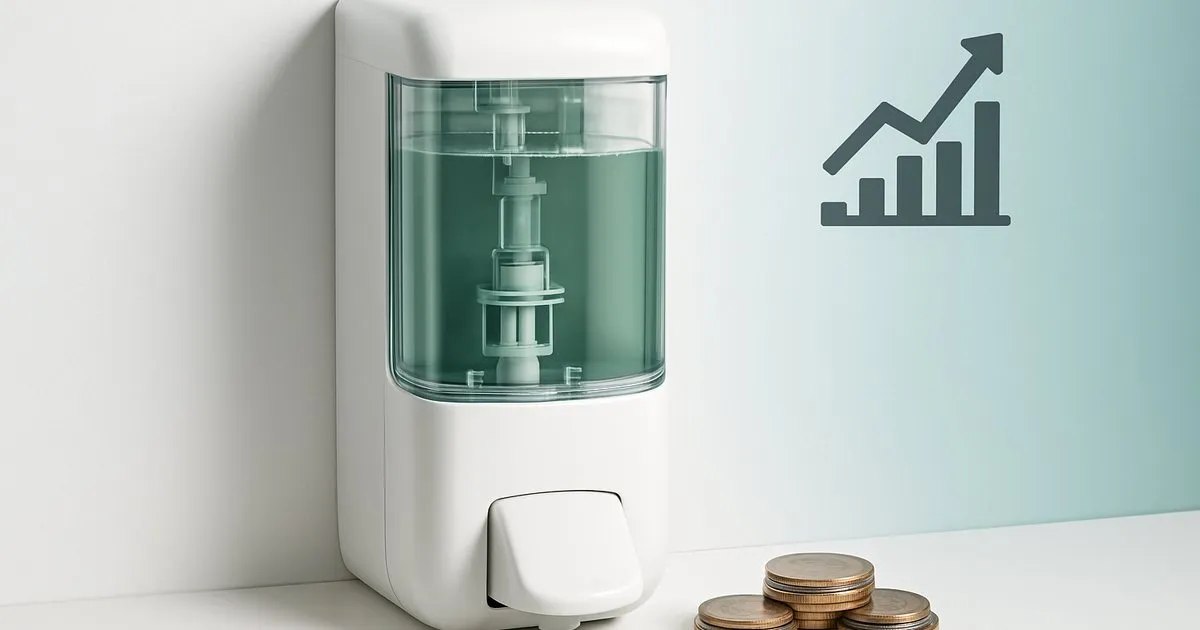
Touchless units have the same foam engine, driven by a motor instead of your hand, so the viscosity and air-chamber rules above all still apply. They also add four failure points of their own:
| Symptom | Check |
|---|---|
| No response at all | Batteries / charge level. Some models, such as the Xiaomi 1S, will not dispense while charging |
| Motor runs, no foam | Soap level, prime (3+ cycles), and viscosity. Thick soap stalls small motors |
| Dispenses randomly or not at all | Clean the IR sensor window; soap film or a reflective counter confuses it |
| Weak foam on a cartridge unit | Use the brand's own refill; a different soap may not match the pump's dilution |
For commercial wall-mount units, see our comparison of bulk-fill vs cartridge soap dispensers. Sealed cartridges remove most of the dilution and contamination problems described here.
When It Really Is a Defect: What Brands Should Specify
If you sell foaming hand soap, every failure above becomes a 1-star review with your brand on it, even when the cause is a formula mismatch. The fix happens at the purchase-order stage. These are the checks we recommend writing into a foam pump PO. They are the same ones we run before shipping.
| Specification | What to require | Why it matters |
|---|---|---|
| Formula compatibility | Your actual formula, filled and aged 4 weeks at 40°C, then foam-tested | Catches thickening, seal swelling and screen clogging before launch |
| Output volume | 0.4 ml or 0.8 ml per stroke, ±10% | Must match your dilution; a concentrated formula needs the smaller dose |
| Mesh | Count stated (100–200 mesh), single or double screen | Finer screens give creamier foam but clog sooner on thicker formulas |
| Priming | First foam within 10 full strokes | The most common "dead on arrival" complaint |
| Stroke life | 3,000+ cycles with no loss of prime | A 250 ml bottle at 0.8 ml/stroke empties in about 310 strokes, so refills multiply this |
| Leak test | Filled bottles held inverted 24 h, no weeping at collar | Catches thread and gasket issues before e-commerce shipping |
| Spring | Stainless steel (or metal-free) for bathroom / shower use | Carbon-steel springs corrode in wet environments |
| Capping torque | Stated range for your neck finish | Over-torque creates the vacuum fault in Fix 5 |
Factory pricing for reference: stock foam pump heads start from about $0.16/pc FOB, and complete foaming dispenser sets (bottle + pump, stock colour) run $0.28–$0.55 per set. MOQ is 3,000 pieces per model with a 15–25 day lead time, and custom logos start from 5,000 pieces. Full sourcing details are in our foam pump selection and sourcing guide and the foaming soap dispenser OEM guide.
Foam Pump vs Lotion Pump: Is Foam the Right Format?
If your soap is thick and you don't want to dilute it, a foam pump is the wrong format. A lotion pump handles roughly 500–10,000 cP and dispenses 1–2 ml of neat product. A foam pump uses roughly 60% less soap per wash, but only with a thin, diluted formula. For a full side-by-side, read our foam soap dispenser guide, which covers how foam dispensers work, the 7 dispenser types and the economics of foam vs liquid soap. If the problem is a spray bottle rather than a soap pump, our spray bottle troubleshooting guide covers trigger sprayers.
Related Guides
- Foam Soap Dispenser Guide: Types, How They Work & Savings
- Foam Pump Selection: Specifications & Sourcing
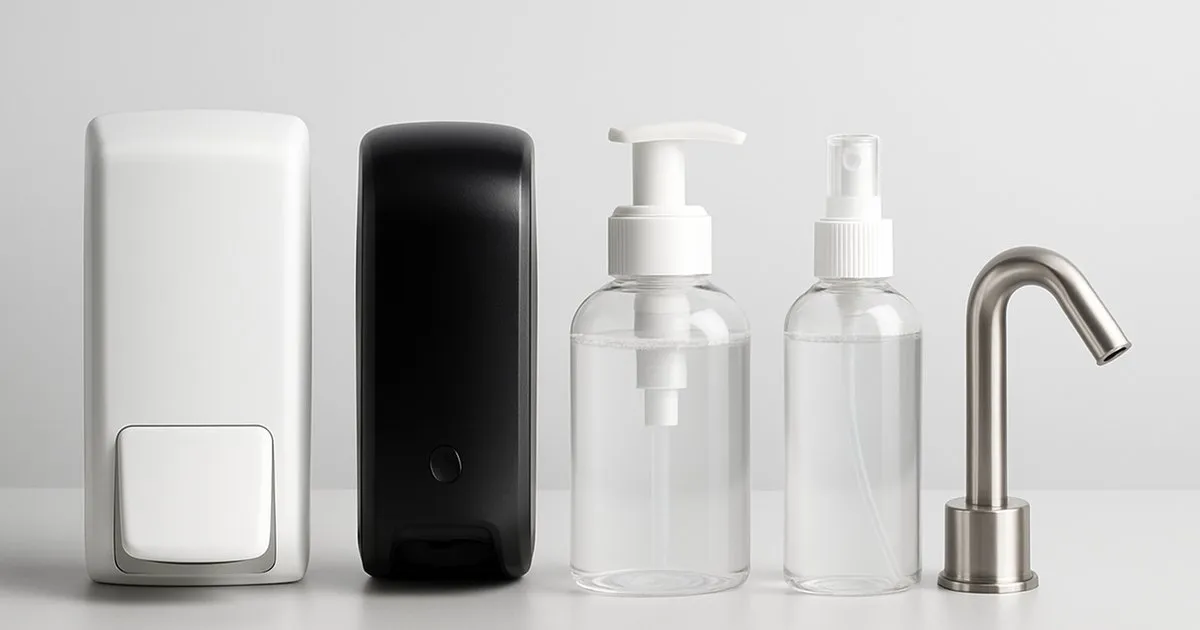
- Types of Soap Dispensers
- Foaming Soap Dispenser Manufacturer: OEM Guide
- How to Fix a Spray Bottle That Won't Spray
- Foam Pump Bottles: Product Range
Request a Quote for Foam Pump Bottles
Factory direct from Yuyao, China: 0.4 / 0.8 ml foam pumps on 40/410 and 43/410 necks, with formula compatibility, priming and leak checks written into your PO. MOQ 3,000 pcs, with custom colour and logo available.
Last Updated: October 13, 2026
Sourcing note for brands
If your foaming dispensers fail in the field, it is usually a pump-spec mismatch, not a formula problem. Desiky supplies foam pump bottles and wholesale spray bottles direct from our Yuyao factory with 100% leak testing.