Every janitorial-supply blog ranks "bulk-fill vs. cartridge soap dispenser" with the same three bullet points: bulk-fill is cheaper, cartridges are more hygienic, pick one. None of them show the actual math a facilities manager needs to defend a budget line, and none of them cite the study behind the hygiene claim — they just say "studies show." We manufacture the foam pumps and cartridge valves that go inside both systems, so this guide gives you the numbers: cost per 1,000 washes, the real contamination data, and what changes the calculation for food service versus a low-traffic office.
Quick Answer
- Bulk-fill costs roughly 30-50% less per wash than sealed cartridge refills, but that gap shrinks once you add the labor time to clean and refill an open reservoir — cartridge swaps take under 30 seconds versus 3-5 minutes to empty, rinse, dry, and refill a bulk unit properly.
- A peer-reviewed field study found bulk-refillable dispensers increased bacteria on washed hands 26-fold (1.42 log10 CFU) when the reservoir was contaminated, while sealed-cartridge refills reduced hand bacteria roughly 2-fold (0.30 log10 CFU) in the same setting (Zapka et al., Applied and Environmental Microbiology, 2011).
- CDC guidance says bulk dispensers must be fully emptied, cleaned, and dried before every refill — "topping off" a partially full reservoir is the specific practice linked to contamination.
- Foam systems use 0.4-0.8ml per stroke versus 3-5ml for a liquid pump stroke of similar wash coverage, because foam is pre-aerated 3-8x — this is usually the bigger lever on cost per wash than bulk vs. cartridge format.
- Rule of thumb: food service, healthcare, and schools should default to sealed cartridge or foam-cartridge systems; low-traffic offices and factory floors with an enforced cleaning schedule can run bulk-fill safely and save money.
What's Actually Different Inside the Dispenser
"Bulk-fill" and "cartridge" describe the refill format, not the dispenser mechanism, and mixing the two up is where most buying mistakes start.
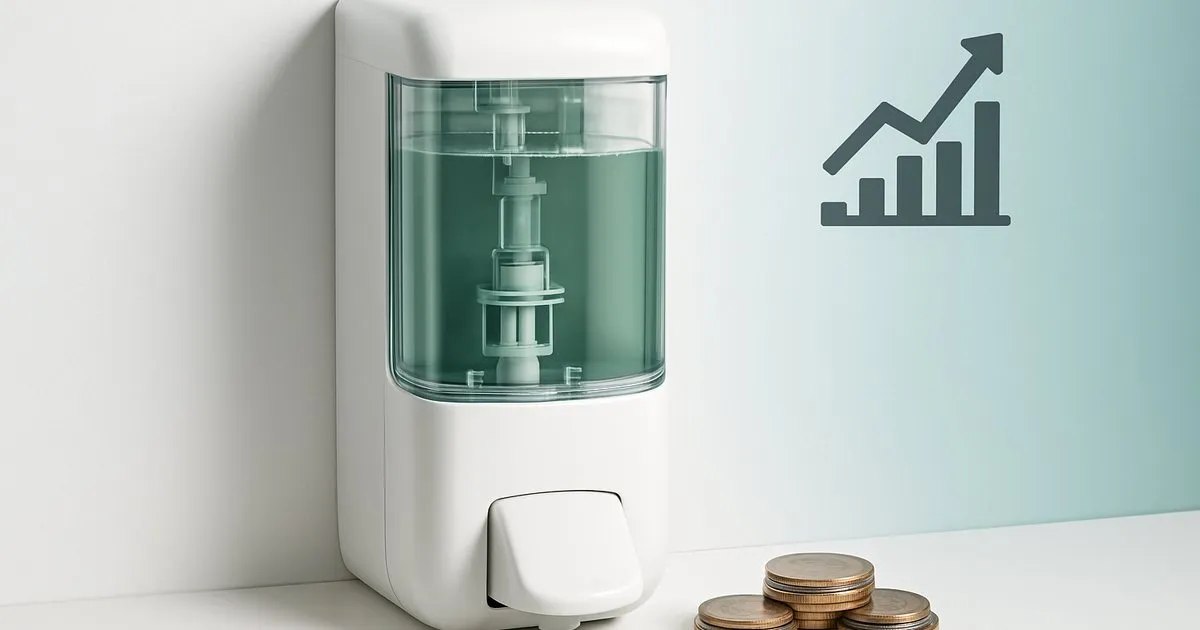
Bulk-fill (open reservoir): a housing with a removable lid or funnel port. Staff pour liquid or foam concentrate directly into the tank, and a standard piston or foam pump draws from the bottom. Because the tank is refilled from an open container, any bacteria on the funnel, the staff member's hands, or residue left in the tank transfers directly into the fresh product.
Sealed cartridge: the refill is a pre-filled, factory-sealed pouch or rigid cartridge with its own one-way valve. The dispenser's pump mechanism engages the cartridge's valve without ever exposing the product to open air or hands. When it's empty, the whole cartridge is swapped — nothing is poured, and nothing in the dispenser housing touches the fresh product.
This is the same distinction we cover from the pump-engineering side in our foam pump specifications guide: a cartridge system needs a pump with a compatible valve interface (usually a specific bayonet or Luer-style fitting), while a bulk-fill system uses a standard neck-mounted pump like the foam pumps we ship on most OEM programs.
The Real Cost Math: Per-Wash, Not Per-Bottle
Comparing sticker price on the dispenser or the refill container is meaningless — the number that matters is cost per 1,000 hand washes, because that's what scales with a building's foot traffic.
| Factor | Bulk-Fill (open reservoir) | Sealed Cartridge |
|---|---|---|
| Typical dispenser unit cost | Lower — simpler housing, no valve interface | Higher — proprietary valve engagement mechanism |
| Refill product cost per wash | Lowest — buying liquid/foam concentrate by the case or drum | 20-40% higher — you pay for the sealed pouch, the valve, and lower packaging volume per unit |
| Refill time per unit | 3-5 minutes (empty, rinse, dry, refill, wipe exterior) | Under 30 seconds (unclip, insert new cartridge) |
| Cleaning/disinfection required | Yes, every refill per CDC guidance | No — sealed system is never opened |
| Contamination risk | Documented — see hygiene data below | Effectively eliminated between refills |
| Waste per refill cycle | None beyond the concentrate container | One sealed pouch/cartridge per refill |
| Best fit | Low-traffic office, warehouse, factory floor | Food service, healthcare, schools, public restrooms |
Worked example: a 50-dispenser office building averaging 4,000 washes/month across all units. At an illustrative $0.012/wash for bulk-fill concentrate versus $0.018/wash for cartridge product, the raw product cost difference is roughly $24/month ($288/year) in bulk-fill's favor. But if refilling a bulk unit properly (empty, clean, dry, refill) takes 4 minutes versus 30 seconds for a cartridge swap, and refills happen twice a month per dispenser at a $22/hour loaded labor rate, that's an extra 58 labor-hours/year — about $1,270/year — that bulk-fill adds back. For most mid-size facilities, the labor cost of doing bulk-fill correctly erases most or all of the raw product savings. The math only favors bulk-fill decisively when refill labor is already on-site and idle (e.g., a factory floor with maintenance staff on a fixed shift) rather than a contracted janitorial visit billed by the hour.
Need dispenser-compatible pumps for a facilities program? We manufacture both open-neck foam pumps and cartridge-valve assemblies to your dispenser's spec. Get a quote with your dispenser make/model and target output.
Looking for a reliable spray bottle supplier?
Get free samples and a factory-direct quote within 12 hours.
Get a Free Quote →The Hygiene Data Bulk-Fill Sellers Don't Cite Precisely
Most facilities-supply articles say "studies show bulk soap dispensers can be contaminated" without naming the study. The most-cited one is Zapka et al., published in Applied and Environmental Microbiology (American Society for Microbiology) in 2011, an elementary-school field study on bulk-soap-refillable dispensers. The findings, specifically:
- Roughly 1 in 4 surveyed bulk-refillable dispensers in the study environment tested positive for extrinsic bacterial contamination in the soap reservoir itself.
- Washing with soap from a contaminated bulk dispenser increased Gram-negative bacteria on hands by 1.42 log10 CFU per hand — a 26-fold increase.
- Washing with soap from a dispenser using sealed refills in the same setting reduced hand bacteria by 0.30 log10 CFU per hand — roughly 2-fold.
- The bacteria recovered were predominantly Gram-negative organisms capable of transferring from hands to food-contact surfaces and other people — the exact opposite of what handwashing is meant to prevent.
The CDC's response to this class of finding is a specific operational instruction, not a ban: bulk dispensers should be completely emptied, cleaned, and fully dried before every refill — "topping off" a reservoir that still has old product and residue in it is the practice most consistently linked to contamination. The failure mode isn't the open-reservoir mechanism itself; it's a refill process that skips the clean-and-dry step, which is exactly what happens when refilling is rushed or delegated to whoever is nearest the empty dispenser.
Foam vs. Liquid: The Bigger Lever Most Buyers Miss
Buyers fixate on bulk-fill-vs-cartridge, but the foam-vs-liquid decision usually moves the cost-per-wash number more. As covered in our foam soap dispenser guide, a foam pump pre-mixes liquid concentrate with air at a 3:1 to 8:1 expansion ratio before it leaves the nozzle. That means a foam pump needs to draw only 0.4-0.8ml of liquid concentrate per stroke to deliver a wash-sized dollop, versus 3-5ml per stroke for a standard liquid pump covering the same hand surface. Concentrate is the expensive part of the refill — cutting the liquid drawn per wash by 75-85% typically cuts cost-per-wash more than switching refill format does.
| Refill type | Liquid drawn per wash | Contamination exposure | Typical use case |
|---|---|---|---|
| Bulk liquid (open reservoir) | 3-5ml | Highest — open pour + open reservoir | Low-traffic office, factory floor |
| Bulk foam (open reservoir) | 0.4-0.8ml | High — open pour, lower reservoir dwell time | Office restrooms wanting lower cost per wash |
| Sealed cartridge, liquid | 3-5ml | Low — sealed pouch, no open pour | Healthcare, food prep areas |
| Sealed cartridge, foam | 0.4-0.8ml | Lowest — sealed pouch + air dilution | Food service, schools, high-traffic public restrooms |
Annual Budget: What a 50-Dispenser Building Actually Spends
Using the worked example above (4,000 washes/month across 50 units, roughly 80 washes per dispenser per month — typical for a mixed office building), here's how the four refill types compare on an annual basis, product cost only:
- Bulk liquid: ~$576/year in concentrate, plus ~$1,270/year in refill labor if done to CDC standard = ~$1,850/year total cost
- Bulk foam: ~$230/year in concentrate (foam's lower draw per wash), plus the same ~$1,270/year labor = ~$1,500/year total cost
- Sealed cartridge, liquid: ~$864/year in refills, plus ~$95/year labor (30-second swaps) = ~$960/year total cost
- Sealed cartridge, foam: ~$345/year in refills, plus ~$95/year labor = ~$440/year total cost
These are illustrative figures built from the per-wash assumptions above and a $22/hour loaded labor rate — plug in your regional soap pricing and labor cost to get your building's real number. The pattern holds across most facilities we've supplied pumps for: switching from bulk liquid to sealed-cartridge foam is usually the single biggest cost lever available, not because cartridges are inherently cheap, but because foam's lower liquid draw per wash outweighs the higher per-unit price of a sealed refill.
How to Choose for Your Facility
Match the format to what's actually being risked, not just the line-item cost:
- Food service, commercial kitchens, healthcare: sealed cartridge, foam or liquid. The contamination risk of an open reservoir near food-contact surfaces isn't worth the savings.
- Schools, daycare, high-traffic public restrooms: sealed cartridge foam. High wash frequency plus inconsistent refill discipline (rotating custodial staff, rushed shifts) is exactly the failure pattern in the Zapka study.
- Low-traffic offices, warehouses, factory floors with dedicated maintenance staff: bulk-fill foam is defensible if the refill process is written down and enforced — empty, clean, dry, refill, every time, no topping off.
- Any facility using a third-party janitorial contract billed hourly: run the labor math above before assuming bulk-fill is cheaper. Contracted refill labor is usually the number that flips the decision toward cartridge.
OEM Manufacturing: What We Supply for Both Systems
We manufacture the pump mechanisms for both formats out of our Ningbo facility — open-neck foam pumps (28/410, 40/410, 43/410 necks, 0.4-2.0ml output, from $0.16/pc FOB at 3,000+ MOQ) covered in full in our foam pump specification guide, and cartridge-valve pump assemblies built to match a specific dispenser housing's engagement mechanism. Cartridge-side tooling is dispenser-specific — there's no industry-wide standard fitting the way there is for FTC spray-pump necks — so cartridge programs need either your dispenser's engineering drawing or a physical sample unit before we quote tooling.
MOQ for stock foam pump configurations starts at 3,000 pieces with 15-25 day lead times; custom cartridge-valve tooling runs $3,000-$9,000 and 45-70 days depending on cavity count, the same tooling economics covered in our foam pump bottle selection guide.
Frequently Asked Questions
Is bulk-fill or cartridge cheaper overall?
Bulk-fill concentrate is cheaper per wash, but once refill labor is counted — especially contracted janitorial labor billed by the hour — sealed cartridge foam is usually the lower total-cost option, because 30-second cartridge swaps eliminate most of the labor bulk-fill requires to refill hygienically.
Are bulk-fill soap dispensers actually unsafe?
Not inherently — the risk comes from "topping off" a reservoir without fully emptying, cleaning, and drying it first. A peer-reviewed field study found contaminated bulk dispensers increased hand bacteria 26-fold, while sealed refills reduced hand bacteria roughly 2-fold in the same setting. A bulk-fill program with an enforced clean-and-dry refill protocol avoids most of that risk.
What's the difference between foam and liquid refill cost?
A foam pump draws 0.4-0.8ml of concentrate per stroke versus 3-5ml for a liquid pump delivering similar hand coverage, because the foam pump pre-mixes concentrate with air at a 3:1 to 8:1 ratio. That typically cuts cost-per-wash by 60-80% regardless of whether the refill is bulk or sealed cartridge.
How often should a bulk-fill dispenser be cleaned?
Every single refill cycle, per CDC guidance — fully empty the reservoir, clean it, and let it dry completely before adding new product. Cleaning intervals longer than "every refill" are the specific practice linked to biofilm formation and contamination in the published research.
Can I retrofit an existing bulk-fill dispenser to take sealed cartridges?
Generally no. Cartridge engagement is a mechanical valve interface built into both the dispenser housing and the cartridge, and it isn't standardized across brands, so retrofitting means replacing the dispenser housing, not just the pump. Confirm this with your dispenser manufacturer before budgeting for a switch.
What MOQ do you need for OEM foam pump or cartridge-valve orders?
Stock foam pump configurations start at 3,000 pieces with 15-25 day lead times. Cartridge-valve assemblies are dispenser-specific and require your housing's engineering drawing or a physical sample before we can quote tooling and MOQ.
Related Guides
- Foam Soap Dispenser Complete Guide
- Foam Pump Selection Guide: Specifications & Sourcing
- Foam Pump Bottle Selection Guide
- Foam Pumps Product Line
Sourcing pumps for a facilities soap program?
Tell us your dispenser type (bulk-fill or cartridge), target output, and monthly volume, and we'll quote pump specs and pricing. Request a Quote for This Product →