Quick Answer: What Actually Defines a Foam Pump?
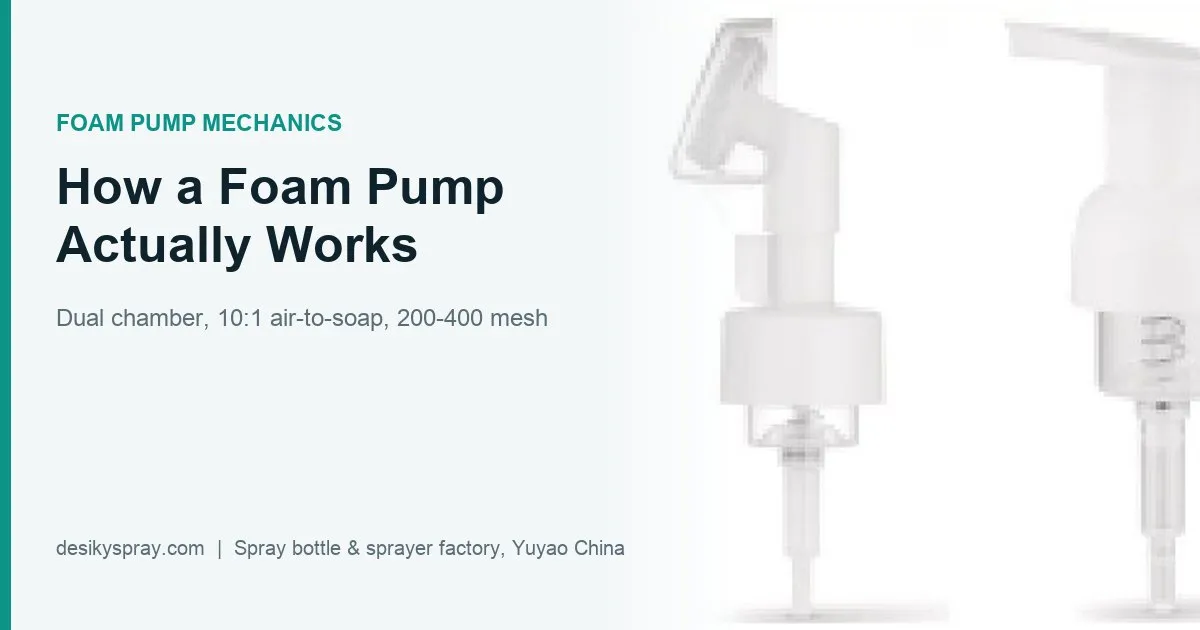
A foam pump is a dual-chamber dispensing closure that pulls liquid and air simultaneously, forces the mixture through a fine mesh screen, and delivers foam without any propellant. Four specifications determine whether it works for your product: neck finish (28/410 through 43/410), output dosage (0.4ml to 2.0ml per stroke), formula viscosity (must stay under roughly 200 cP), and mesh configuration (single or double screen, 10-50 micron pore size).
Get one of those four wrong and the pump either dribbles liquid instead of foam, clogs within 200 strokes, or simply will not thread onto your bottle. We assemble and test foam pumps at our Yuyao factory, and this guide covers the specification decisions in the order we walk new customers through them — plus the MOQ, pricing, and lead-time numbers most supplier blogs leave out.
Foam Pump Anatomy: The 9 Parts That Decide Foam Quality
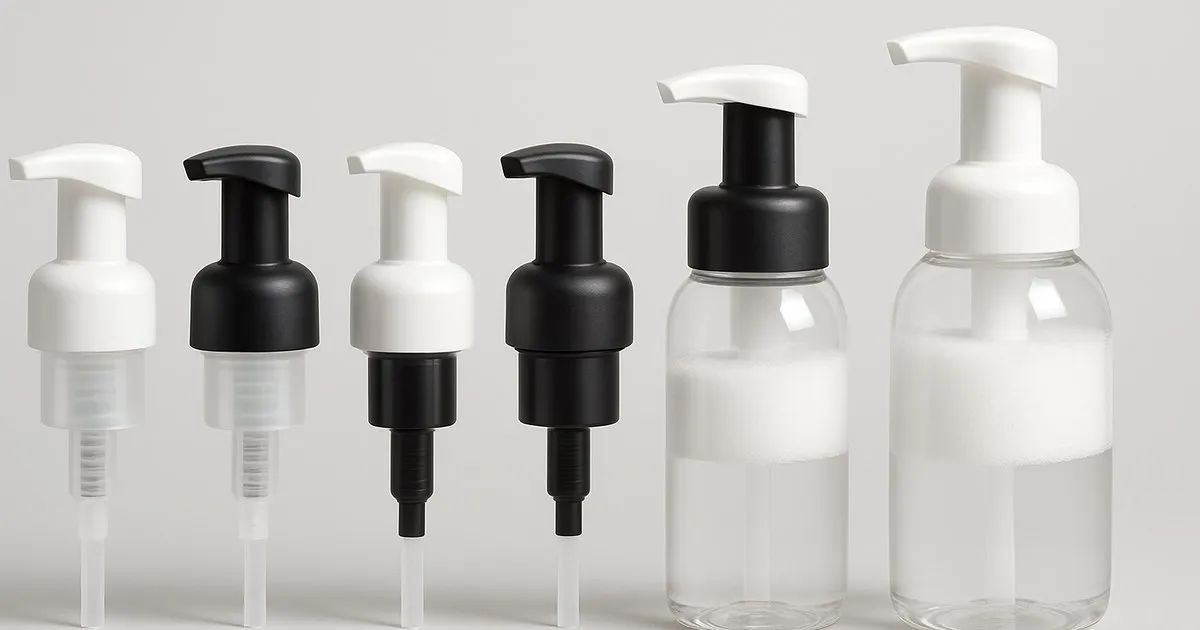
If you have only ever seen a foam pump from the outside, the engineering looks trivial. It is not. A standard foamer contains nine functional parts, and three of them are where cheap pumps fail.
| Component | Function | Typical material | Failure impact |
|---|---|---|---|
| Actuator (head) | User contact surface, foam exit channel | PP | Cosmetic only |
| Closure / collar | Threads onto bottle neck, seals | PP or PE | Leaks in transit |
| Liquid piston | Draws metered liquid from dip tube | PP or POM | Inconsistent dose |
| Air piston | Draws ambient air into mixing chamber | PP | Wet, collapsing foam |
| Mixing chamber | Turbulent air-liquid contact zone | PP | Uneven bubble size |
| Mesh screen (1 or 2) | Shears bubbles down to uniform micro-foam | Nylon or PP mesh | Clogging, coarse foam |
| Spring | Returns actuator, sets stroke force | 304 SS or PP | Rust, stroke fatigue |
| Ball or valve seat | One-way liquid intake | PP, glass or SS ball | Prime loss, air lock |
| Dip tube | Draws liquid from bottle base | PP or PE | Dead stock at bottom |
The three that matter most: mesh, spring, and valve. In our teardown of low-cost imports, the most common defect is a single-layer mesh welded off-center, which shears bubbles unevenly and produces the wet, sagging foam that end users complain about. The second most common is a plain carbon-steel spring that oxidises within weeks in a bathroom environment — always specify 304 stainless steel or an all-plastic spring.
For the consumer-facing explanation of the same mechanism, including a step-by-step diagram, see our companion article on how foaming soap dispensers work.
Looking for a reliable spray bottle supplier?
Get free samples and a factory-direct quote within 12 hours.
Get a Free Quote →Neck Finish: Why Foamer Pumps Do Not Fit Ordinary Bottles
This is the single most expensive mistake we see brands make: ordering 20,000 bottles and 20,000 foam pumps from two different suppliers, then discovering the pumps will not thread on.
A foam pump needs a wide neck because it has to house two pistons side by side, not one. A 28/410 lotion pump body is around 12mm in diameter; a foamer engine is typically 22-26mm. That is why foaming bottles look stubby — the neck is disproportionately wide relative to the body.
| Neck finish | Neck OD | Typical output | Best-fit bottle | Common use |
|---|---|---|---|---|
| 28/410 | 28.0mm | 0.4 - 0.8ml | Slim 100-250ml | Travel foamers, facial cleanser, sample sizes |
| 33/410 | 33.0mm | 0.8ml | 250-300ml | Mid-size personal care |
| 40/410 | 40.0mm | 0.8 - 1.2ml | Stubby 250-500ml | Industry standard for hand soap |
| 42/410 | 42.0mm | 0.4 - 1.2ml | 300-500ml | Retail hand wash, refill formats |
| 43/410 | 43.0mm | 1.2 - 2.0ml | 500ml - 1L | Commercial washrooms, salon back-bar |
The number before the slash is neck outer diameter in millimetres; 410 is the thread standard (a single continuous thread turn). A 40/410 pump and a 40/410 bottle from any two compliant suppliers will mate — but only if both are genuinely to spec. We gauge every incoming neck batch with a plug gauge because out-of-tolerance necks are the leading cause of field leakage.
Practical rule: if you are buying pump and bottle separately, order the pump first and send that exact pump to your bottle supplier as the mating sample. Never rely on the printed spec alone. Our foam pump bottle range ships as matched pump-and-bottle assemblies precisely to remove this risk.
Output Dosage: How Much Foam Per Stroke Do You Actually Need?
Output is stated as liquid volume drawn per stroke, not foam volume. Because a foam pump expands product roughly 3 to 8 times, a 0.8ml pump delivers about 2.4-6.4ml of visible foam. Brands routinely over-specify here and then wonder why their cost per wash is high.
| Output per stroke | Foam delivered | Strokes per 500ml | Recommended for |
|---|---|---|---|
| 0.4ml | ~1.5 - 3ml | ~1,250 | Facial cleanser, kids products, travel sizes |
| 0.8ml | ~3 - 6ml | ~625 | General hand soap — the safe default |
| 1.2ml | ~4 - 9ml | ~415 | Retail hand wash, shaving foam, pet shampoo |
| 1.6 - 2.0ml | ~6 - 15ml | ~280 | Commercial washrooms, salon, industrial hand cleaner |
Our recommendation: unless you have a specific reason, specify 0.8ml. It is the highest-volume tooling in the industry, which means the shortest lead times, the lowest unit price, and the widest colour and finish availability. Moving to 1.6ml or 2.0ml typically adds 10-18% to unit cost and 5-10 days to lead time because those cavities run less frequently.
One more consideration that only shows up after launch: perceived value. A 0.4ml pump on a premium 200ml facial cleanser gives roughly 500 uses, which reads as excellent value to the customer. The same 0.4ml pump on a 500ml kitchen hand soap makes users press four times per wash and feels stingy. Match dosage to the wash gesture, not to the bottle size.
Viscosity Limits: The Truth About "Viscous Foam Pumps"
We get this request every month: "Do you have a foam pump for a thick, viscous formula?" The honest manufacturer answer is that high-viscosity foaming is a physics problem, not a pump problem.
Foam pumps work by pulling liquid through a narrow orifice and a fine mesh at low pressure. The workable window is roughly:
- Ideal viscosity: 1 - 50 cP (water is 1 cP at 20 degrees C) — clean, dense, repeatable foam
- Workable: 50 - 200 cP — requires larger mesh pore size and often a 1.2ml+ engine; foam becomes wetter
- Above 200 cP — the mesh blinds, output drops stroke by stroke, and the pump loses prime. No commercially available foamer solves this reliably
Surfactant chemistry matters as much as viscosity. Formulas need roughly 5% or more active surfactant to generate stable foam, a pH between about 4.5 and 9 to avoid attacking PP components, and low or zero suspended solids. Exfoliating beads, clay, and undissolved botanical particles will block a 10-50 micron mesh regardless of viscosity.
What to do instead if your formula is thick:
- Dilute and reformulate. Most "thick" foaming hand soaps on shelf are 1:3 to 1:5 concentrate-to-water. Reducing thickener load is cheaper than exotic tooling.
- Switch to a double-mesh, large-pore engine. Buys you headroom up to roughly 200 cP at the cost of slightly wetter foam.
- Move to a lotion or airless pump. If the formula genuinely must stay thick, it is not a foam product — see our guidance on choosing between spray, pump and dropper closures.
We will run a free compatibility test on your actual formula before you commit to tooling. Send 200ml, and we return stroke-by-stroke output data across 1,000 cycles. Request a sample and compatibility test here.
Air-to-Liquid Ratio and Mesh Selection: Tuning Foam Density
Foam texture is not a fixed property of "a foam pump". It is tuned by two variables you can specify at order time.
Air-to-liquid ratio is set by the relative bore of the air piston and liquid piston. Standard foamers run somewhere between 1:3 and 1:10 liquid-to-air depending on design intent:
| Ratio (liquid:air) | Foam character | Typical application |
|---|---|---|
| 1:3 - 1:4 | Dense, creamy, slower collapse | Premium facial cleanser, shaving foam |
| 1:5 - 1:7 | Balanced, airy but stable | Hand soap, body wash |
| 1:8 - 1:10 | Very light, high volume, fast collapse | Value hand soap, high-perceived-volume retail |
Mesh configuration is the second lever. A single mesh produces coarser bubbles and resists clogging; a double mesh shears bubbles twice and produces the tight micro-foam premium brands want, at higher clog risk with imperfect formulas. Pore sizes in production run 10-50 microns, with 25-35 microns the common compromise.
Manufacturer note: customers frequently ask for the densest possible foam and the most clog-resistant pump in the same brief. Those pull in opposite directions. Decide which failure you can live with — slightly airier foam, or occasional field clogs — before you finalise the spec. In our experience the airier option generates far fewer customer complaints.
Mono-Material Foam Pumps and EU PPWR Compliance
If you sell into the EU, this section is not optional. Regulation (EU) 2025/40 — the Packaging and Packaging Waste Regulation — entered into force in February 2025 and requires all packaging placed on the EU market to be recyclable in practice and at scale by 2030, with minimum recycled-content thresholds between 30% and 65% for plastic packaging categories.
A conventional foam pump is a recycling problem: PP body, nylon mesh, stainless spring, sometimes a glass ball. Mixed materials mean the whole closure is typically rejected at sorting.
All-plastic (mono-material PP) foam pumps replace the metal spring with a moulded PP spring and use a PP mesh, giving a closure that sorts with a PP or PE stream. The trade-offs are real and worth knowing before you specify:
| Factor | Conventional foam pump | Mono-material PP foam pump |
|---|---|---|
| Spring | 304 stainless steel | Moulded PP |
| Recyclability | Usually rejected at sorting | Sorts with PP stream |
| PPWR 2030 readiness | Requires redesign | Compliant path |
| Cycle life (our test) | 20,000+ strokes | 8,000 - 12,000 strokes |
| Stroke feel | Crisp, consistent | Slightly softer return |
| Unit cost premium | Baseline | +15% to +30% |
| MOQ | 3,000 pcs | 10,000 pcs |
Market direction supports the investment: the mono-material pump segment is valued at roughly US$1.6 billion in 2026 and projected to reach US$2.4 billion by 2033, a 5.9% CAGR, driven almost entirely by regulatory mandates rather than consumer pull. For most brands, 8,000-12,000 strokes on a mono-material pump comfortably outlasts a 500ml bottle used at 625 strokes per fill across several refills.
PCR (post-consumer recycled) resin is the companion decision. We can run foam pump closures in 30-50% PCR PP; see our detailed breakdown on PCR plastic in bottle and closure production for colour-matching limits and cost impact.
Foam Pump QC: The 6 Tests We Run Before Shipping
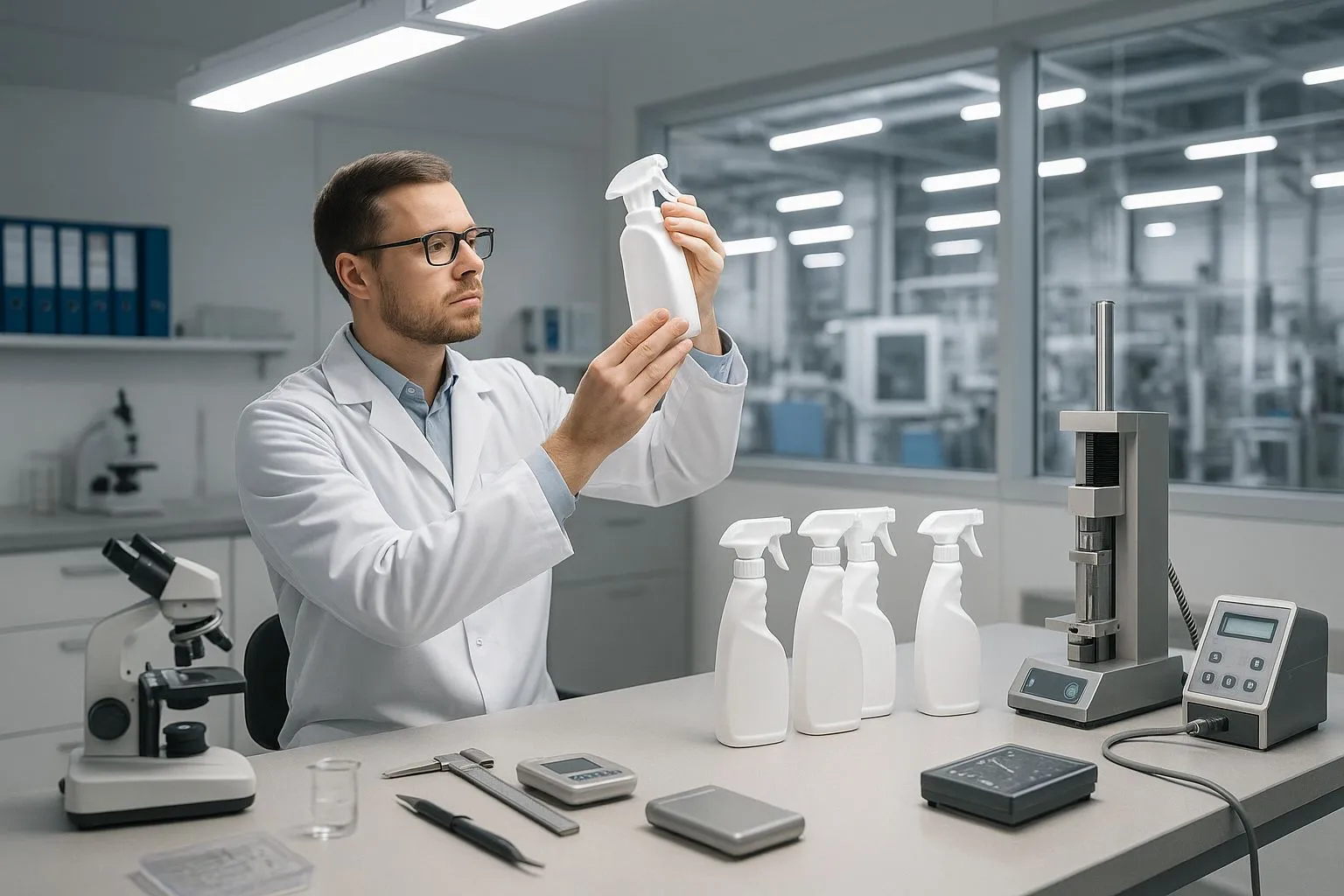
Ask any supplier for their QC protocol. If the answer is "we check appearance", walk away. Here is what a serious foam pump inspection actually covers.
| Test | Method | Our accept criteria |
|---|---|---|
| Output consistency | Gravimetric, 20 strokes, 5 samples per cavity | Within +/-10% of nominal dose |
| Cycle life | Automated stroke rig with target formula | No output loss at 5,000 cycles; report to 20,000 |
| Prime strokes | Count strokes from dry to full output | 3 strokes or fewer |
| Leak / vacuum | Inverted 24h at 40 degrees C, plus vacuum decay | Zero leakage |
| Torque retention | Apply 15-18 in-lb, retest after 48h | Retains 70%+ of applied torque |
| Material compliance | FDA 21 CFR 177 / EU 10/2011 documentation, BPA-free | Certificates per resin lot |
Inspection level is AQL 2.5 for major defects and AQL 4.0 for minor, per ISO 2859-1. We provide the full report with photos before the container is sealed. Our wider approach is documented in the spray bottle quality standards and testing guide.
Foam Pump MOQ, Pricing and Lead Times (FOB Ningbo)
Almost no supplier blog publishes numbers. Here are ours, current for 2026. These are indicative FOB Ningbo prices for pump-only orders in stock colours; matched pump-and-bottle assemblies price separately.
| Configuration | MOQ | 3,000 - 10,000 pcs | 10,000 - 50,000 pcs | 50,000+ pcs |
|---|---|---|---|---|
| 28/410 foamer, 0.4ml, stock white | 3,000 | $0.16 - $0.20 | $0.13 - $0.16 | $0.11 - $0.13 |
| 40/410 foamer, 0.8ml, stock white | 3,000 | $0.18 - $0.23 | $0.15 - $0.18 | $0.12 - $0.15 |
| 43/410 foamer, 1.2-2.0ml | 5,000 | $0.24 - $0.31 | $0.20 - $0.24 | $0.17 - $0.20 |
| Mono-material all-PP foamer | 10,000 | $0.26 - $0.34 | $0.22 - $0.27 | $0.19 - $0.22 |
| Custom Pantone colour | 10,000 | +$0.02 - $0.04/pc | +$0.01 - $0.03/pc | +$0.01/pc |
| Metallised or soft-touch actuator | 10,000 | +$0.05 - $0.09/pc | +$0.04 - $0.07/pc | +$0.03 - $0.05/pc |
Lead times: 15-25 days for stock configurations, 25-35 days for custom colour, and 45-70 days if a new actuator mould is required. Custom actuator tooling runs $3,000 - $9,000 depending on cavity count and surface finish — which amortises to under $0.10 per unit on a 100,000-piece programme and under $0.03 across a three-year run.
Cost driver most buyers miss: colour changeover. Ordering five Pantone colours at 2,000 pieces each costs materially more than 10,000 pieces in one colour, because each changeover consumes purge material and machine hours. If budget is tight, launch in one colour and add SKUs at reorder.
For the full economics of moving from stock to custom tooling, see our custom plastic bottle manufacturing and OEM production guide.
How to Choose a Foam Pump Supplier: 7 Questions That Filter Fast
Most foam pump "manufacturers" listed on B2B marketplaces are trading companies. These seven questions separate them in a single email:
- "What is your air-to-liquid ratio on this SKU, and can you change it?" A factory knows the number. A trader forwards the question.
- "Single or double mesh, and what pore size?" If they cannot answer in microns, they do not control the tooling.
- "Can you run my formula for 1,000 cycles and send stroke-by-stroke output data?" Real factories have the rig; traders offer to "send a sample".
- "Stainless or plastic spring, and which grade?" The answer should be 304 SS or moulded PP, stated without hesitation.
- "Show me the plug gauge report for the neck finish." This is the leak-prevention document that matters.
- "What is your unit price at 3,000, 10,000 and 50,000?" A tiered answer indicates real cost structure; a single flat price indicates a markup on someone else's quote.
- "Can I video-call your assembly line right now?" The fastest filter of all.
We answer all seven in writing before quoting. If you are evaluating suppliers more broadly, our guide to choosing a spray bottle supplier covers audit checklists and payment-term red flags in more depth.
Matching Foam Pumps to Your Product Category
| Product | Neck | Output | Ratio | Mesh | Notes |
|---|---|---|---|---|---|
| Hand soap (retail 300-500ml) | 40/410 or 42/410 | 0.8 - 1.2ml | 1:6 | Double | The volume default |
| Facial cleanser (150-200ml) | 28/410 or 33/410 | 0.4ml | 1:3 - 1:4 | Double | Dense foam signals premium |
| Commercial washroom (1L) | 43/410 | 1.6 - 2.0ml | 1:7 | Single | Prioritise clog resistance |
| Pet shampoo | 40/410 | 1.2ml | 1:5 | Single | Formulas often carry solids |
| Salon and barber back-bar | 43/410 | 1.2 - 1.6ml | 1:6 | Single | High cycle count per day |
| Travel and hotel amenity | 28/410 | 0.4ml | 1:5 | Double | Under 100ml for cabin baggage |
If your programme extends beyond foamers into sprayers and cosmetic closures, our cosmetic bottle range and custom OEM bottle service share the same tooling and QC infrastructure, which lets you consolidate to a single supplier and one container.
Frequently Asked Questions
How does a foam pump work without any propellant?
Two pistons move on the same stroke. A small liquid piston draws a measured dose up the dip tube while a much larger air piston pulls ambient air into a parallel chamber. The two streams meet in a mixing chamber and are forced through a fine mesh screen, which shears the mixture into uniform micro-bubbles. All the energy comes from your hand — no propellant, no battery.
Why does my foam pump dispense liquid instead of foam?
Almost always one of three causes: the formula is too viscous (above roughly 200 cP), surfactant level is too low (under about 5% active), or the mesh is blocked by dried product or suspended solids. Flush with warm water first; if output stays liquid, the formula needs reformulating, not the pump replacing.
Can I use a regular pump bottle with a foam pump?
No, and this is the most common sourcing error. Foam pump engines are 22-26mm in diameter and need a 28mm-plus neck. A standard 24/410 lotion bottle will not accept a foamer. Always confirm neck finish on both parts, and ideally source pump and bottle as a matched assembly.
What is the ideal dilution for a foaming hand soap?
Typical concentrate-to-water ratios run 1:3 to 1:5. Start at 1:4, evaluate foam density and rinse-off, then adjust. Higher water content gives lighter foam and lower cost per wash but weaker cleansing perception.
What is your MOQ and lead time for foam pumps?
MOQ is 3,000 pieces for stock configurations in stock colours, 10,000 pieces for custom Pantone colour or mono-material all-PP construction. Lead time is 15-25 days for stock, 25-35 days for custom colour, and 45-70 days when new actuator tooling is required.
Are all-plastic foam pumps as durable as pumps with a metal spring?
Not quite. In our cycle testing, mono-material PP foamers deliver 8,000-12,000 strokes versus 20,000-plus for stainless-spring designs. For a 500ml bottle at roughly 625 strokes per fill, that is still 13-19 full refills, which exceeds the practical life of most bottles.
Do foam pumps really reduce soap consumption?
Yes, substantially. Because the pump expands product 3-8 times with air, a single 0.8ml dose covers both hands. Facility studies and our own customer data consistently show 50-70% reduction in soap volume per handwash versus a liquid pump, which is why commercial washrooms switched first.
Foam Pump Market: Size, Growth & Trends in 2026
The global foam pump market reached an estimated $1.8 billion in 2025 and is projected to grow at 6.2% CAGR through 2030, driven by three forces: hygiene awareness post-COVID, sustainability regulation (EU PPWR mandating recyclable packaging by 2030), and the 50-70% soap savings that facility managers cannot ignore.
Key foam pump market trends we see from our factory floor:
- Mono-material pumps are the fastest-growing segment. European brands now specify all-PP construction to meet PPWR recyclability requirements, even at the cost of reduced cycle life (8,000-12,000 vs 20,000+ for metal-spring designs).
- Touchless foam dispensers are replacing manual pumps in commercial settings at a 15-20% annual rate, driven by hygiene protocols in healthcare, hospitality, and food service.
- Emerging markets (Southeast Asia, Latin America, Middle East) are adopting foam dispensers 3-5 years behind North America and Europe, creating a wave of new OEM demand from regional brands.
- Foam-to-cream formulations are expanding the foam pump beyond hand soap into skincare, shaving, and haircare, each requiring different mesh configurations and output volumes.
For manufacturers and brand owners, the foam pump market opportunity is clear: lower per-wash cost, better user experience, and regulatory tailwinds all point in the same direction. The key competitive advantage is specification accuracy — matching pump output, mesh density, and neck finish to your exact formula and bottle.
Related Guides
- How Do Foaming Soap Dispensers Work? Mechanism Explained
- Custom Plastic Bottle Manufacturing: OEM Process, MOQ and Pricing
- Spray Bottle Quality Standards and Testing Guide
- PCR Plastic and Sustainable Bottle Production
- HDPE vs PET vs PP: Bottle Material Comparison
Get a Foam Pump Quote
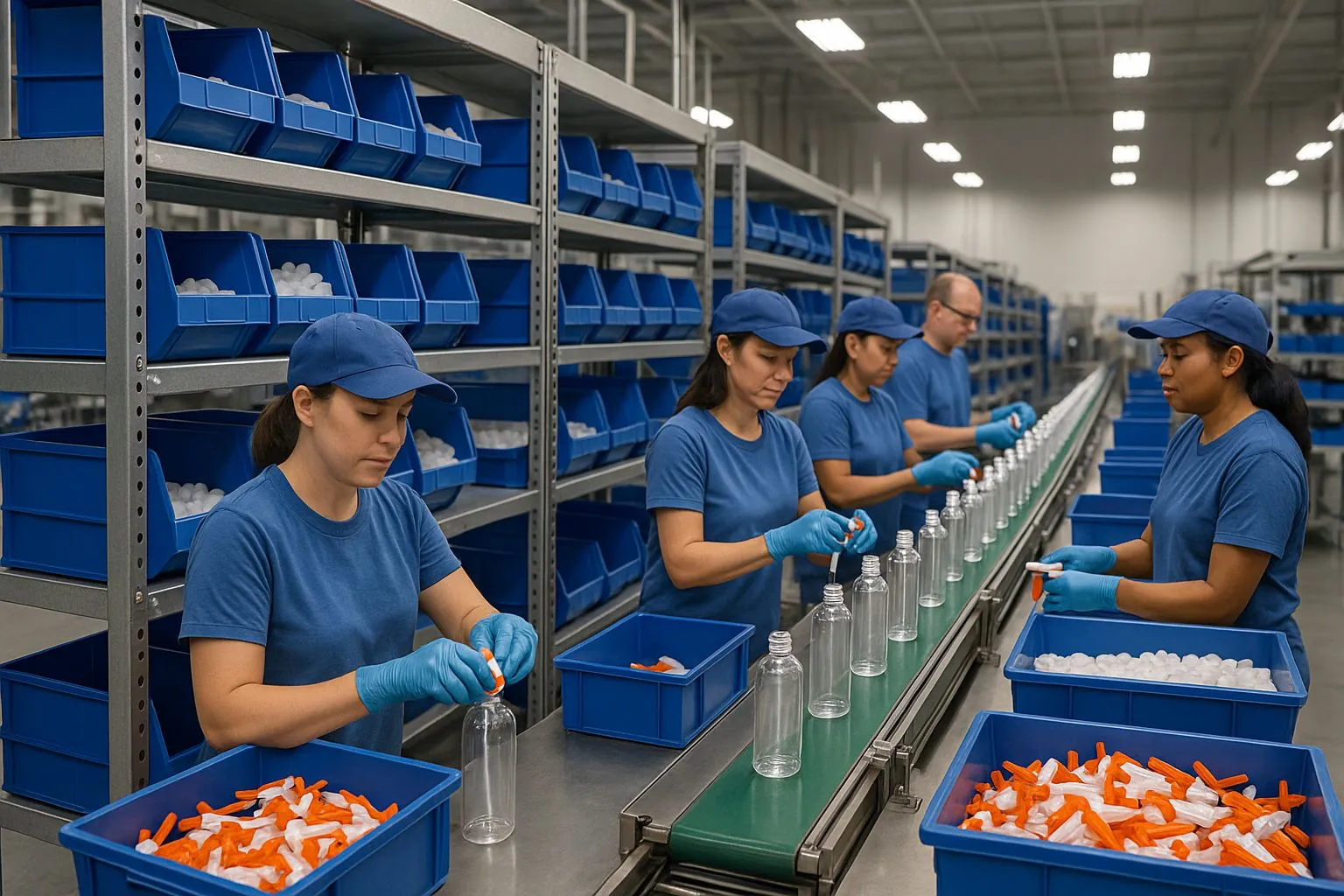
We manufacture and assemble foam pumps and matched foaming bottles in Yuyao, China, with in-house injection moulding, automated assembly, and a testing lab that runs your actual formula before you commit to tooling. MOQ starts at 3,000 pieces, samples are free, and we answer specification questions with numbers rather than adjectives.
Send your formula viscosity, target neck finish, output dosage, and annual volume, and we will come back with a tiered quote and a compatibility assessment within 24 hours.
Request a foam pump quote | Order free samples | Browse foam pump bottles
Also see: Spray Bottles Wholesale & Bulk for all product categories with tiered pricing.