The bottles passed inspection at the factory. They passed again at your warehouse. Six weeks later the retailer sends back a pallet of leakers, and everyone in the chain is holding a torque reading that says the package was fine. Nobody is lying. The readings were taken at different moments, and on a threaded closure that is the same thing as taking them on different packages.
We manufacture spray bottles and trigger sprayers in Yuyao, China, and capping is the single most common place where a technically correct spec produces a commercially broken package. The articles that rank for capping torque today are written by capping-machine builders and closure distributors. They are not wrong — but two of the three we read give no numbers at all, and none of them mentions the part that actually causes most "it leaks at the correct torque" complaints on a sprayer: the dip tube.
Quick Answer
- Application torque, 28 mm closure on a plastic bottle: 13–17 in-lb per one widely used chart, 12–21 in-lb per another. Both are published guidance. Pick one, write it on the drawing, and stop treating "28 mm" as if it implied a number.
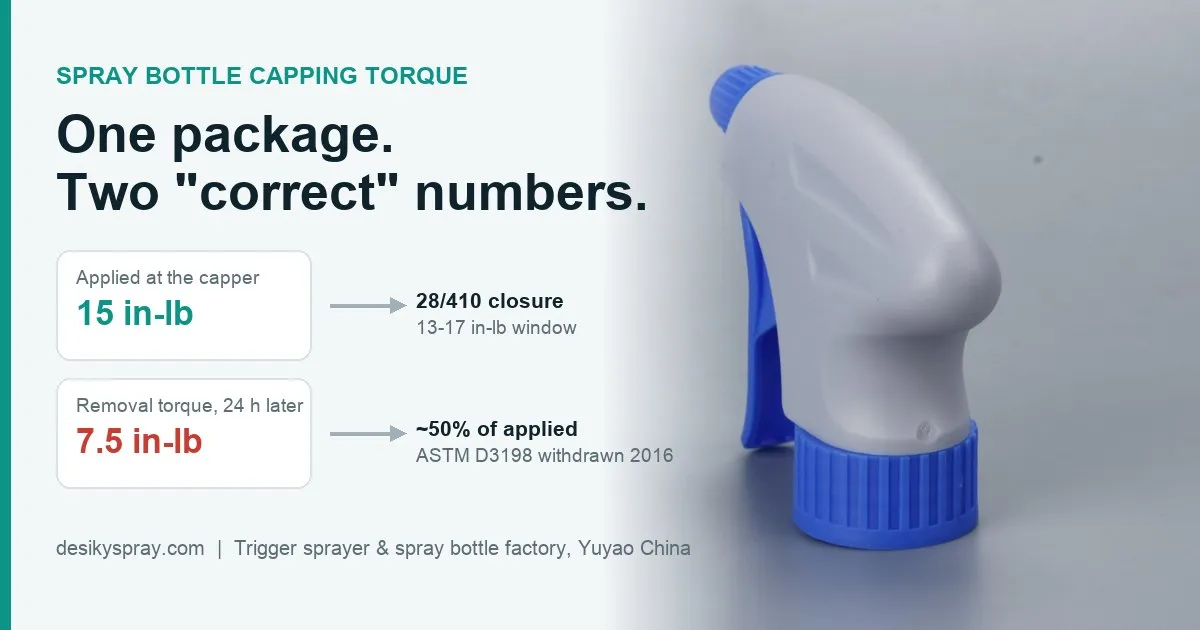
- Removal torque is not a number, it is a curve. Roughly 70–75% of applied torque measured immediately, roughly 50% measured 24 hours later. A removal-torque limit with no time stamp cannot be enforced by either side.
- ASTM D3198 — the test every spec sheet cites — was withdrawn in 2016 with no replacement. What is still active is ASTM D2063/D2063M (torque retention, measured over time) and ASTM D3474 (calibrating the meter).
- On a trigger sprayer, the top cause of leaks at correct torque is a dip tube cut too long. It bottoms out on the base and levers the closure off the sealing land. Spec 1–2 mm clearance and a 45° cut.
- A 28/410 thread OD band is about 27.70–28.10 mm (0.40 mm). Multi-cavity blow moulding of a thin-wall neck holds about ±0.3 mm at best. Ask which process forms the neck before you ask for a Cpk.
What Capping Torque Actually Controls
Torque is not the seal. Torque is the input you can measure on a production line; the seal is compression of the liner or gasket against the bottle's sealing land — the flat annular face on top of the neck. Everything between the two is friction, and friction is the part nobody specs.
That distinction explains the two failure modes. Under-torque leaves the gasket under-compressed and product weeps past the land. Over-torque is the one buyers underestimate: it deforms the closure skirt, distributes compression unevenly across the land, and on a thin-wall neck it will jump or strip threads. Over-tightening is cited by closure distributors as the more common cause of leaks in practice, which is counter-intuitive enough that most quality agreements are written with only a lower limit.
Write both limits. A spec that says "minimum 12 in-lb" invites the filler to run at 22 to be safe, and at 22 in-lb a 28 mm sprayer on a lightweighted PET neck is a thread-strip waiting for the first temperature cycle in a container.
The Torque Chart by Neck Size — and Why Two Charts Disagree
Here are the two most-cited published application-torque guidelines for the sizes that matter on spray packaging, side by side. Values are inch-pounds, for plastic containers.
| Closure size | Chart A (ebottles) | Chart B (Kinex Cappers) | Where they overlap | Chart B's ceiling vs A |
|---|---|---|---|---|
| 20 mm | 10–12 | 8–12 | 10–12 | same |
| 24 mm | 12–15 | 10–18 | 12–15 | +20% |
| 28 mm (most trigger sprayers) | 13–17 | 12–21 | 13–17 | +24% |
| 33 mm | 16–20 | 15–25 | 16–20 | +25% |
| 38 mm | 19–23 | 17–26 | 19–23 | +13% |
Read the last two columns, because that is the finding. The two charts broadly agree on how tight is tight enough. They disagree on how tight is too tight, by 13–25% at every size above 20 mm. The lower bounds are a sealing question and the physics is shared; the upper bounds are a structural question and depend on assumptions about wall thickness and closure design that neither chart states.
The practical consequence for a spray bottle programme: take the lower ceiling. A trigger sprayer sits on a neck that is usually the thinnest-walled part of a lightweighted bottle, and the closure is a moulded shroud rather than a stiff flat cap. If you run a 28 mm sprayer at 20 in-lb because one chart allows it, you are inside published guidance and outside the other chart entirely. For 28 mm, 13–17 in-lb is the interval both sources will defend.
Looking for a reliable spray bottle supplier?
Get free samples and a factory-direct quote within 12 hours.
Get a Free Quote →Removal Torque Is a Time Series, Not a Number
This is where most supplier–buyer disputes actually live, and it is arithmetic rather than opinion.
Two published data points define the curve. Kinex's worked example applies about 17 in-lb and measures removal at approximately 12.5 in-lb — about 73.5%, measured on the line. The ebottles guidance states that testing the same package 24 hours later, "you may expect a removal torque of 50% of the original application torque."
Apply both to a 28 mm trigger sprayer capped at 15 in-lb, the midpoint of the agreed window:
| When you measure | Fraction of applied torque | Reading on a 15 in-lb package | Who normally measures here |
|---|---|---|---|
| Immediately, at the capper | ≈73.5% | 11.0 in-lb | The filler's line QC |
| 24 hours later | ≈50% | 7.5 in-lb | The factory's next-day retain check |
| On arrival, weeks later | 50% or below | ≤7.5 in-lb | Your incoming inspection |
The same package reads 11.0 in-lb and 7.5 in-lb — a 32% drop produced by nothing but elapsed time. Now put a common clause into that table: "removal torque shall be not less than 10 in-lb." The line passes it. Your incoming inspection fails it by 25%. Both parties used the same method, the same meter and the same package, and the argument is unwinnable because the specification never said when.
The mechanism is not mysterious — it is stress relaxation. The liner or gasket is a viscoelastic polymer under sustained compression, and it creeps; the closure skirt relaxes; thread friction settles. Everything that made the reading high on the line goes away over the first day, most of it in the first hours.
Fix it in one line. Write the removal-torque limit as a pair: value and elapsed time and storage temperature. For example: "Removal torque ≥ 7 in-lb measured 24 ± 2 h after capping, samples held at 23 ± 2 °C." Now both laboratories can produce the same number, and a failure means something.
The Standard on Your Spec Sheet Was Withdrawn in 2016
Search any packaging specification for a torque clause and you will find ASTM D3198, "Standard Test Method for Application and Removal Torque of Threaded or Lug-Style Closures." It is on supplier drawings, in quality agreements, and in the marketing copy of torque testers being sold today.
ASTM's own record for D3198 reads: "Standard Withdrawn, No replacement — Last Updated: Jan 15, 2016." It has been gone for a decade. Here is what is actually in force:
| Standard | Status | What it covers | What that implies |
|---|---|---|---|
| ASTM D3198 | Withdrawn 2016, no replacement | Application and removal torque — a single measurement | Citing it makes a spec unauditable; no current method backs it |
| ASTM D2063/D2063M | Active (current edition -24) | Measurement of torque retention for packages with continuous-thread closures, using manual torque testing equipment, over stated environmental conditions | The surviving method is explicitly about torque over time |
| ASTM D3474 | Active | Calibration and use of torque meters in packaging applications | Your meter and theirs must be calibrated the same way, or the numbers are not comparable |
Read the middle row again, because it settles the previous section. ASTM deleted the "measure it once" test and kept the "measure it over time" test. The standards body already concluded that a single torque reading does not characterise a package. Most purchase orders have not caught up. If your quality agreement cites D3198, replace the clause with a D2063-style retention requirement — a starting value, a time point, and a hold condition — and reference D3474 for meter calibration so both labs are on the same instrument basis.
A Trigger Sprayer Is Not a Cap: Four Things the Charts Don't Cover
Every torque chart in circulation was built for caps: short, stiff, rotationally symmetric, nothing hanging below the closure. A trigger sprayer violates all four assumptions, and that is where our warranty queue lives.
1. The dip tube can hold the closure off the seal
This is the one that costs brands the most and appears in none of the competing articles. A rigid dip tube cut too long touches the bottle base before the closure reaches the sealing land. The capper then applies correct torque — against the dip tube, not against the gasket. The reading is perfect. The package leaks.
The published guidance is consistent: cut the tube 1–2 mm shorter than the bottle's interior height, or leave roughly 1/8 inch (about 3.2 mm) of clearance from the inside bottom, with a 45° angled cut so the opening cannot seal flat against the base. Measure from the underside of the gasket inside the closure to the notched end of the tube — not from the top of the sprayer. Curved or flexible tubes are the exception: they are cut roughly an inch longer so the tube bends into the bottom corner once the closure is screwed down.
Two symptoms tell you which way the error went. Leaks at correct torque with a visible gap under the skirt means the tube is too long. A sprayer that works until the bottle is 10–15% empty and then draws air means it is too short. Both look like sprayer defects on a complaint form; neither is. We cover the downstream symptoms in how to fix a spray bottle that stopped spraying.
2. Torque-controlled capping gives you random trigger orientation
Chuck and spindle cappers stop when they reach a torque, which means the trigger finishes wherever the torque happened to be reached. If your artwork assumes the trigger points over the front label panel, torque-only capping will not deliver it. You need an orientation-capable capper, or a package design where orientation does not matter. Decide this before you approve artwork, not after the first production run.
3. The chart's "closure size" is not what the chuck grips
A 28 mm chart value refers to a 28 mm thread. On a sprayer, the chuck grips the ribbed skirt and the machine sees the whole shroud as a lever. Chuck liner condition, shroud rib geometry and shroud draft all change the relationship between what the machine applies and what the threads feel. Validate on the actual capper with the actual sprayer — a chart is a starting point for a trial, never a release spec.
4. Residue on the finish changes friction, and friction is the whole game
A film of surfactant or oil on the threads or the land lowers friction: the capper reaches its target torque later in the rotation, over-compressing the gasket, or reaches it early on a sticky finish and under-compresses. Filler drip and overflow around the neck is a leading stealth cause of erratic torque data. An air knife or wipe station immediately before the capper removes more variation than most torque re-validations do.
Neck Finish: 28/400 vs 28/410 vs 28/415, and the Tolerance Arithmetic
The number before the slash is the T dimension — the outside diameter across the threads, in millimetres. The number after the slash is the thread series, and it encodes how much thread engagement you get:
| Series | Approx. thread turns | Engagement | Typical use on spray packaging |
|---|---|---|---|
| -400 | ≈1 turn | Shallowest | Simple caps; marginal for a sprayer's side loads |
| -410 | ≈1.5 turns | Middle ground | The default for trigger sprayers and fine-mist pumps |
| -415 | ≈2 turns | Deepest | Taller closures, higher-torque or higher-vibration applications |
The extra half turn on -410 over -400 is the reason sprayers standardised there: a closure that is repeatedly pulled sideways by a trigger needs more than one thread holding it. Full T/E/I/S/H dimensional tables are published in the GPI/SPI finish standards, and your supplier should be quoting from the drawing, not from the code.
The arithmetic buyers skip
A 28 mm finish is commonly held to a T-dimension band of about 27.70–28.10 mm — a total width of 0.40 mm. Meanwhile, published engineering guidance on forming the neck of thin-walled containers in multi-cavity blow moulding puts repeatable accuracy at about ±0.3 mm at best — a 0.60 mm spread.
Divide them. The process capability index Cp is the spec width over the process spread: 0.40 ÷ 0.60 ≈ 0.67. To reach the Cpk ≥ 1.33 that buyers routinely paste into quality agreements, you would need a spread of 0.40 ÷ 1.33 ≈ 0.30 mm, or ±0.15 mm — half the best-case capability of that forming method. Writing Cpk 1.33 on the T dimension of a blow-moulded neck is not a demanding spec; it is an unachievable one, and any supplier who accepts it is either not measuring or planning to report numbers they did not take.
The honest version: this belongs to the process, not the plastic
That ±0.3 mm figure applies to necks formed by blowing. It is not a property of HDPE, PP or PET. In extrusion blow moulding (EBM), the neck is formed as the parison is pinched and calibrated. In injection blow (IBM) and injection stretch blow (ISBM), the neck is injection moulded in a steel cavity before the body is blown, and it holds far tighter — the finish never sees the blowing step at all.
So the practical rule is one competitors do not state: if your torque window is tight, buy a neck that was injection moulded, not blown. In our product mix that usually means a PET bottle rather than an HDPE one — for reasons that have nothing to do with the resin's chemistry, which we cover separately in HDPE vs PET vs PP for spray bottles.
What to ask for instead of an impossible Cpk: (1) which process forms the neck; (2) the measured cavity-by-cavity T-dimension spread from a recent run, not a target; (3) cavity identification on the bottle, so that when one cavity drifts you can quarantine 1/8 of a lot instead of all of it.

Why AQL sampling will not catch a drifting cavity
This deserves saying plainly, because it is a common false comfort. An AQL 2.5 final inspection looks for defects. A cavity running at 28.08 mm while its neighbours run at 27.75 mm produces no defects — every bottle is inside the drawing, every bottle passes visual and functional checks, and the lot is accepted correctly. The bottles then meet a torque window that was validated on a different cavity, and a predictable fraction of them seal differently.
Sampling plans find defectives; they do not find dimensional stratification inside tolerance. The only thing that finds it is measuring the T dimension stratified by cavity — which is why cavity ID on the bottle is worth more to you than another percentage point of AQL. More on what to inspect and when in our spray bottle quality standards and testing guide.
The 13% Under-Torque Hiding in Your Purchase Order
US packaging specs are written in inch-pounds. Chinese factory torque meters and capping equipment are commonly set in kgf·cm or N·cm. A specification that says "15" with a unit buried in a header — or lost in a re-typed drawing — converts silently:
| If the spec is read as… | in-lb | N·cm | kgf·cm | Error vs intended 15 in-lb |
|---|---|---|---|---|
| 15 in-lb (intended) | 15.0 | 169.5 | 17.3 | — |
| 15 kgf·cm | 13.0 | 147.1 | 15.0 | 13% under-torqued |
| 15 N·cm | 1.33 | 15.0 | 1.53 | 91% under — caps fall off |
Conversions: 1 in-lb = 11.2985 N·cm = 1.1521 kgf·cm. The 15 N·cm error is obvious within minutes — the caps are loose in the carton. The kgf·cm error is the dangerous one: 13.0 in-lb is still inside the 13–17 in-lb window, so nothing fails at the line. It fails months later, at the bottom of the window, on the units that also happened to come from the loose-side cavity. Put the unit on every torque value, in the same cell as the number, and ask the factory to photograph the meter display during validation.
What to Write on the Purchase Order
Everything above reduces to about ten lines. This is the clause set we ask buyers to send us, because it is the one we can actually hold ourselves to.
| # | Specify | Example wording |
|---|---|---|
| 1 | Application torque, both limits, with unit | 15 ± 2 in-lb (169.5 ± 22.6 N·cm) |
| 2 | Removal torque with elapsed time and temperature | ≥ 7 in-lb at 24 ± 2 h, held at 23 ± 2 °C |
| 3 | Method reference that still exists | Torque retention per ASTM D2063/D2063M; meters calibrated per ASTM D3474 |
| 4 | Neck finish by drawing, not by code | 28/410 per supplier drawing rev. X, T dimension and tolerance stated |
| 5 | Neck forming process | Injection-moulded finish (IBM/ISBM) or EBM — state which |
| 6 | Cavity identification | Cavity number moulded on base; validation samples drawn per cavity |
| 7 | Dip tube length and cut | Length to give 1–2 mm base clearance when seated; 45° cut; measured from gasket underside |
| 8 | Trigger orientation | Required / not required — and if required, confirm the capper can do it |
| 9 | Leak test | 100% or sampled; method and pass criteria stated |
| 10 | Who validates on which machine | Torque window confirmed on the filler's production capper before first full run |
Our own line runs 100% vacuum leak testing at −60 kPa with a final AQL 2.5 inspection, and our defect rate has stayed below 0.5%. That catches leakers we create. It does not catch a torque window validated on the wrong machine, which is why items 1, 2 and 10 have to come from your side. If you are moving from sample approval into first production, our sample testing and approval guide and bulk sourcing guide for cleaning-product brands cover what to lock down at each stage, and trigger sprayer specifications covers output per stroke and nozzle selection.
Frequently Asked Questions
What is the correct capping torque for a 28 mm spray bottle?
Published guidance for a 28 mm closure on a plastic container ranges from 13–17 in-lb in one widely used chart to 12–21 in-lb in another. The interval both sources support is 13–17 in-lb, and that is the safer window for a trigger sprayer because the closure is a moulded shroud on a thin-wall neck. Treat it as a starting point for a trial on your own capper, not as a release specification.
Why is removal torque lower than application torque?
The liner or gasket is a viscoelastic polymer under sustained compression and it creeps, while the closure skirt relaxes and thread friction settles. A worked example from a capping-equipment maker shows about 17 in-lb applied reading about 12.5 in-lb on removal immediately — roughly 73%. Closure-distributor guidance puts removal at about 50% of applied torque when measured 24 hours later.
Is ASTM D3198 still a valid standard for torque testing?
No. ASTM D3198 was withdrawn in 2016 with no replacement, although it still appears on many current spec sheets and torque-tester datasheets. The active standards are ASTM D2063/D2063M for torque retention of continuous-thread closures measured over stated environmental conditions, and ASTM D3474 for calibration and use of packaging torque meters.
My bottles leak even though the torque reading is correct — what causes that?
On a trigger sprayer, check the dip tube first. A rigid tube cut too long bottoms out on the bottle base and holds the closure off the sealing land, so the capper torques against the tube instead of compressing the gasket. The reading looks perfect and the package leaks. Other causes are product residue on the threads or sealing land, a damaged or missing gasket, and a neck from a cavity running at the opposite end of the tolerance band from the one used to validate the torque window.
What is the difference between 28/400, 28/410 and 28/415?
All three have a nominal 28 mm thread outside diameter; the suffix is the thread series. 400 gives roughly one thread turn, 410 roughly 1.5 turns, and 415 roughly two turns. Trigger sprayers and fine-mist pumps standardise on 410 because a closure that is pulled sideways every time the trigger is squeezed needs more than a single turn of engagement.
How long should a dip tube be cut for a spray bottle?
For a rigid tube, cut it so the end sits 1–2 mm above the inside bottom — roughly 1/8 inch of clearance — with a 45° angled cut so the opening cannot seal flat against the base. Measure from the underside of the gasket inside the closure to the notched end of the tube. Curved or flexible tubes are cut about an inch longer so they bend into the bottom corner when the closure is seated.
Can I require Cpk 1.33 on the bottle neck diameter?
Not on a blow-formed neck. A 28 mm finish is typically held to about a 0.40 mm total T-dimension band, while multi-cavity blow moulding of thin-wall necks is documented at about ±0.3 mm at best — a Cp near 0.67. Ask instead for the neck forming process (injection-moulded finishes on IBM/ISBM bottles hold much tighter), the measured cavity-by-cavity spread from a real run, and cavity identification on the bottle.
Get a Package That Holds Its Torque
Desiky manufactures trigger sprayers, fine-mist sprayers and spray bottles in Yuyao, China, about 40 minutes from Ningbo Port, with 500,000+ units of monthly capacity. Send us your fill, your capper type and your target torque window, and we will come back with the neck drawing, the forming process, the dip tube length for your bottle height, and samples to run on your own line before you commit to a production quantity.
Request a Quote and Capping Spec Sheet →
Related Guides: Trigger Sprayer Wholesale | Spray Bottle Nozzle Specifications | Custom Plastic Bottle Manufacturing | Quality Standards & Testing | Continuous Spray Bottles