Search "cosmetic bottles exporter" or "skincare bottle supplier" and every result looks the same: a trading company homepage with a product wall of stock photos, no Shore hardness, no piston-travel spec, no tooling cost, and a "MOQ: negotiable" that means they have not made the part themselves. That is exactly why buyers land on our cosmetic bottles page after searching those terms and then leave without an inquiry — a photo wall answers nothing a formulator or packaging engineer actually needs before committing a PO.
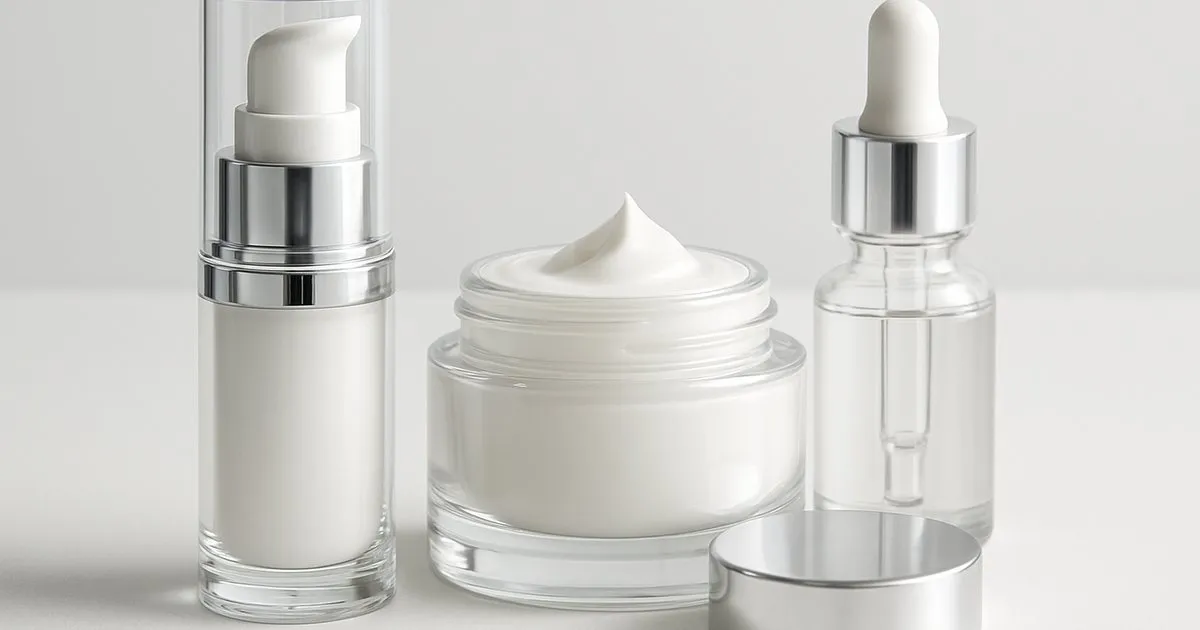
We mold this range — acrylic airless pump bottles, glass cream jars, and PP twist-up sticks — at our factory in Yuyao, China, alongside our spray and dispenser lines. This guide gives you the numbers a real quote should contain: pump mechanism and dead-space data, material tradeoffs, MOQ and tooling cost by customization level, and the compliance paperwork retail buyers actually ask for.
Quick Answer
- "Airless" means a rising-piston pump, not a vacuum jar. A false bottom rises as product is dispensed, so no air replaces the void — residual product left in the container drops to roughly 3–5% versus 10–18% in an open jar scooped with a finger or spatula.
- Standard airless actuation output is 0.15–0.30 ml per full stroke, and the pump needs a formulation viscosity under roughly 50,000–80,000 cP to prime reliably — thicker balms and anhydrous sticks should stay in a jar or twist-up format.
- MOQ starts at 3,000 pcs on existing tooling (acrylic, glass, or PP) in stock colors, 20–30 days lead time. Custom tooling for a new bottle shape runs $3,500–$9,000 and 40–55 days including T1/T2 samples.
- Acrylic costs 20–35% more than PP but reads as "premium" on shelf; glass costs 2–3× PP and is the default for eye cream and serum positioning where clarity signals quality.
- Ask for REACH SVHC and RoHS reports before Prop 65 — for a plastic or glass jar with no electronics, those two cover 90% of what EU and mainstream US retail buyers will actually request.
What "Airless" Actually Means — and Why It Is Not a Vacuum Jar
Buyers use "airless" and "vacuum" interchangeably, and suppliers let them, but the mechanism only works one way: a rising-piston pump. A disc sits at the bottom of the inner sleeve, sealed against the wall. Each actuation pulls the disc upward by exactly the volume dispensed, so the space above the product is always filled by the disc rather than by air. Nothing is ever "sucked out" — the piston is pushed up from below as the pump draws product out from above.
This matters for three practical reasons buyers routinely miss:
- Oxidation control, not sterility. An airless pump keeps atmospheric oxygen away from actives like vitamin C, retinol, and peptides that degrade on air contact. It does not sterilize the formulation — a preservative system is still required unless the fill is single-use.
- Residual waste drops but does not hit zero. Across our own fill trials on the YS-025 and YS-026 bodies, residual product left in the container after the piston reaches full travel runs 3–5% of fill volume for a well-matched viscosity, versus 10–18% typically scraped out of an open jar. Marketing copy claiming "zero waste" is describing the pump, not physics.
- The piston has a viscosity ceiling. Above roughly 50,000–80,000 cP (thick balms, anhydrous sticks, heavy butters), the piston cannot track the dispensing rate and the pump either stalls or under-doses. That formulation belongs in a jar or a twist-up stick, not an airless pump — no amount of pump redesign fixes a viscosity mismatch.
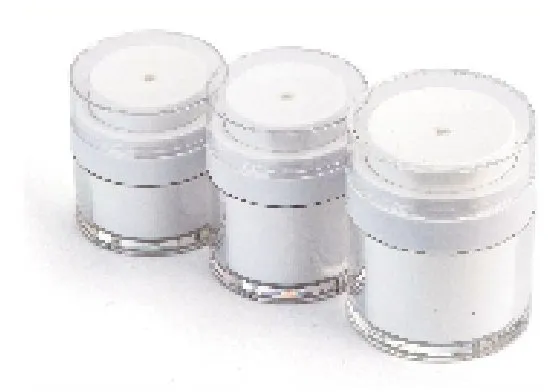
Six Cosmetic Bottle Formats — Which One Fits Your Formulation
"Cosmetic bottle" covers at least six mechanically distinct products, and the format decision should come from the formulation, not from what looks nicest in a mockup.
| Format | Model | Body / Cap | Capacity | Best for | Not suited for |
|---|---|---|---|---|---|
| Square rotating vacuum flask | YS-025 | Acrylic / PP | 15 / 30 / 50 ml | Serum, light lotion, foundation | Thick balms, gritty exfoliants |
| Acrylic press vacuum cream jar | YS-026 | Acrylic / PP | 15 / 30 / 50 g | Face cream, eye cream, moisturizer | Anhydrous sticks, waxes |
| Hydrogel cream jar | YS-029 | Glass / Acrylic | 15 / 30 / 50 g | Hydrogel, eye cream, premium finger-scoop | Air-sensitive actives (open jar, no piston) |
| Acrylic mushroom bottle | YS-027 | Acrylic / PP or metal | 15 / 30 / 50 / 100 ml | Serum, essence, liquid foundation | High-viscosity cream |
| Rotating twist-up deodorant stick | YS-024 | PP | 50 / 75 g | Solid deodorant, balm sticks | Any liquid or low-viscosity fill |
| Standard lotion bottle | YS-028 | PP / PET | Multiple, see catalog | Body lotion, sunscreen, thinner emulsions | Air-sensitive actuals needing airless control |
The two most common misorders we see: a brand specifying the mushroom bottle (open pump, no piston) for a vitamin C serum that oxidizes within weeks, and a brand specifying the acrylic vacuum jar for a thick shea-butter balm that will not prime through the piston. Send us your formulation's approximate viscosity in cP and whether it contains oxygen-sensitive actives, and we will tell you which of the six actually fits before you tool anything.
Not sure which format matches your formula? Send us the viscosity, active ingredients, and target retail price and we will recommend a format with a matched sample. Get a packaging recommendation and quote →
Looking for a reliable spray bottle supplier?
Get free samples and a factory-direct quote within 12 hours.
Get a Free Quote →Material Stack: Acrylic vs Glass vs PP for Skincare Packaging
Material is the single biggest lever on both cost and shelf perception, and the three options are not interchangeable on drop resistance or on the certifications you can offer downstream.
| Material | Typical FOB premium vs PP | Drop resistance | Clarity / shelf read | Watch out for |
|---|---|---|---|---|
| PP (polypropylene) | Baseline | High — will not shatter | Opaque or frosted only | Reads as mass-market unless paired with a heavy-wall design |
| Acrylic (PMMA) | +20–35% | Moderate — cracks under sharp impact, does not shatter into shards like glass | Glass-clear or high-gloss, the "premium plastic" look | Scratches more easily than glass; needs a hard-coat finish for retail-grade shelf life |
| Glass | +100–200% | Low — shatters on hard impact | True clarity, coldest premium feel | Adds 30–60% to freight weight and CBM cost; needs foam or molded-pulp inserts to survive ocean freight |
A pattern we see constantly: a startup brand specifies glass for the "premium feel," then discovers the freight and breakage-insurance cost erases the margin gain, and switches to acrylic with a hard-coat mid-production. Deciding the material before quoting saves that rework — acrylic gets you 80% of the visual premium of glass at a third of the landed cost.
Airless Pump Specifications a Real Quote Should Contain
The same discipline that applies to spray pumps applies here: five numbers separate a comparable quote from five unrelated products.
| Parameter | Typical range | Why it matters |
|---|---|---|
| Actuation output | 0.15–0.30 ml per full stroke | Determines doses per fill and whether the pump under- or over-delivers active ingredient per use |
| Viscosity ceiling | Up to ~50,000–80,000 cP | Above this the piston cannot track dispensing and the pump stalls or leaves product behind the disc |
| Residual fill after full travel | 3–5% of nominal capacity | The honest number for "how much is wasted" — not zero, but a real reduction versus an open jar |
| Piston/disc seal material | LDPE or TPE wiper | A poor seal lets product bypass the disc and cake behind it, which shows up as a "broken pump" complaint at month two, not week one |
| Neck/collar fit | Bayonet or snap-fit, factory-specific — not FTC-standardized like spray or lotion pump necks | Unlike 28/410 spray pumps, airless neck fittings are not interchangeable across factories; confirm the pump and bottle come from the same tool set before ordering components separately |
That last point trips up more buyers than any other spec on this page. Spray and lotion pumps follow FTC-standard neck finishes (20/410, 24/410, 28/410) so a pump from one factory fits a bottle from another. Airless pumps do not have an industry-wide standard bayonet size — ours are matched to our own bottle tooling. If you are sourcing the bottle from one supplier and the pump from another, get a fit sample before committing to a production run; a mismatched airless assembly is the single most common cause of "the pump won't click in" complaints we get asked to diagnose on other factories' components.
MOQ, Tooling and Lead Time
| Order type | MOQ | Tooling cost | Lead time |
|---|---|---|---|
| Existing mold, stock color, no branding | 3,000 pcs | None | 20–25 days |
| Existing mold + pad print or hot-stamp logo | 3,000 pcs | $150–$450 plate/setup | 22–28 days |
| Existing mold + custom Pantone color | 10,000 pcs per color | None (masterbatch cost built into unit price) | 28–35 days |
| Modified body on existing platform (new cap, new neck detail) | 10,000 pcs | $3,500–$6,000 | 40–50 days incl. T1 sample |
| Full custom mold — new bottle and pump housing | 30,000 pcs | $6,500–$9,000 | 50–55 days incl. T1/T2 samples |
As with our other OEM lines, the mold belongs to whoever pays for it — put that in writing along with storage and transfer terms. Most skincare brands launching a new SKU do not need a full custom mold: a Pantone color match, a hard-coat finish upgrade on acrylic, and a printed carton get you a differentiated shelf presence for a fraction of the cost and lead time of new tooling. Our OEM vs ODM guide covers how to decide which route fits your volume.
Certifications and Compliance for Skincare Packaging
| Market | What buyers actually ask for | Applies to |
|---|---|---|
| United States | CPSIA lead/phthalate testing on any printed or coated surface; California Prop 65 disclosure | Printed caps, hot-stamp foil, colored resin |
| European Union | REACH SVHC screening; RoHS if any metallic-look coating or trim is used | Acrylic, glass, PP, and any electroplated cap accents |
| Retail chains (all markets) | ISO 9001 supplier audit; food-contact-grade resin declaration is sometimes requested even though cosmetic packaging is not food packaging | The factory and the resin supply chain, not the finished cosmetic product |
One distinction worth being precise about: cosmetic packaging itself is not FDA-regulated as food contact material in the US, but many retail buyers still ask for the same food-contact-grade resin certificates used on our spray bottle line, mainly as a proxy for resin purity. We can supply those declarations for PP and acrylic on request — ask specifically, because a generic "FDA compliant" claim with no document behind it is exactly the vague answer this guide is trying to help you avoid.
Packaging and Container Math
Cosmetic bottles are light per unit but the finished pack (bottle + pump + outer carton) drives your freight cost more than the resin does. For the YS-026 acrylic vacuum jar at 30g fill:
- Bulk-packed (polybag, no retail carton): approximately 2,000 pcs per carton at 0.06 CBM → roughly 33,000 pcs per CBM
- A 20ft GP container (26–28 usable CBM) holds approximately 850,000–900,000 pcs bulk-packed
- Add an individual retail carton with insert: volume drops to roughly 250,000–300,000 pcs per 20ft container — a 65–70% volume penalty, similar to what we see across our other bottle lines
Glass jars in the same capacity roughly double the carton weight and typically require molded-pulp or foam divider inserts to survive ocean freight without chip damage at the rim — factor that into your landed cost comparison against acrylic, not just the unit FOB price.
How to Write an RFQ That Gets a Comparable Quote
Most cosmetic packaging RFQs read "quote 30ml cream jar, 5000pcs" and come back with five prices from $0.28 to $1.40 for five different products. A specification that produces comparable numbers needs seven lines:
- Format — airless pump, open jar, mushroom bottle, or twist-up stick
- Capacity — in ml or g, with fill viscosity if known (in cP or a comparable reference product)
- Material — PP, acrylic, or glass, and whether a hard-coat or metallized finish is wanted
- Actuation output needed (airless only) — how much product per dose your formulation and dosage instructions require
- Decoration — pad print, hot stamp, UV coating, or metallization; number of colors and position
- Packaging — polybag, printed carton, or gift box, with dimensions if known
- Test scope — which certifications and reports you need, and for which market
Send that to every supplier on your shortlist and the price spread collapses to something you can actually compare. This is the same specification discipline we recommend across our whole OEM range — see our custom plastic bottle manufacturing guide for the supplier-vetting side, and our quality standards and testing guide for what to check when samples arrive.
Common Mistakes We See in Cosmetic Packaging Sourcing
- Specifying an airless pump for a formulation above the viscosity ceiling. Anhydrous balms and heavy butters need a jar or twist-up stick, not a piston pump — this is the single most common mismatch we get asked to fix after a failed first sample.
- Sourcing the bottle and pump from different factories without a fit sample. Airless neck fittings are not standardized across suppliers the way spray pump necks are; a mismatched assembly shows up as "pump won't seat" at the sample stage, not the RFQ stage.
- Choosing glass for "premium feel" without pricing the freight. Glass adds 30–60% to per-unit freight weight and needs protective inserts most acrylic programs do not.
- Assuming "airless" means zero product waste. Realistic residual is 3–5% of fill, not zero — set that expectation with your formulation and marketing teams before launch.
- Skipping a preservative system because the pack is airless. Airless controls oxidation, not microbial contamination — the formulation still needs a preservative unless it is genuinely single-use.
Frequently Asked Questions
What is the MOQ for OEM skincare bottles?
3,000 pieces on existing tooling in a stock color for any of our airless, jar, or twist-up formats. Adding a pad-printed or hot-stamped logo keeps the same 3,000-piece minimum; a custom Pantone color match raises it to 10,000 pieces per color.
How is an airless pump different from a vacuum jar or a regular pump jar?
An airless pump uses a rising piston that fills the space left as product is dispensed, so air never replaces the void — this limits oxidation of air-sensitive actives. A regular open jar has no piston; product is exposed to air and typically scooped with a finger or spatula, and residual waste runs 10–18% of fill versus 3–5% for a well-matched airless pump.
What viscosity range works in an airless pump?
Formulations up to roughly 50,000–80,000 cP prime reliably. Thicker anhydrous balms, waxes, and heavy butters exceed the piston's ability to track the dispensing rate and should be packaged in a jar or twist-up stick instead.
Should I choose acrylic or glass for a premium skincare line?
Acrylic delivers roughly 80% of the visual premium of glass — clear, glossy, scratch-resistant with a hard-coat finish — at about a third of the landed cost once you factor in glass's 30–60% freight weight penalty and the need for protective inserts. Glass still wins where true clarity and cold-to-touch feel are non-negotiable for the brand positioning.
Can I source the airless bottle and pump from different factories?
Not without risk. Unlike FTC-standard spray and lotion pump necks (20/410, 24/410, 28/410), airless bayonet fittings are factory-specific with no industry-wide standard. Always request a fit sample of the pump on the actual bottle before committing to separate suppliers for each component.
What certifications do skincare packaging buyers actually ask for?
For the US: CPSIA lead and phthalate testing on printed or coated surfaces, plus California Prop 65 disclosure. For the EU: REACH SVHC screening and RoHS on any metallic-look trim. Retail chains typically also want an ISO 9001 supplier audit on the factory itself.
How much product is actually left behind in an airless bottle?
Realistically 3–5% of nominal fill volume when the viscosity is well matched to the pump, based on our own fill trials on the YS-025 and YS-026 bodies — a meaningful reduction from the 10–18% typically left in an open jar, but not the "zero waste" some marketing claims imply.
Related Guides
- Custom Plastic Bottle Manufacturing: OEM Production Process
- Bottle OEM vs ODM: Which Manufacturing Model Fits Your Brand?
- Cosmetic Spray Bottle Buyer's Guide
- Cosmetic Spray Bottle Wholesale Supplier Guide
- Spray Bottle Quality Standards & Testing Guide
- Cosmetic & Personal Care Bottles — Product Range
Get a Specified Quote
Desiky manufactures airless pump bottles, cream jars, and twist-up sticks in acrylic, glass, and PP from our factory in Yuyao, China, under ISO 9001 process control. Send us your formulation's viscosity, capacity, and target certifications, and we will return a matched-format recommendation, a fit sample, and FOB pricing within 12 hours.