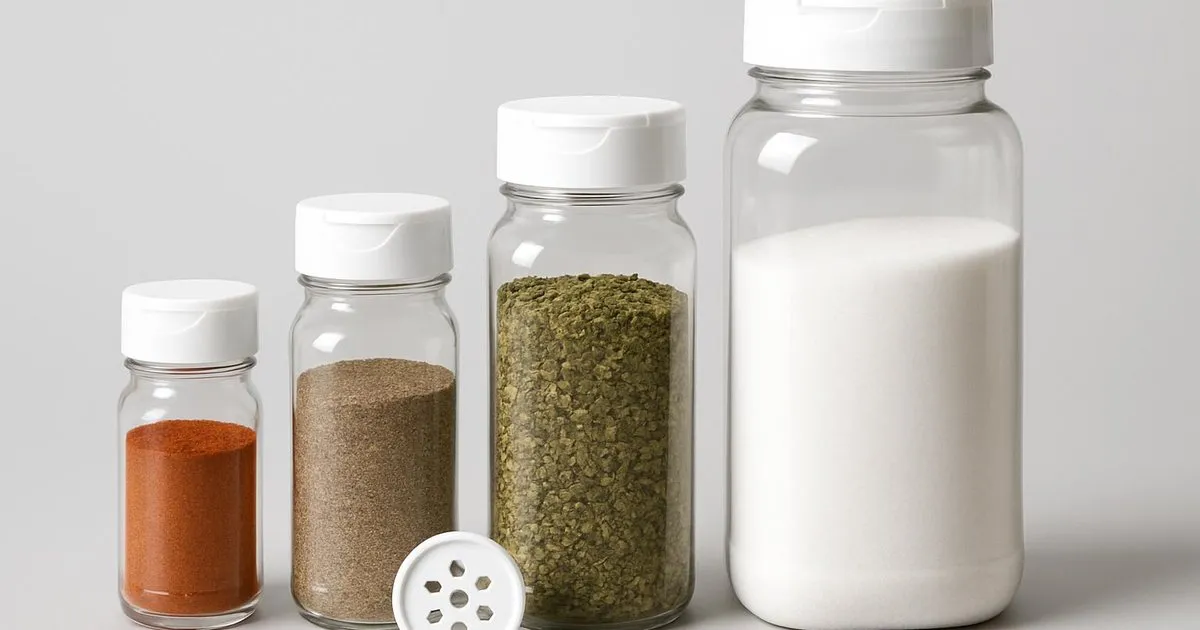
Every "spice jar size guide" on page one of Google answers the same question — 4 oz is the classic size — and then stops. That answer is fine for a home cook choosing a rack. It is useless for a spice brand, because a spice brand does not sell volume, it sells net weight. The label says "2.5 oz (70 g)", not "4 fl oz", and the jar that holds 4.3 oz of salt holds less than 0.8 oz of dried oregano leaves. We manufacture glass and PP kitchen containers, seasoning bottles and dispensing closures in Yuyao, China, and the most expensive mistake we see from new spice brands is choosing one jar for the whole line and discovering the fill problem after the labels are printed.
This guide covers what the size charts leave out: how much each spice actually weighs in each jar, which neck finish and sifter fitment go with which size, how big the sifter holes should be for each grind, the US and EU rules that punish an under-filled jar, and how retail and foodservice formats differ.
Quick Answer
- The standard retail spice jar is 4 fl oz (120 ml) with a 43-485 neck finish. The usual retail range runs 2-8 fl oz (60-240 ml); 8 oz jars use 53-485, and 16-32 oz foodservice containers use 63-485.
- Jar volume and net weight are different numbers. Filled to about 100 ml, a 4 oz jar holds roughly 120 g of salt, 54 g of garlic powder, 45-48 g of black pepper or paprika, and only about 20 g of dried oregano leaves. That is about a 6x spread.
- Sifter holes should be at least 3x the largest particle. In practice that means about 2 mm for fine powders, 3-4 mm for coarse grinds, and a spoon opening for leaves and flakes.
- Empty headspace is regulated. In the US, 21 CFR 100.100 treats non-functional slack-fill as misbranding. McCormick paid a $2.5 million class settlement in 2020 over black pepper tins that allegedly held about 25% less pepper in the same-size tin.
- Factory terms: glass jars from 2,000-3,000 pcs, PET/PP from 5,000 pcs, and 15-25 days lead time for stock molds. A custom sifter hole pattern is a small insert tool, not a new jar mold.
Spice Jar Size Chart: 1 oz to 32 oz, With Neck Finish and Use
Start with the container itself. Sizes are sold by brimful volume in fluid ounces. The neck finish is the two-number code that decides which caps and sifters fit. The first number is the opening diameter in millimetres, and "485" is the continuous-thread style used across most spice closures. As we explained in our neck finish and capping torque guide, a closure only seals if the finish codes match exactly. A 43-400 cap on a 43-485 jar will thread and still leak.
| Jar size (brimful) | Metric | Typical neck finish | Where it is used | Typical buyer |
|---|---|---|---|---|
| 1-1.5 oz | 30-45 ml | 28-400 / 33-485 | Saffron, vanilla powder, sample and gift sets | Premium / gift brands |
| 2-3 oz | 60-90 ml | 38-485 / 43-485 | Specialty blends, subscription refills | DTC spice brands |
| 4 oz | 120 ml | 43-485 | Everyday retail spices — the grocery-shelf default | Retail and private label |
| 6 oz | 180 ml | 43-485 / 48-485 | High-use staples (garlic, chili, cinnamon) | Retail "value" sizes |
| 8 oz | 240 ml | 53-485 | Salt blends, rubs, club-store packs | Retail and club |
| 16 oz | 480 ml | 63-485 | Restaurant back-of-house | Foodservice |
| 32 oz | 960 ml | 63-485 / 89 mm wide mouth | High-volume kitchens, BBQ, pizza chains | Foodservice |
Two practical notes from our production floor. First, round and square 4 oz jars are not interchangeable on a filling line, even with the same finish. The star-wheel and puck tooling is shape-specific, so ask your co-packer before you switch. Second, if you want to run 2 oz, 4 oz and 6 oz in one family, specify one shared finish (43-485). You then buy one cap mold, one sifter insert and one liner size, which roughly halves closure SKUs and closure MOQ exposure.
Volume Is Not Net Weight: What Each Spice Actually Fills
This is the section no competitor page has, and it is the one that decides your label. Dried spices vary enormously in bulk density, meaning grams per millilitre of loosely poured product. We used measured cup weights of commercial spices published by Chef's Resources. They agree with USDA FoodData Central wherever we cross-checked; for example, USDA lists ground black pepper at 2.3 g per teaspoon, or 0.47 g/ml, against 0.48 g/ml here. We then applied them to a 4 oz jar filled to a practical 100 ml. That leaves headspace below the sifter fitment so the jar can be capped without compressing product into the threads.
| Spice | Measured weight per US cup | Bulk density (g/ml) | Net weight in a 4 oz jar (100 ml fill) | Label claim |
|---|---|---|---|---|
| Table salt | 10.13 oz | 1.21 | ~121 g | 4.3 oz |
| Garlic powder | 4.49 oz | 0.54 | ~54 g | 1.9 oz |
| Cinnamon, ground | 4.09 oz | 0.49 | ~49 g | 1.7 oz |
| Black pepper, ground (table grind) | 4.00 oz | 0.48 | ~48 g | 1.7 oz |
| Paprika | 3.84 oz | 0.46 | ~46 g | 1.6 oz |
| Cumin seed, whole | 3.84 oz | 0.46 | ~46 g | 1.6 oz |
| Chili powder | 3.76 oz | 0.45 | ~45 g | 1.6 oz |
| Onion powder | 3.75 oz | 0.45 | ~45 g | 1.6 oz |
| Basil, ground | 2.67 oz | 0.32 | ~32 g | 1.1 oz |
| Oregano, dried leaves | 1.71 oz | 0.20 | ~20 g | 0.7 oz |
Three things follow from this table.
- One jar cannot serve a whole line at one price point. A 4 oz jar of oregano leaves holds well under half the product weight of the same jar of garlic powder, and about a sixth of the salt. Brands usually solve this by pricing per jar and letting the net weight float, or by moving leafy herbs into a larger jar or a bag refill.
- Your real fill will be 10-25% denser than the spoon figure. Spoon measures are loosely poured. On a filling line, and especially after truck vibration, powders consolidate. Powder engineers express this as the Hausner ratio (tapped density ÷ bulk density), which is typically 1.10-1.25 for free-flowing powders and higher for cohesive ones. That means a jar filled "to the shoulder" at the plant can arrive with visible headspace, which is the slack-fill problem covered below.
- Always run a fill trial on your actual grind. A coarse Tellicherry pepper and a fine table-grind pepper differ more than the table shows. Before you finalise label copy, we fill 20 production-sample jars with the customer's product, tap-settle them, and weigh them. Our sample approval guide explains how to run that trial on your side as well.
Looking for a reliable spray bottle supplier?
Get free samples and a factory-direct quote within 12 hours.
Get a Free Quote →Sifter Caps: Matching Hole Size to the Grind
A sifter fitment is a separate PE insert pressed into the jar neck under a flip-top or dual-flapper cap. The cap gets attention; the insert decides whether the product actually comes out. The failure modes are predictable. If the holes are too small, cohesive powders bridge across them: garlic and onion powder absorb humidity and cake, and the customer has to shake the jar hard. If the holes are too large, fine chili powder pours out in clumps.
Our tooling rule of thumb is a hole diameter at least 3x the largest particle, going to 5x for hygroscopic powders:
| Grind / product | Typical particle size | Recommended hole diameter | Common pattern |
|---|---|---|---|
| Fine powders (cayenne, cinnamon, paprika) | ≤0.5 mm | 1.5-2.5 mm | 7-12 holes |
| Hygroscopic powders (garlic, onion) | ≤0.5 mm, cakes | 2.5-3 mm | 5-7 holes |
| Coarse grinds (cracked pepper, granulated garlic, rubs) | 1-2 mm | 3-4 mm | 3-5 holes |
| Seeds (cumin, fennel, sesame) | 2-5 mm | 5-6 mm or open pour side | 1-3 holes + pour |
| Leaves and flakes (oregano, basil, chili flakes) | 3-8 mm | Spoon/pour opening | Dual flapper: sift + spoon |
Two supply-side details matter to buyers. First, the insert must match the finish I.D., not just the O.D. Glass jars have wider bore tolerances than PET, so an insert specified for a PET 43-485 jar can sit loose in a glass 43-485 jar. We check insert retention with a 1 m drop test on filled jars. Second, a custom hole pattern for your brand, such as a logo-shaped pour hole or a different hole count per SKU, needs only a new insert cavity. That is a small tool with a short lead time, not a new jar mold, so it is one of the cheapest ways to differentiate a shelf.
Building a spice line and unsure which jar fits which SKU?
Send us your SKU list and target net weights. We will recommend jar sizes, a shared neck finish and sifter patterns, and we can run a fill trial on your actual product. Request a Quote for This Product →
The Rules That Punish an Under-Filled Jar
United States: slack-fill and net quantity labeling
Under 21 CFR 100.100, a food container is misleading if it is filled to less than its capacity for reasons other than six recognised functions: protecting the contents, the requirements of the filling machine, unavoidable product settling during shipping and handling, a specific function of the package, a reusable container with significant value, or the inability to reduce the package size further (for example, to fit mandatory labeling). Settling is a defence, but only for settling you can document, which is another reason to keep the fill trial data described above.
This is not theoretical. McCormick faced a class action alleging it cut the black pepper in its tins by about 25% (and in its grinders by about 19%) while keeping the same tin size. The case settled for $2.5 million, with final approval in June 2020. Spices are a textbook slack-fill target because the jar is transparent and the headspace is visible.
Net quantity is regulated by 21 CFR 101.105. The declaration must appear in both US customary and metric units, within the bottom 30% of the principal display panel (PDP), parallel to the base. Minimum type height depends on PDP area:
| Principal display panel area | Minimum net-quantity type height |
|---|---|
| 5 sq in or less | 1/16 inch (1.6 mm) |
| More than 5, up to 25 sq in | 1/8 inch (3.2 mm) |
| More than 25, up to 100 sq in | 3/16 inch (4.8 mm) |
| More than 100, up to 400 sq in | 1/4 inch (6.4 mm) |
| More than 400 sq in | 1/2 inch (12.7 mm) |
Here is the jar-size trap. For a cylindrical container, the PDP is taken as 40% of height × circumference. A typical 4 oz round jar about 48 mm in diameter with a 60 mm label band has roughly 14 sq in of label area, so its PDP is about 5.6 sq in. That lands just above the 5 sq in line, which means 1/8-inch type, not 1/16. A slightly slimmer jar drops below the line. Choose the jar before the label designer sets the net weight in 6 pt type.
European Union: the average system and the e-mark
EU pre-packages follow the "average" system from Directive 76/211/EEC. The batch average must meet the declared quantity, and only a small share of packs may fall below the tolerable negative error (TNE). For typical spice fills, the TNE is 9% for 5-50 g, 4.5 g for 50-100 g, and 4.5% for 100-200 g. A 20 g oregano jar may therefore run 9% light (about 1.8 g), while a 121 g salt jar in the same jar may run only 4.5% light (about 5.4 g). Heavy powders get half the percentage tolerance, so they need the more accurate filler, usually an auger or net-weigher rather than a volumetric cup filler.
Retail vs Foodservice Spice Containers: What Actually Changes
A common question in search is what separates a jar meant for home use from a container meant for foodservice. The answer is not just size. The container is designed for a different job:
| Factor | Retail / home jar | Foodservice container |
|---|---|---|
| Size | 2-8 oz (60-240 ml) | 16-32 oz (480-960 ml), sometimes larger |
| Material | Glass for premium lines; PET for value lines | PET or PP — shatter-resistant in a busy kitchen |
| Opening | 43-485 with shaker/sifter insert | 63-485 or 89 mm wide mouth, for spoon and measuring-cup access |
| Closure | Flip-top sifter, often with an induction seal | Dual flapper (sift + spoon), gloved-hand friendly |
| Label priority | Shelf appeal, brand story, front-panel space | Large legible name, lot code, a date the line cook can read |
| Shape | Round or square for racks and drawers | Square or with grip panels, to stack on a shelf and hold one-handed |
| Cost logic | Price per jar; packaging is part of the product | Cost per pound of spice; packaging should be as cheap as possible |
If you are planning both channels, the efficient move is to share the closure system, not the jar. For example, a 4 oz retail jar and an 8 oz club size can both run on the 43/53 family, while foodservice runs its own 63-485 line. Brands that force one jar into both channels usually end up with a retail jar that looks industrial or a foodservice jar that costs too much.
Glass, PET or PP: Material Choice for Spice Jars
Spices lose value through two paths: moisture, which causes caking and mold risk, and volatile oil loss and oxidation, which dulls aroma and color. Materials trade these off differently. The same trade-offs are covered for bottles in our HDPE vs PET vs PP comparison.
- Glass is effectively impermeable to both moisture and oxygen, so the closure becomes the weak point. Spend on the liner (induction seal or PE foam liner), not on thicker glass. Glass also gives the premium shelf look covered in our spice jar comparison guide.
- PET is clear, light and shatter-resistant, and a better oxygen barrier than PP. It is the standard for value-retail and 16-32 oz foodservice containers.
- PP has lower water-vapor transmission than PET but a weaker oxygen barrier, and it is usually translucent rather than crystal clear. It suits closures, sifter-cap bodies and kitchen dispensers more than show-through retail jars.
All food-contact materials should come with a migration test report for your market: FDA 21 CFR 174-178 in the US, and EU 10/2011 for plastics plus LFGB for Germany. The testing process is the same one we describe in our FDA and LFGB food-grade compliance guide.
Pricing, MOQ and Lead Time From the Factory
| Configuration | FOB price range | MOQ | Lead time |
|---|---|---|---|
| PET 4 oz jar + sifter + flip cap | $0.15-$0.40 | 5,000 pcs | 15-25 days |
| PP flip-top shaker jar | $0.20-$0.50 | 5,000 pcs | 15-25 days |
| Glass 4 oz jar + metal or PP cap | $0.40-$1.20 | 3,000 pcs | 20-30 days |
| Glass jar + bamboo lid with silicone seal | $0.60-$1.50 | 2,000 pcs | 25-35 days |
| Custom color, logo or sifter hole pattern | + insert tooling | 10,000 pcs typical | +10-15 days |
Prices depend on glass weight, decoration (screen print vs label), liner type and carton count, so treat these ranges as budgeting figures rather than a quote. Brands that want a functional point of difference — a press-to-dispense sifter cap, a measured-dose insert — should budget for the extra tooling step rather than assume it comes free with a stock jar.
Checklist Before You Order Spice Jars
- List every SKU with its target net weight, not its target jar.
- Convert each one to volume using its bulk density, add 10-20% for headspace and settling, then pick the jar.
- Keep the family on one or two neck finishes to limit closure SKUs.
- Match the sifter hole size to each grind. Leafy herbs need a spoon side.
- Run a tap-settle fill trial on production samples, and keep the data as your slack-fill documentation.
- Check the PDP area of the jar before the label is laid out, so you know whether you need 1/16- or 1/8-inch type for the net quantity.
- Get migration test reports for your target market before the first production order.
Related Guides
- Wholesale Spice Jars: Glass vs Bamboo-Lid Comparison
- Glass Oil Dispenser Bottle OEM Factory Guide
- Food-Grade Packaging: FDA and LFGB Compliance
- Neck Finish and Capping Torque Guide
Ready to spec your spice jar line?
Tell us your SKUs, net weights, target market and annual volume. We will send jar and sifter recommendations, samples and FOB pricing within 24 hours. Request a Quote for This Product →
Sourcing spice jars for your brand
Desiky supplies spice jars, seasoning bottles and mixing cups through our kitchen accessories range, alongside wholesale spray bottles — one factory, one shipment.