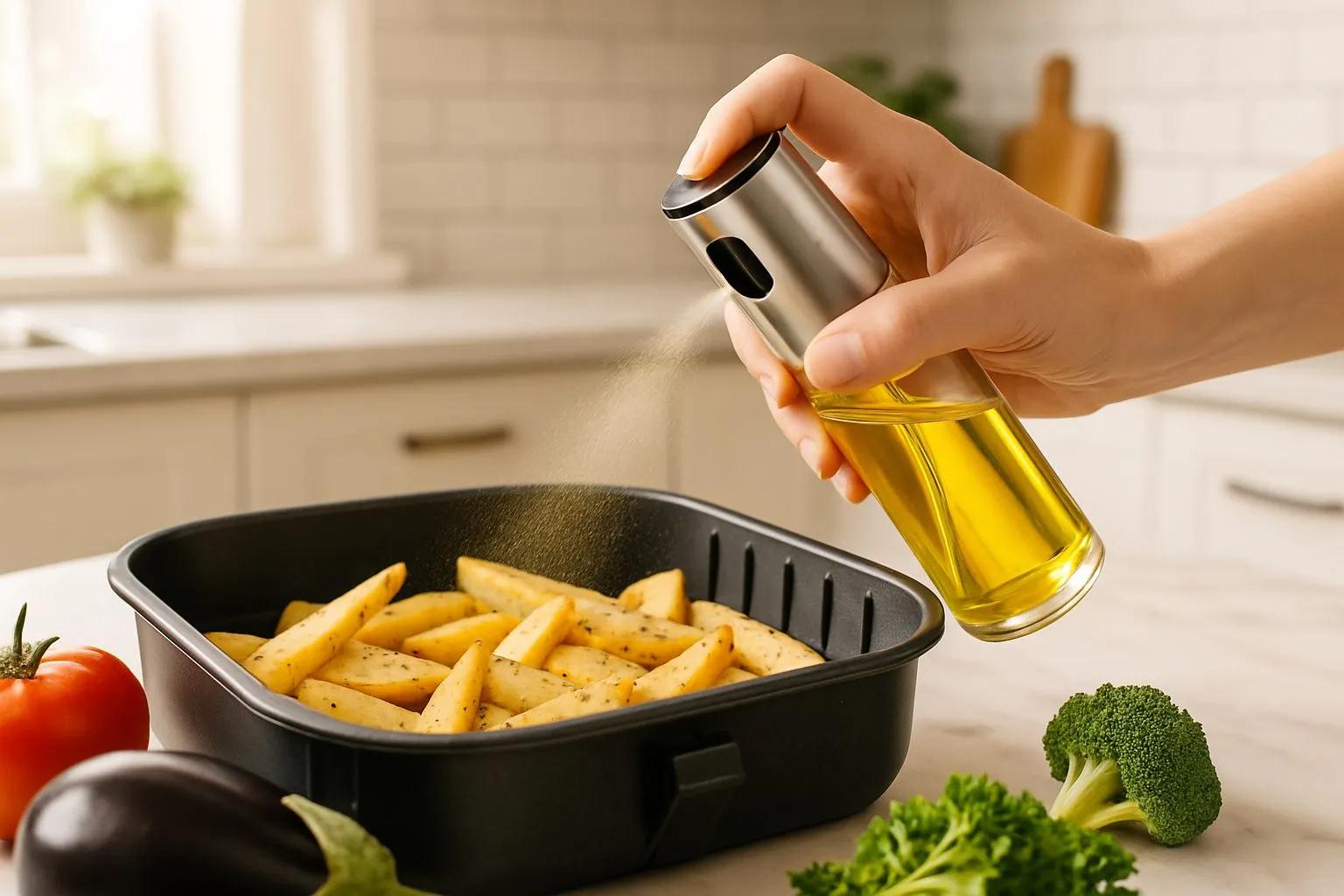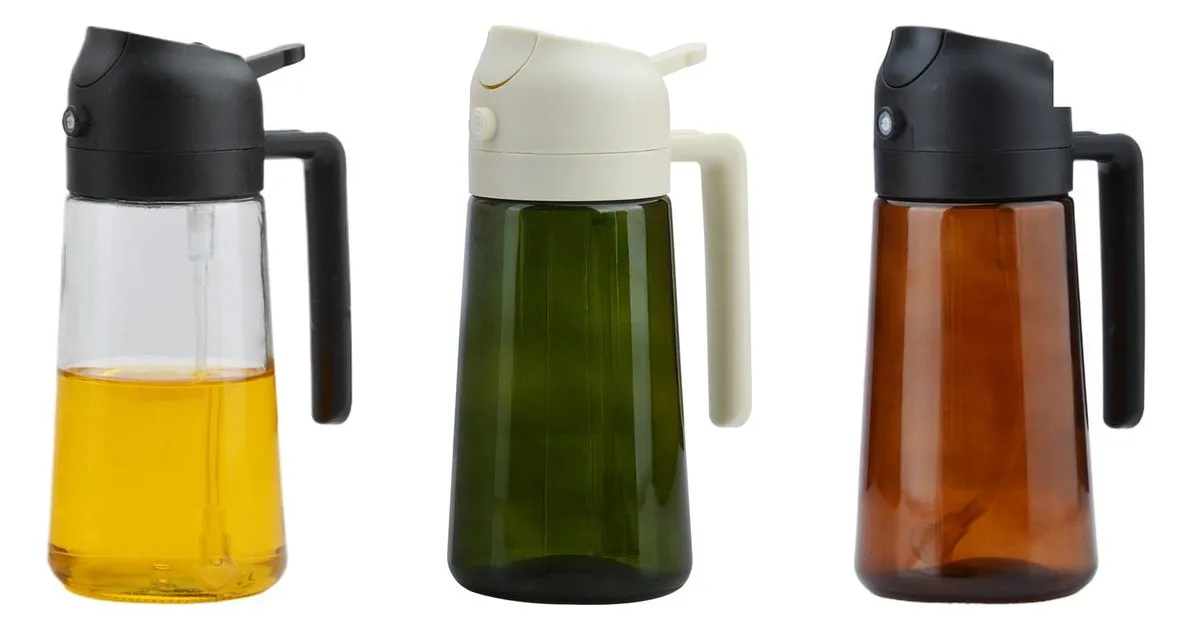
Most 2-in-1 oil dispensers look identical in a product photo: a glass body, a handle, a press-spray head and a flip spout. The differences show up three months after launch — in one-star reviews that say "drips down the side," "stopped spraying after two weeks," or "arrived cracked." We make glass 2-in-1 oil dispensers in Yuyao, China, and almost every problem a kitchen brand brings us traces back to something that was never written into the purchase order.
The pages that rank for oil dispenser bottle factory today are supplier directories and catalog pages. They list "lead-free glass, FDA, custom logo" and stop there — no wall weight, no dose per press, no drip test, no price. This guide is the spec sheet those pages leave out: how to choose the dispenser type, what glass to specify, which parts touch the oil, the tests we run before approving a batch, the food-contact rules by market, and FOB pricing with MOQ.
Quick Answer
- Body: borosilicate glass for clear bottles that will see hot-water washing; amber or dark green glass if you sell premium olive oil positioning.
- Head: list every oil-contact part (dip tube, piston, valve, spring, gasket, nozzle) with its material — a PP resin certificate does not cover the whole head.
- Performance: write dose per press (grams, mean ± %), drips after pouring, and leak-after-cleaning into the spec, measured with your actual oil.
- Commercials (our factory): 470 ml 2-in-1 dispensers from $1.20–2.50 FOB Ningbo; stock from 2 pcs, logo from 3,000 pcs, custom color from 10,000 pcs; 20–25 days for custom orders.
Which Type of Oil Dispenser Are You Actually Buying?
"Oil dispenser" covers four different mechanisms, and they fail in different ways. Choose the type first, because it decides the price band, the Amazon category you compete in, and the complaints you will get.
| Type | How It Dispenses | Typical FOB (1,000+ pcs) | Best For | Most Common Complaint |
|---|---|---|---|---|
| Pour-only cruet | Gravity pour through spout, optional flip cap | $0.60–1.50 | Olive oil and vinegar table sets, gift sets | Oil running down the outside after pouring |
| Press-spray oil bottle | Pump atomizes oil through a nozzle | $0.80–1.80 | Air fryer and grill accessory lines | Clogging, weak or uneven spray |
| 2-in-1 spray + pour | One head: press to spray, open spout to pour | $1.20–2.50 | Mid-to-premium kitchen brands, Amazon "oil dispenser" listings | Drips at the spout; spray stops if spout seal leaks air |
| Gravity auto-open pour (with or without spray) | Lid opens when tilted, closes upright | $1.60–2.80 | Differentiated designs, retail gift channels | Lid sticking after oil residue builds up |
Prices are indicative FOB Ningbo ranges. The 2-in-1 figure comes from our 2026 wholesale price guide; the other rows are typical market ranges we see when benchmarking. Confirm with a quotation, because capacity, glass weight, head design and packaging all move the price. If you only need spray, our glass oil spray bottles are cheaper and lighter to ship.
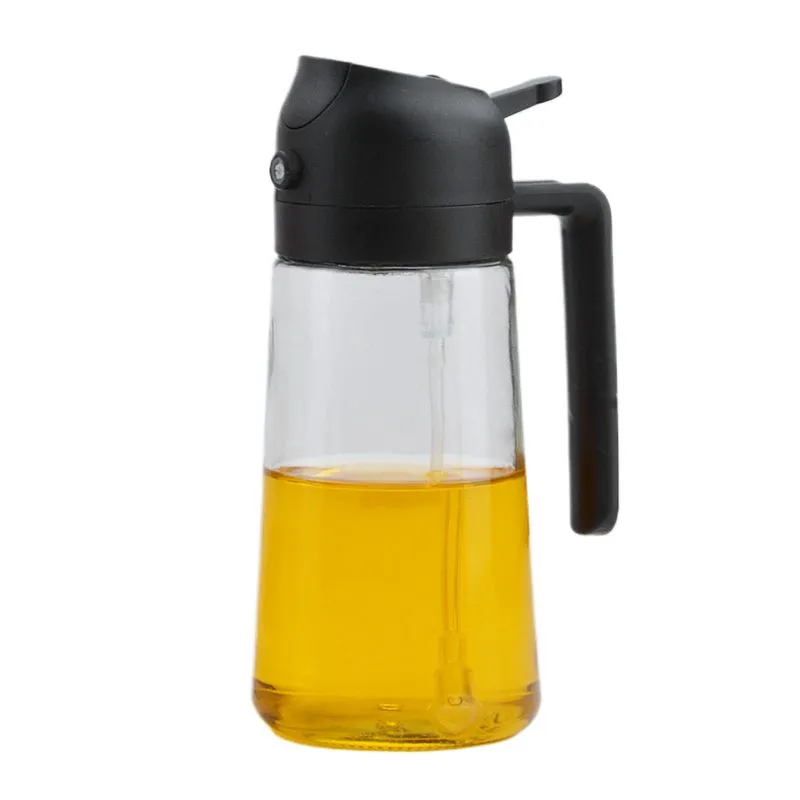
Glass Body: Borosilicate vs Soda-Lime vs Tinted
Glass is where suppliers are least specific. "High borosilicate" appears on listings for bottles that are actually soda-lime. Here is what the materials actually do:
| Property | Borosilicate 3.3 | Soda-Lime (clear flint) | Tinted Amber / Green |
|---|---|---|---|
| Linear expansion coefficient | ≈3.3 × 10⁻⁶/K (ISO 3585) | ≈9 × 10⁻⁶/K | Depends on base glass |
| Thermal shock behavior | Much better tolerance of hot-water rinsing and dishwasher cycles | More prone to cracking with sudden temperature change | Same as its base glass |
| Light protection for oil | None (clear) | None (clear) | Reduces light exposure; not complete protection |
| Relative cost | Highest | Lowest | + small premium over base glass |
| Typical use | Clear premium dispensers, handle designs | Budget cruets, pour-only bottles | Olive oil positioning, "freshness" messaging |
Two things matter more than the material name. First, thermal shock resistance belongs to the finished bottle, not just the glass type — wall thickness, handle joints and surface condition all change it. Ask for a test to ISO 7459 or ASTM C149 with a stated temperature differential and pass criteria, not the words "heat resistant." Second, ask how the supplier verifies borosilicate. A simple density or expansion check on a few pieces per lot catches a switched glass supplier.
On tinted glass: amber and dark green reduce light-driven oxidation compared with clear glass, and the International Olive Council advises storing olive oil away from light. That makes our green glass dispenser and amber brown glass dispenser a reasonable story for olive oil brands. Keep the claim honest — "helps protect oil from light," not "keeps oil fresh for months." We cover the flavor side in glass vs plastic oil sprayers.
Looking for a reliable spray bottle supplier?
Get free samples and a factory-direct quote within 12 hours.
Get a Free Quote →Specify Every Part That Touches the Oil
A 2-in-1 head has eight to twelve parts. Supplier pages say "food-grade PP" as if the head were one piece. When a retailer's compliance team asks for documents, you need the full oil-contact bill of materials. This is the template we fill in for each customer:
| Component | Oil Contact? | Typical Material | What to Ask For |
|---|---|---|---|
| Bottle body | Yes | Borosilicate or soda-lime glass | Glass type, weight (g), lead/cadmium release data if decorated |
| Dip tube | Yes | PP or PE | Resin grade + food-contact statement; length vs bottle height |
| Pump cylinder / piston | Yes | PP, POM on some designs | Resin grade per part, not one certificate for "the head" |
| Valve ball / check valve | Yes | Glass ball or PP | Material; behavior with viscous oil after 24 h standing |
| Spring | Often yes | 304 stainless steel | Grade confirmation; external-spring designs keep it out of the oil path |
| Gasket / seal | Yes | Silicone or PE | Silicone: EU BfR Recommendation XV test; US 21 CFR 177.2600 |
| Nozzle / pour spout | Yes | 304 stainless steel or PP | Grade; burr-free orifice; spout shape for drip cutoff |
| Cap, handle, button | No (usually) | PP, ABS | Color masterbatch; confirm handle does not contact oil |
| Assembly lubricant | Possibly | Food-grade lubricant or none | Whether any is used — often forgotten |
304 stainless is generally suitable for cooking oil and normal culinary vinegar at room temperature. Salty marinades or soy sauce left standing for weeks are a different case and should be tested separately if you market the bottle for them.
Need a filled-in BOM for your compliance team? We send a component material list with every quotation. Request samples and the material list →
Performance Tests to Write Into the Purchase Order
"Leak-proof" and "drip-free" mean nothing until they have a method and a number. We run the tests below during sample approval, and repeat the fast ones on every production lot. Use your own oil — extra virgin olive oil, avocado oil and blended vegetable oil do not behave the same, especially below 15°C, when olive oil thickens.
| Test | Method (Our Practice) | Suggested Acceptance |
|---|---|---|
| Dose per press | 10 presses weighed individually, bottle full / half / near-empty, oil at 20–25°C | Mean within your stated grams per press, variation ≤ ±15% |
| Priming | New head, count presses to first full spray | ≤ 5 presses |
| Restart after standing | Fill, stand 7 days, then spray | Full spray within 3 presses, no blockage |
| Pour cutoff | Pour 20 ml, return upright, wipe, hold 60 s over white paper | No drop running down the outside of the spout |
| Leak | Vacuum at −60 kPa for 10 s, then tilt 90° for 30 s | No oil at head, spout or thread |
| Leak after cleaning | Disassemble, wash, dry, reassemble 20 times, repeat leak test | Same as new |
| Cycle life | Pump actuations on oil-filled bottle | Agree a number with the buyer, e.g. 5,000 presses without loss of spray |
| Thermal shock | ISO 7459 / ASTM C149 on finished bottles | No breakage at the agreed temperature differential |
About dose: commercial listings quote anywhere from roughly 0.2 g to 0.5 g of oil per press, and some sprayers are sold by teaspoon per pull. There is no category-wide number, so put your measured figure on the packaging and in the spec. When a sprayer "clogs," ask the factory to separate the cause — a physical blockage, poor atomization from thick oil, loss of prime, or an air leak at the pour spout seal. On a 2-in-1 head, a spout that does not close airtight is a common hidden reason the spray side goes weak. For a deeper look at spray mechanisms, see our continuous oil spray technology guide, and for sample approval steps, how to test and approve samples.
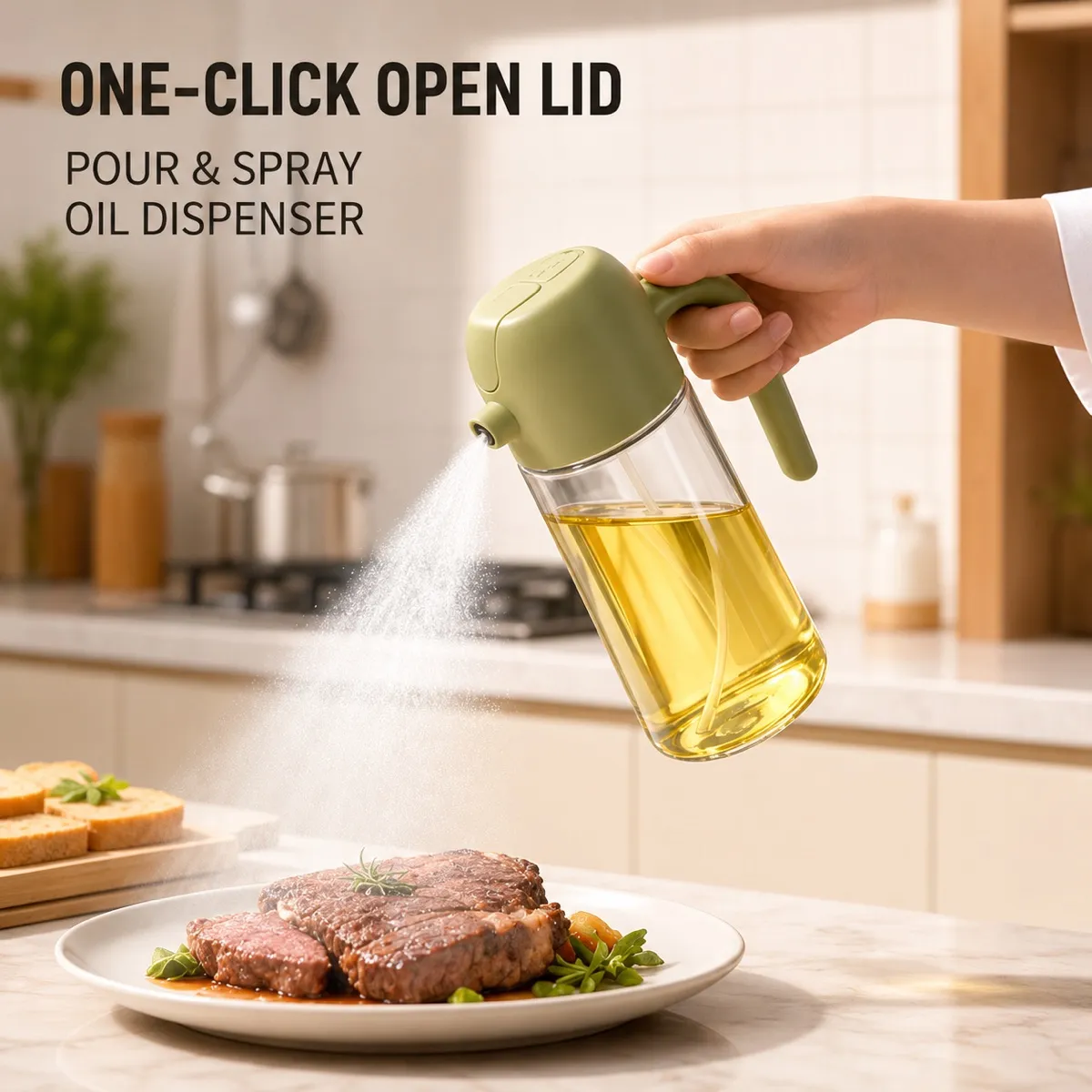
Common Failures, Root Causes and Spec Fixes
| Customer Complaint | Usual Root Cause | What to Put in the Spec |
|---|---|---|
| "Oil drips down the bottle" | Blunt spout lip; no oil return path | Sharp-edged or return-channel spout; pour cutoff test |
| "Stopped spraying" | Oxidized oil residue in orifice; air leak at spout seal; loss of prime | Restart-after-standing test; detachable nozzle; cleaning instructions |
| "Arrived broken" | Carton tested for export pallets, not parcel shipping | Drop test of the retail unit to ISTA 3A (parcel) or Amazon requirements |
| "Leaks after washing" | Gasket displaced or deformed during reassembly | Captive gasket design; 20-cycle clean-and-reassemble leak test |
| "Cracked in the dishwasher" | Soda-lime glass or thin handle joint | Borosilicate body; thermal shock test; hand-wash instruction for the head |
| "Logo faded" | Silk-screen ink not cured for dishwasher exposure | Decoration durability test; ceramic ink or etched logo for dishwasher claims |
Food-Contact Compliance by Market
No single "FDA certificate" or "LFGB certificate" covers an oil dispenser. Compliance is a set of documents tied to the actual parts, and it needs to be updated when a resin or supplier changes. Our food-grade spray bottle compliance guide goes deeper; this is the short version for oil dispensers:
| Market | Key Rules | Documents Buyers Usually Request |
|---|---|---|
| United States | 21 CFR 177.1520 (polyolefins such as PP/PE); 21 CFR 177.2600 (rubber/silicone for repeated use); California Prop 65 for exposure to listed chemicals such as lead | Resin supplier FDA letters per part; third-party extraction test; lead/cadmium test on decorated glass |
| European Union | Framework Regulation (EC) 1935/2004; GMP Regulation (EC) 2023/2006; plastics Regulation (EU) 10/2011 (simulant D2 or substitutes for oily foods, simulant B for vinegar) | Declaration of Compliance for plastic parts; migration test report; ISO 7086 lead/cadmium release for glass hollowware |
| Germany | LFGB §30/31 (legal provisions, not a certificate); BfR Recommendation XV for silicone | LFGB test report from an accredited lab; sensory (odor/taste) test often requested by retailers |
| Amazon (all markets) | Category compliance for food-contact kitchenware; packaging program (SIPP / ISTA-6 Amazon SIOC where applicable) | Food-contact test report, packaging test report for the exact shipping configuration |
One practical point: a test report covers the product that was tested. If you change from a 470 ml to a 350 ml body or add a colored enamel decoration, confirm whether the report still applies. Selling on Amazon? Our Amazon FBA spray bottle guide covers listing and packaging preparation.
Packaging and Shipping Glass Dispensers
Glass dispensers are heavy for their size — 245 g for our 470 ml clear bottle and 347 g for the 500 ml mouse-head model, before the gift box. That changes your freight math compared with plastic oil sprayers.
- Retail unit: a colored gift box around 85 × 85 × 190 mm is about 0.0014 m³. Allowing for master cartons and gaps, a 20-foot container holds roughly 14,000–17,000 boxed units. Plan for weight as well as volume on mixed loads.
- Export cartons vs parcel shipping: a carton that survives pallet transport to your warehouse may fail in parcel delivery. ISTA 1A and 2A are screening or partial simulations; ISTA 3A simulates parcel distribution. Test the exact sellable unit — bottle, installed head, inserts and box.
- Head installed or separate: shipping the head installed saves your customer an assembly step but needs a transit seal or clip so the spout does not open and the button does not get pressed.
- Acceptance after drop test: check for chips, cracks, head damage, and leakage and spray/pour function afterwards — not only "glass survived."
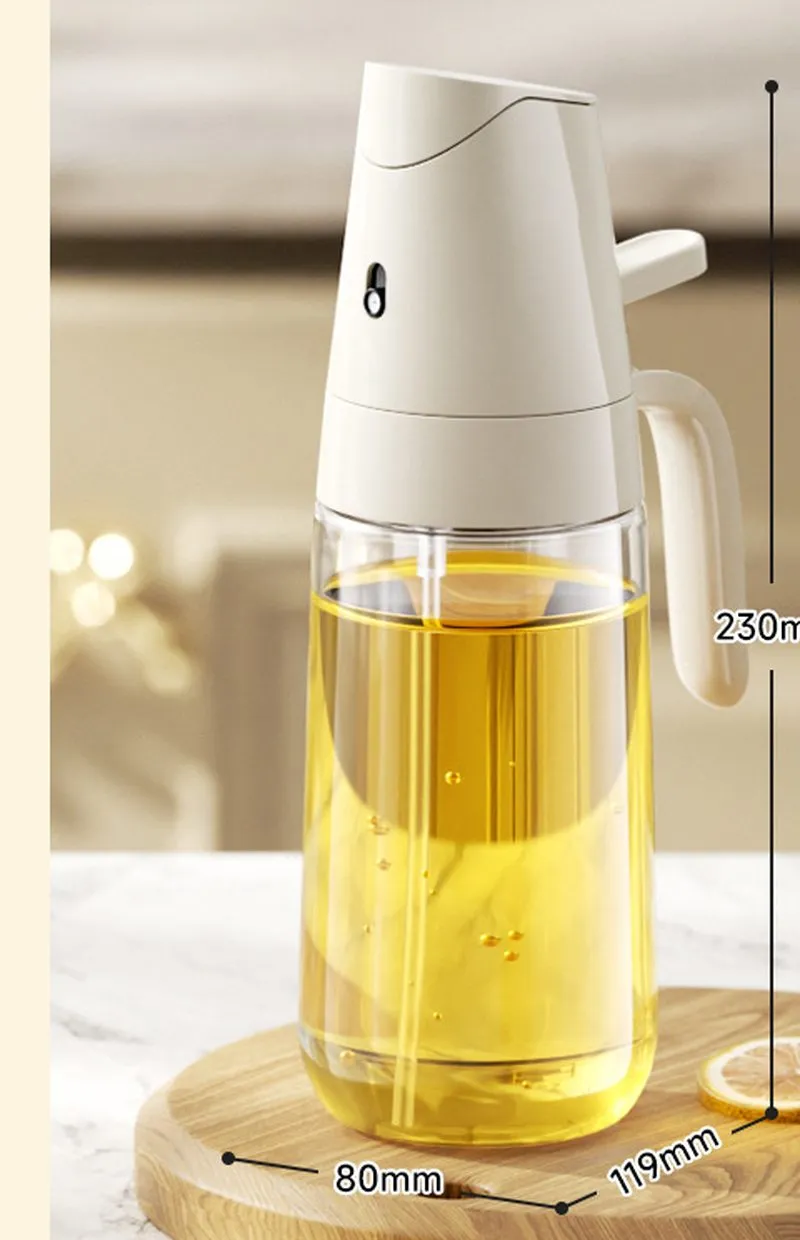
Price, MOQ and Lead Time From Our Factory
| Order Type | MOQ | Lead Time | Price / Cost Notes |
|---|---|---|---|
| Stock 2-in-1 dispensers (clear, green, brown, 4 cap colors) | 2 pcs | Dispatch in 48 hours | 470 ml: $1.20–2.50 FOB Ningbo depending on model and quantity |
| Logo printing (silk screen or hot stamping) | 3,000 pcs | 20–25 days | Silk screen about $0.03–0.06 per color; hot stamping $0.05–0.10 |
| Custom gift box / private label packaging | 5,000 pcs | 20–25 days | Box price depends on board, print and insert |
| Custom cap or handle color | 10,000 pcs | 20–25 days | Pantone matching on PP parts |
| New mold (new bottle or head design) | 10,000 pcs typical | Mold time + production | Mold $1,500–5,000 one-time for bottle-level tooling; head tooling quoted per design |
Our factory is about 40 minutes from Ningbo Port, runs 100% vacuum leak testing at −60 kPa and a final AQL 2.5 inspection, and has kept its defect rate below 0.5%. For how we compare with other Chinese suppliers, see top spray bottle manufacturers in China. Kitchen brands building a full oil line can also read our cooking oil spray bottle sourcing guide and consumer-facing olive oil sprayer comparison.
Frequently Asked Questions
What is the MOQ for custom glass oil dispenser bottles?
At our factory, stock 2-in-1 oil dispensers ship from 2 pcs within 48 hours. Logo printing starts at 3,000 pcs, custom gift boxes at 5,000 pcs and custom cap or handle colors at 10,000 pcs, with a 20–25 day lead time for custom orders.
How much does a 2-in-1 oil dispenser cost wholesale?
A 470 ml glass 2-in-1 spray and pour oil dispenser typically costs $1.20–2.50 FOB Ningbo at 1,000+ pcs, depending on glass type, head design and quantity. Pour-only cruets run about $0.60–1.50, and logo printing adds about $0.03–0.06 per color.
Is borosilicate glass better for oil dispensers?
Borosilicate 3.3 glass expands about one third as much as soda-lime glass when heated, so it handles hot-water washing and dishwasher cycles better. Thermal shock resistance still depends on the finished bottle's wall thickness and handle joints, so ask for an ISO 7459 or ASTM C149 test on the actual bottle.
Why does my oil sprayer stop spraying?
The usual causes are oxidized oil residue in the nozzle, thick oil at low temperatures, loss of prime after standing, or an air leak at the pour spout seal on 2-in-1 heads. A restart test after 7 days of standing and a detachable nozzle for cleaning prevent most complaints.
What certifications does an oil dispenser need for the US and EU?
In the US, plastic parts should comply with 21 CFR 177.1520 and silicone seals with 21 CFR 177.2600, and decorated glass should be checked for Prop 65 lead exposure. In the EU, you need Regulation (EC) 1935/2004 compliance, a Declaration of Compliance and migration testing under Regulation (EU) 10/2011 for plastic parts. German retailers often also ask for an LFGB test report.
Does amber or green glass keep olive oil fresher?
Amber and dark green glass reduce the light reaching the oil compared with clear glass, which helps slow light-induced oxidation. They do not give complete protection, so the bottle should still be stored away from light and heat, as the International Olive Council recommends.
Get Oil Dispensers Built to a Written Spec
Desiky manufactures glass oil sprayers and 2-in-1 oil dispensers in five series in Yuyao, China, with 500,000+ units of monthly capacity across our product lines. Send us your target capacity, glass color, oil type, market and packaging, and we will return a quotation with the component material list and free samples for your dose, drip and leak tests.
Request a Quote for Oil Dispenser Bottles →
Related Guides: Oil Dispenser Manufacturer — 5 Glass Series | 500 ml Mouse-Head Oil Dispenser | First Love 2-in-1 Oil Sprayer | Glass vs Plastic Oil Sprayer | Oil Sprayer Wholesale