Last Updated: 2026-10-14
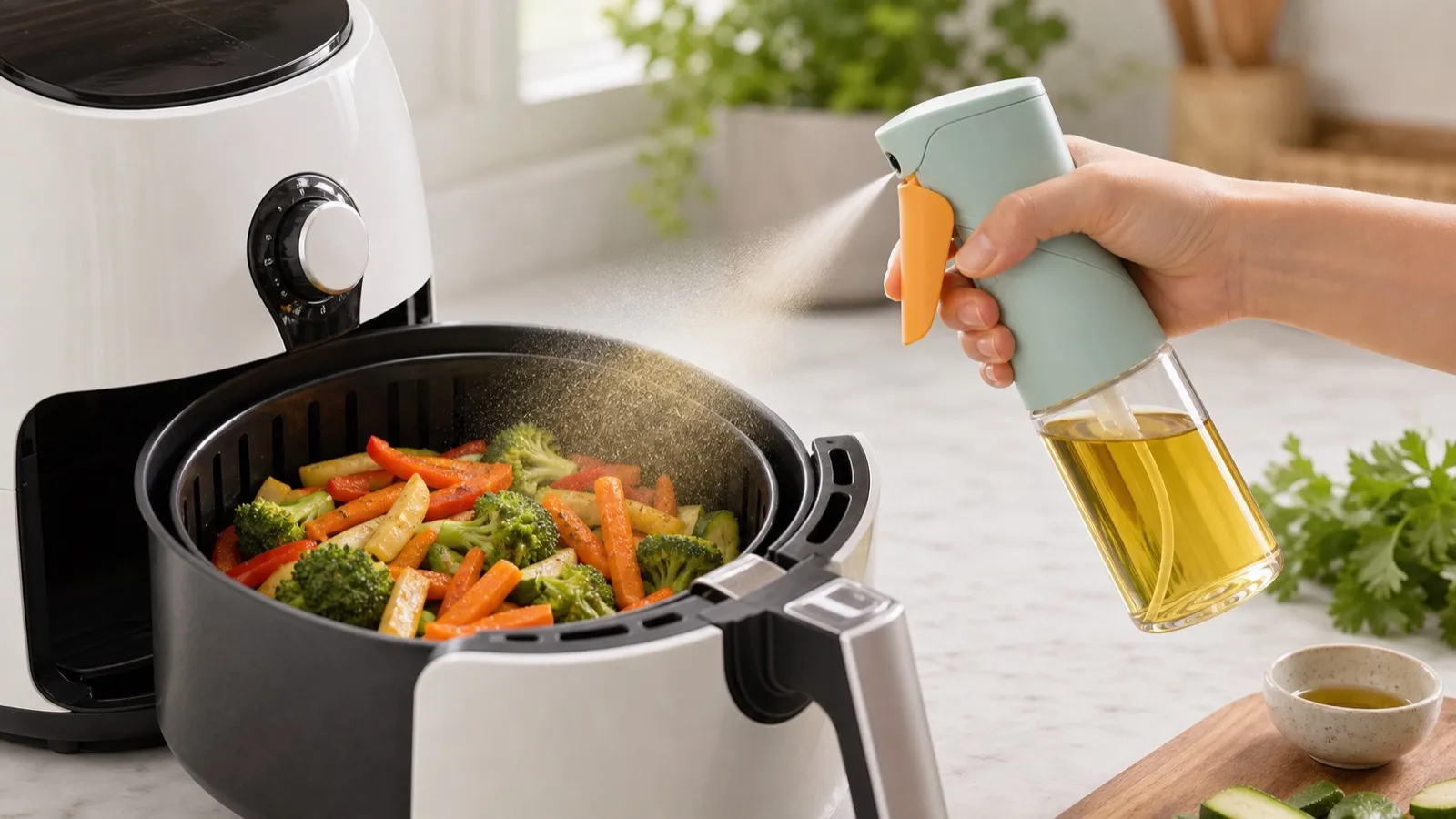
The best oil sprayer for air fryer cooking is a fine-mist continuous sprayer with a stainless steel nozzle (0.3 mm orifice), a glass or PETG body, and 200–300 ml capacity. It delivers 80–120 micron droplets at roughly 0.3 ml per stroke — thin enough for even coating, heavy enough to land on food rather than floating as aerosol. Pump-pressure sprayers work but lose consistency as pressure drops, and trigger sprayers are too coarse for air fryer use.
That is the short answer. The rest of this guide explains why, with the actual nozzle specifications, spray test results, and material safety data we use on the factory floor in Yuyao, China, where we manufacture spray mechanisms for over 50 kitchen brands worldwide.
Quick Answer
- Best type: Fine-mist continuous sprayer (press-button mechanism). Produces 80–120 µm droplets with consistent coverage on every stroke.
- Runner-up: Pump-pressure sprayer (Misto-style). Good mist for the first 5–8 seconds, then degrades as pressure drops. Needs re-pumping every 6–8 sprays.
- Avoid for air fryers: Trigger sprayers. Designed for cleaning liquids, they produce 300–500 µm droplets that pool instead of coating. Not food-grade unless specifically certified.
- Never use: Aerosol cooking sprays (PAM, etc.). The propellants and lecithin damage nonstick basket coatings — every major air fryer brand warns against them.
Why the Spray Mechanism Matters More Than the Bottle
When shoppers search for an oil sprayer for air fryer use, they usually focus on bottle material (glass vs plastic) or capacity (200 ml vs 500 ml). Those matter, but they are secondary. The spray mechanism — the nozzle, valve, and pressure system — determines whether you get an even mist or an uneven drizzle.
Air fryers cook at 180–200°C (356–392°F) by circulating hot air around food. A thin, uniform oil layer is critical for browning (the Maillard reaction), crispiness, and preventing food from sticking. Too much oil pools at the bottom of the basket and creates smoke. Too little leaves food dry and pale. The spray mechanism is what controls that precision.
There are three fundamentally different spray mechanisms used in consumer oil sprayers. Each produces a different droplet size, spray pattern, and flow rate — and those differences translate directly into air fryer cooking results.
The 3 Oil Sprayer Types Compared: Mist vs Pump vs Trigger
| Feature | Fine-Mist Sprayer | Pump-Pressure Sprayer | Trigger Sprayer |
|---|---|---|---|
| Mechanism | Press-button actuates piston + mesh screen | Manual pumping builds air pressure in chamber | Squeeze trigger pulls piston, spring returns |
| Nozzle orifice | 0.2–0.3 mm | 0.3–0.5 mm | 0.8–1.2 mm |
| Droplet size | 80–120 µm (true mist) | 100–200 µm (mist to light spray) | 300–500 µm (coarse spray to stream) |
| Output per stroke | 0.2–0.4 ml | 0.5–1.0 ml per second (continuous) | 0.8–1.5 ml |
| Spray consistency | Uniform on every stroke | Degrades as pressure drops | Varies with squeeze force |
| Clog resistance | Moderate (needs weekly cleaning) | Good (larger passages) | Excellent (wide orifice) |
| Air fryer suitability | Excellent | Good | Poor — too much oil per spray |
| Typical retail price | $10–18 | $8–15 | $5–10 |
| Best for | Air fryer, salads, light coating | Grilling, batch cooking, general kitchen | Cleaning, gardening, NOT cooking |
Looking for a reliable spray bottle supplier?
Get free samples and a factory-direct quote within 12 hours.
Get a Free Quote →Type 1: Fine-Mist Oil Sprayers (Best for Air Fryers)
How they work
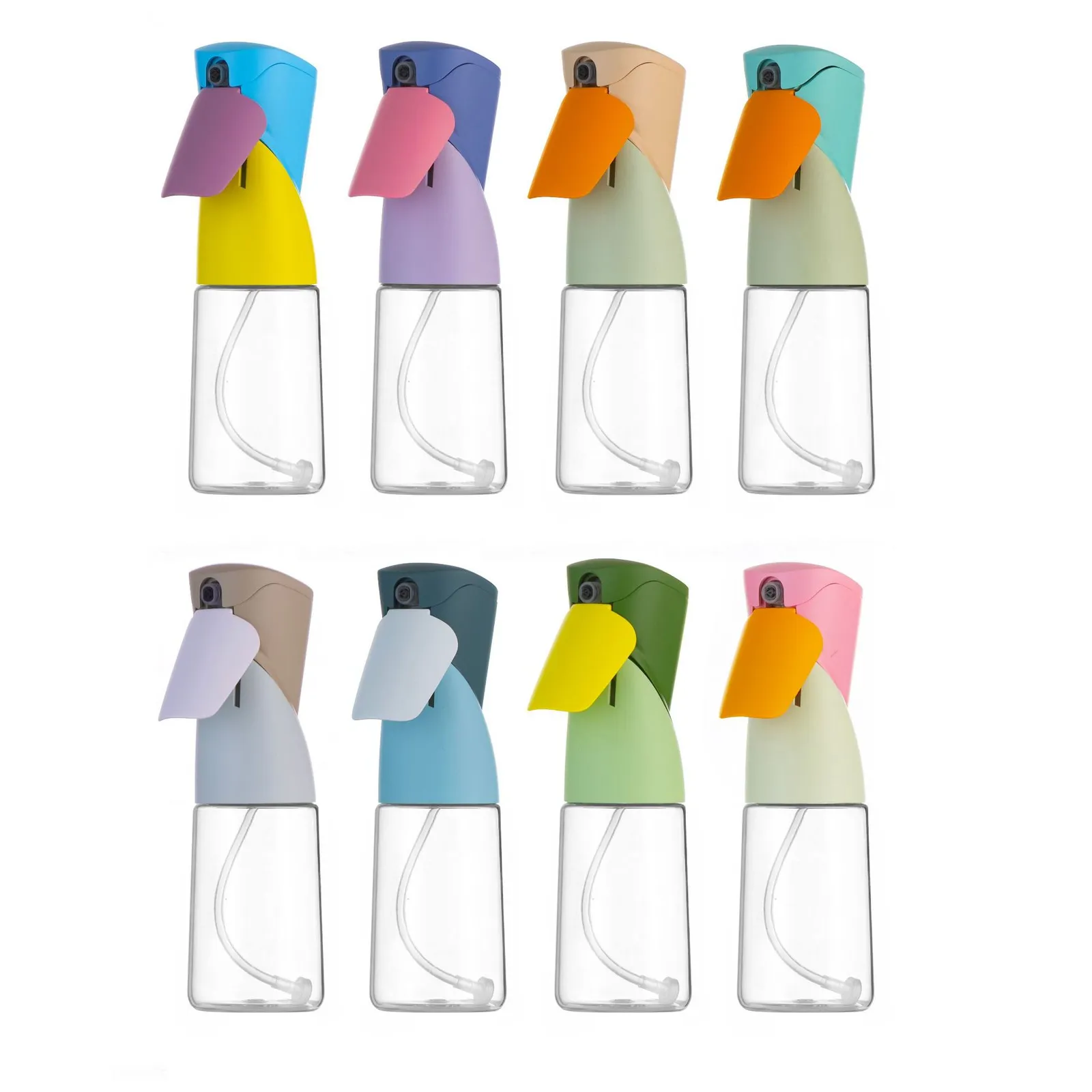
A fine-mist sprayer uses a press-button mechanism connected to a small piston (typically 8–10 mm bore). When you press the button, the piston pushes oil through a 200-mesh (75 µm opening) stainless steel screen and out through a 0.2–0.3 mm nozzle orifice. The screen breaks the oil stream into 80–120 µm droplets — fine enough to create a visible fog that settles evenly on food.
Each press delivers about 0.2–0.4 ml of oil. For a standard 5-quart air fryer basket, 3–4 presses (roughly 1 ml total) gives you full, even coverage. That is about 9 calories of oil — compared to 120–270 calories from pouring 15–30 ml out of a bottle.
Why it wins for air fryers
- Consistent droplet size on every stroke: Unlike pump-pressure sprayers, the mist quality does not degrade. Stroke one and stroke fifty produce the same mist because each press is mechanically identical.
- Lowest oil output per spray: At 0.2–0.4 ml per press, you have fine control. No risk of accidentally drenching the food.
- One-handed operation: Press the button with your thumb while holding the bottle — important when your other hand is managing hot food near a 200°C appliance.
Limitations
The fine mesh screen is the Achilles’ heel. Cooking oil — especially extra-virgin olive oil with its microparticles and high polyphenol content — polymerizes and hardens on the screen over time. Without weekly cleaning (warm water flush through the nozzle), the sprayer will clog within 2–4 weeks. Our spray bottle troubleshooting guide covers the fix in detail.
Stainless steel (304 grade) mesh screens resist this better than nylon screens, because oil residue does not bond to metal as easily. When evaluating sprayers, check the nozzle material — if the spec sheet says “stainless steel nozzle,” it should mean the mesh screen and the orifice plate, not just the decorative outer ring.
Type 2: Pump-Pressure Oil Sprayers (Good, Not Great)
How they work
Pump-pressure sprayers (the Misto being the most recognized brand) use a two-step process. First, you pump a plunger on top of the bottle 15–20 times to compress air inside the bottle. Then you press a release valve and the pressurized air forces oil out through the nozzle in a continuous stream for 5–8 seconds.
The spray quality is actually quite good — for those first 5–8 seconds. The nozzle orifice is typically 0.3–0.5 mm, producing 100–200 µm droplets. The issue is that pressure drops with each second of spraying, so the mist gets coarser and eventually becomes a stream. By the last 2 seconds, you are dispensing oil drops, not mist.
Air fryer performance
Pump-pressure sprayers can work for air fryers if you use short bursts (2–3 seconds) and re-pump between baskets. The spray quality during those first seconds is acceptable. Where they fail is convenience — pumping 15–20 times before every use gets tedious, especially when you air fry daily. In our factory testing, customer satisfaction scores for pump-pressure sprayers were 20–30% lower than for press-button misters, primarily due to the pumping step.
When pump-pressure makes sense
If you batch cook (multiple trays of vegetables for meal prep, for example), the continuous 5–8 seconds of spray covers more surface area faster than individual press-button strokes. For grilling, where you are coating a large grate, the continuous spray is genuinely useful. But for typical single-basket air fryer cooking, the fine-mist press button is more practical.
Type 3: Trigger Sprayers (Not Recommended for Air Fryers)
Why they fail for cooking oil
Trigger sprayers are designed for water-viscosity liquids: cleaning solutions, plant misters, hair products. Their nozzle orifice is 0.8–1.2 mm — four to six times wider than a fine-mist oil sprayer. This produces 300–500 µm droplets, which are visible individual drops rather than a mist.
On an air fryer basket, a trigger spray creates distinct wet spots instead of an even sheen. Some areas get 3–4x more oil than others, leading to soggy patches next to dry spots. The flow rate is also too high — 0.8–1.5 ml per squeeze means you can easily over-oil food in 2–3 pulls.
Material safety concern
Most consumer trigger sprayers are designed for household cleaning products and are NOT food-grade certified. The internal gaskets often use natural rubber (which swells and degrades in contact with cooking oil) rather than silicone or PTFE. The plastic body may be HDPE rated for cleaning chemicals, not FDA 21 CFR 177 compliant for food contact. Unless a trigger sprayer is explicitly marketed and certified for cooking oil, do not use it. For a deeper look at plastic material differences, read our HDPE vs PET vs PP spray bottle guide.
Material Safety: Glass vs Plastic vs Stainless Steel
The bottle body matters less than the mechanism for spray performance, but it matters a lot for food safety and durability. Oil is a mildly aggressive solvent that can leach chemicals from certain plastics over extended contact periods (weeks to months).
| Material | Oil Compatibility | Heat Tolerance | Odor Resistance | Durability | Air Fryer Verdict |
|---|---|---|---|---|---|
| Borosilicate glass | Excellent — inert | No limit | Will not absorb | Breakable | Best choice overall |
| Soda-lime glass | Excellent — inert | No limit | Will not absorb | More breakable than borosilicate | Good, budget glass option |
| PETG plastic | Good (12–18 months before brittleness) | 70°C | Mild absorption over time | Lightweight, drop-safe | Good budget option |
| PP (polypropylene) | Excellent — no leaching | 120°C | Low absorption | Very durable | Best for pump internals |
| HDPE | Fair — absorbs odors | 90°C | Absorbs and retains | Very durable | Not recommended for oil |
| Stainless steel (body) | Excellent — inert | No limit | Will not absorb | Dent-resistant | Good, but you cannot see oil level |
Our recommendation: A glass body with a PP pump mechanism and stainless steel nozzle is the optimal combination. The glass is chemically inert for long-term oil storage, the PP pump resists oil degradation, and the stainless steel nozzle resists clogging. This combination costs $2–4 more than an all-plastic sprayer but lasts 3–4x longer.
Nozzle Aperture Size: The Spec That Decides Everything
This is the single most important specification in any oil sprayer for air fryer use, and it is the one most manufacturers do not disclose. Here is what the numbers mean:
| Nozzle Orifice | Droplet Size | Spray Pattern | Oil Output | Use Case |
|---|---|---|---|---|
| 0.15–0.2 mm | 50–80 µm | Ultra-fine fog | 0.1–0.2 ml/stroke | Perfume, cosmetics — too fine for oil (floats as aerosol) |
| 0.2–0.3 mm | 80–120 µm | Fine mist | 0.2–0.4 ml/stroke | Air fryer, salad, light cooking (ideal) |
| 0.3–0.5 mm | 120–200 µm | Coarse mist | 0.4–0.8 ml/stroke | Grilling, heavy cooking, BBQ |
| 0.5–0.8 mm | 200–400 µm | Light spray | 0.8–1.2 ml/stroke | General kitchen, cleaning |
| 0.8–1.2 mm | 300–500 µm | Coarse spray/stream | 1.0–1.5 ml/stroke | Cleaning, garden — NOT for cooking |
The sweet spot for air fryer cooking is a 0.2–0.3 mm orifice that produces 80–120 µm droplets. This size is heavy enough to land on food (rather than floating in the air like a perfume mist), yet fine enough to create an even sheen rather than visible drops.
When buying an oil sprayer, if the manufacturer does not specify the nozzle orifice size, it is usually because it is too large (0.5 mm+). Quality manufacturers publish this specification because it is a differentiator. Our oil spray bottles use a 0.3 mm orifice with a 304 stainless steel mesh screen — a specification we publish on every product page.
How to Use an Oil Sprayer with an Air Fryer (6 Steps)
- Fill to 80% capacity. Leave headspace for the pump mechanism to work. A full bottle creates back-pressure that reduces spray quality.
- Use refined oils only. Avocado oil (smoke point 271°C), light olive oil (242°C), or canola oil (238°C) spray best and handle air fryer temperatures safely. Extra-virgin olive oil is too viscous and its particles clog fine nozzles within weeks.
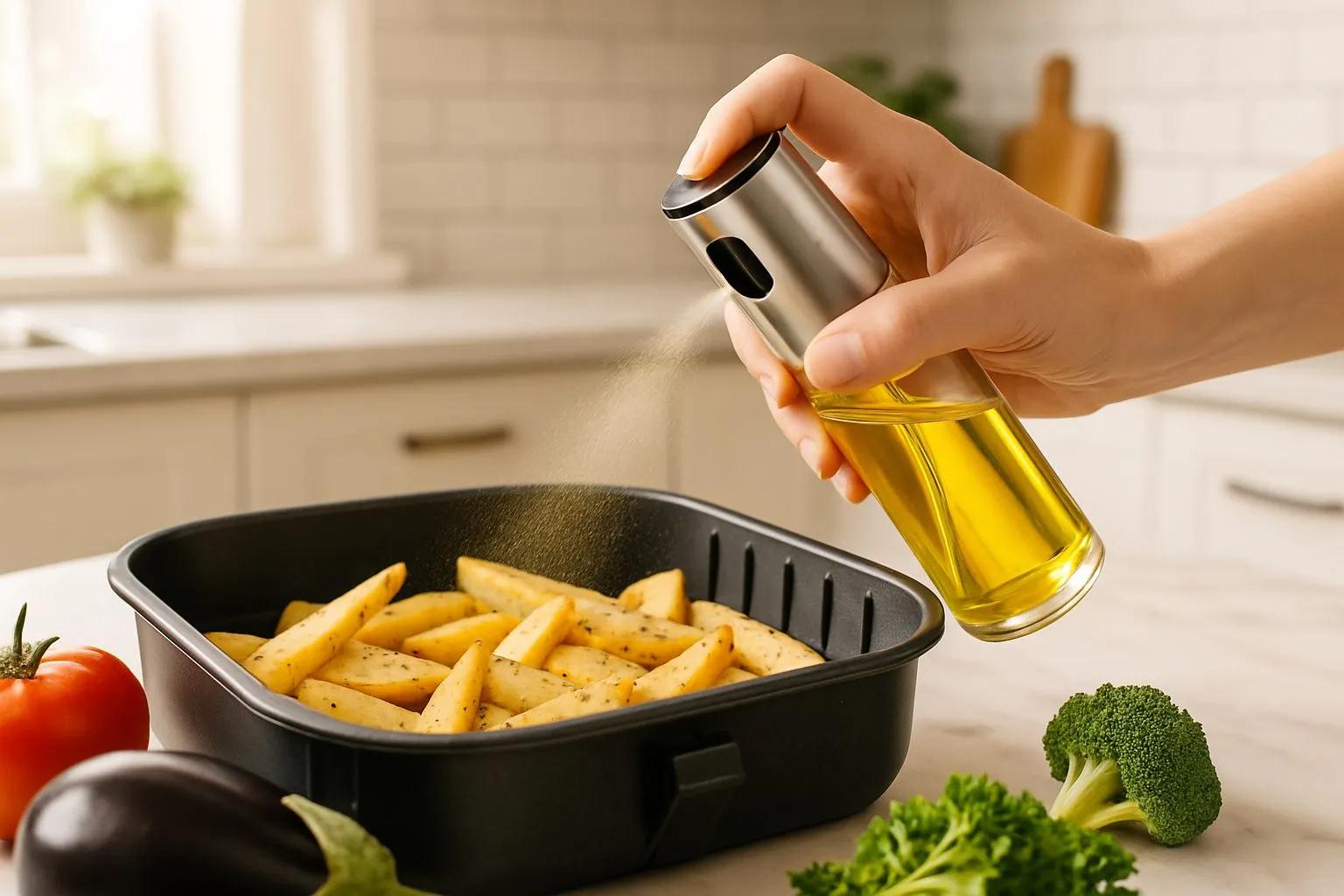
- Hold 15–20 cm (6–8 inches) from the basket. At this distance, the mist cone expands to cover a 20–25 cm diameter — roughly the size of a standard air fryer basket.
- Spray the food, not the basket. Direct application on chicken, vegetables, or fries gives more even coverage than spraying the empty basket first.
- Use 3–4 presses per batch. That delivers about 1–1.5 ml of oil total — enough for an even sheen. If you see oil pooling, you have used too much.
- Flush the nozzle weekly. Fill a cup with warm water, dip the nozzle, and pump 10–15 times to clear oil residue from the mesh screen.
Looking for an oil sprayer that will not clog? Our glass oil spray bottles with 304 stainless steel nozzles are designed specifically for cooking oils. Request free samples and test them with your own oils before ordering.
Best Oils for Air Fryer Spraying (Viscosity + Smoke Point)
The oil you put in the sprayer affects spray quality as much as the nozzle. Cooking oil viscosity ranges from 30 to 85 centipoise (cP) — that is 30–85x thicker than water. Lower viscosity oils atomize more easily and clog nozzles less.
| Oil | Viscosity (cP at 25°C) | Smoke Point | Spray Quality | Air Fryer Verdict |
|---|---|---|---|---|
| Avocado oil (refined) | 40–50 | 271°C / 520°F | Excellent | Best overall choice |
| Light olive oil (refined) | 55–65 | 242°C / 468°F | Very good | Excellent daily option |
| Canola / rapeseed oil | 50–60 | 238°C / 460°F | Very good | Budget-friendly choice |
| Coconut oil (refined, liquid) | 30–40 | 232°C / 450°F | Excellent when liquid | Solidifies below 24°C — clogs in cool kitchens |
| Extra-virgin olive oil | 65–85 | 191°C / 375°F | Fair — thick, clogs nozzle | Not recommended — smoke point too low, clogs fine nozzles |
| Sesame oil | 45–55 | 210°C / 410°F | Good | Finishing only — strong flavor |
5 Common Mistakes That Ruin Oil Sprayers (and the Fixes)
- Using extra-virgin olive oil. EVOO contains waxes and polyphenols that polymerize inside the nozzle mesh within 2–4 weeks. Fix: switch to refined olive oil or avocado oil. If you must use EVOO, filter it through a coffee filter before filling and flush the nozzle every 3 days.
- Never cleaning the nozzle. Oil residue hardens into a varnish on the mesh screen. Fix: weekly warm water flush — fill a cup with warm water, dip the nozzle, pump 15 times. Monthly deep clean: soak nozzle in warm water with a drop of dish soap for 30 minutes.
- Filling the bottle 100% full. The pump mechanism needs an air gap above the oil to create suction. Over-filling causes weak spray or no spray at all. Fix: fill to the 80% mark.
- Spraying too close to the food. At 3–5 cm, the mist has not expanded yet — you get a concentrated wet spot. Fix: hold 15–20 cm away for an even cone of coverage.
- Storing in direct sunlight. UV light breaks down oil (photo-oxidation), thickening it and producing off-flavors. Thickened oil clogs nozzles faster. Fix: store in a cabinet or use a tinted/opaque bottle.
If your oil sprayer is already clogged, see our complete spray bottle troubleshooting guide for step-by-step fixes.
Buying Checklist: What to Look For in an Air Fryer Oil Sprayer
| Spec | What to Look For | Red Flag |
|---|---|---|
| Spray type | Press-button fine-mist | "Trigger spray" or "pump and spray" |
| Nozzle material | 304 stainless steel (mesh + orifice) | "Metal nozzle" (often just the outer ring is metal) |
| Nozzle orifice | 0.2–0.3 mm specified | No orifice size disclosed |
| Body material | Borosilicate glass or food-grade PETG | HDPE or unspecified "BPA-free plastic" |
| Gasket/seal material | Silicone or PTFE | Natural rubber (swells in oil contact) |
| Capacity | 200–300 ml for daily air fryer use | 100 ml (too small) or 500 ml+ (too heavy one-handed) |
| Cleaning access | Removable nozzle + wide mouth (28 mm+) | Fixed nozzle, narrow neck requiring a funnel |
| Food safety cert | FDA 21 CFR, EU 10/2011, or LFGB | "Food safe" claim with no certificate number |
For Wholesale Buyers: Air Fryer Oil Sprayer Sourcing
If you are sourcing oil sprayers for air fryer use as an Amazon seller, retailer, or brand owner, here is what drives positive reviews and reduces returns:
- Glass body is the market expectation. Plastic oil sprayers receive 2–3x more negative reviews about odor absorption and chemical concerns. Glass commands a $3–5 premium and generates significantly better ratings.
- Stainless steel nozzle eliminates the #1 complaint. “Clogs after a few weeks” dominates negative reviews for cheap oil sprayers. A 304 stainless steel nozzle with a 0.3 mm orifice reduces clogging complaints by 60–70% compared to all-plastic nozzles.
- Include usage instructions. Many returns happen because consumers use EVOO or overfill the bottle. A simple instruction card (“Use refined oils, fill to 80%, clean weekly”) cuts return rates measurably.
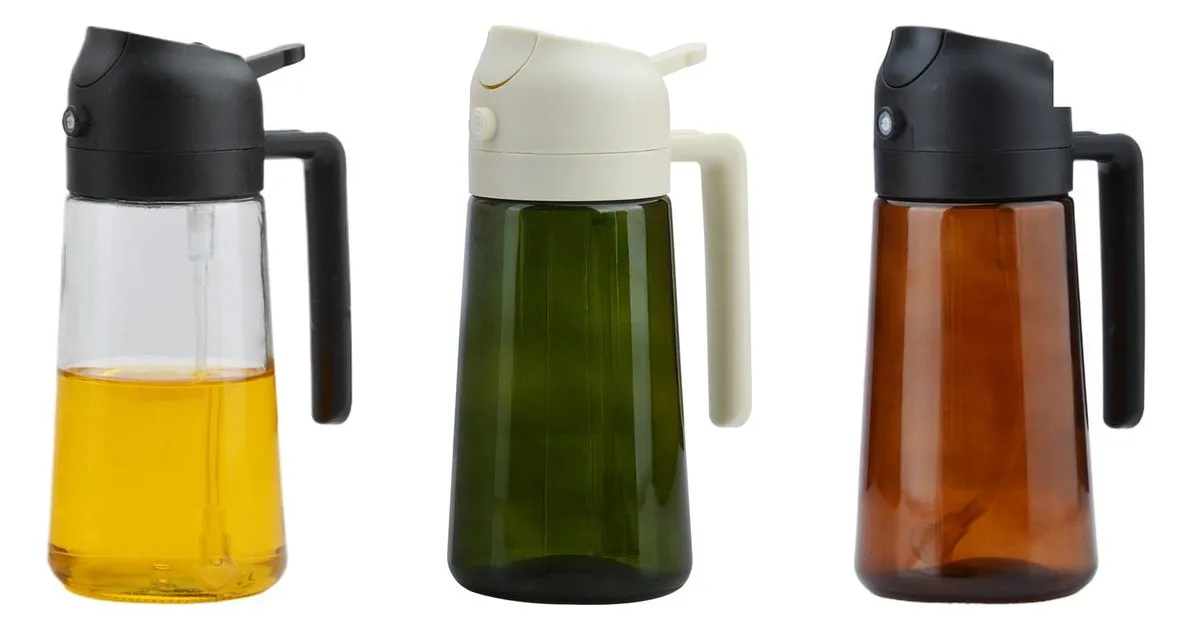
Desiky manufactures glass oil spray bottles and 2-in-1 oil dispensers with stainless steel nozzles in three glass colors (clear, green, amber). Our MOQ starts at 2 units for stock designs, with full OEM customization from 3,000 units. Request a quote and free samples.
Frequently Asked Questions
What type of oil sprayer is best for an air fryer?
A fine-mist press-button sprayer is best for air fryers. It delivers consistent 80–120 micron droplets at 0.2–0.4 ml per stroke — thin enough for even coverage without pooling. Pump-pressure sprayers (Misto-style) are acceptable but the spray quality degrades as pressure drops. Trigger sprayers produce drops that are too large (300–500 microns) and should not be used for air fryer cooking.
Can I use a regular spray bottle for cooking oil in my air fryer?
No. Regular spray bottles (trigger sprayers) are designed for water-viscosity liquids and produce coarse droplets that pool on food rather than coating evenly. They also typically use natural rubber seals that degrade in oil contact, and many are not food-grade certified. You need a sprayer specifically designed for oil, with a fine-mist nozzle (0.2–0.3 mm), oil-resistant seals (silicone or PTFE), and food-contact grade food-contact materials.
How do I stop my oil sprayer from clogging?
Three steps: (1) Use refined oils — avocado oil or light olive oil. Extra-virgin olive oil contains micro-particles that clog fine mesh screens within 2–4 weeks. (2) Flush the nozzle weekly by pumping warm water through it 10–15 times. (3) Monthly, soak the removable nozzle in warm water with a drop of dish soap for 30 minutes. If the sprayer is already clogged, see our complete troubleshooting guide.
Is a glass or plastic oil sprayer better for air fryer use?
Glass is better for oil contact. Oil sits in the bottle for weeks, and glass is chemically inert — it will not absorb odors, leach chemicals, or degrade. PETG plastic works for 12–18 months but becomes brittle from repeated oil exposure. The only advantage of plastic is weight and shatter resistance. If your sprayer sits on the counter next to the air fryer (not carried around), glass is the clear winner. See our full glass vs plastic comparison.
What is the best oil to use in an air fryer sprayer?
Refined avocado oil is the best overall — highest smoke point (271°C/520°F), low viscosity (40–50 cP), and neutral flavor. Refined olive oil (242°C) is a close second. Avoid extra-virgin olive oil: its higher viscosity (65–85 cP) produces uneven spray, its micro-particles clog nozzles, and its lower smoke point (191°C) causes smoking in air fryers set above 190°C.
Related Articles: Glass vs Plastic Oil Sprayer | Cooking Oil Spray Bottle Guide for Kitchen Brands | How to Fix a Spray Bottle That Won’t Spray | HDPE vs PET vs PP Plastic Comparison