Search "lotion pump bottle wholesale" and most results are trading-company catalogs: a grid of stock photos, a "MOQ: negotiable" that means nobody has actually molded the part, and zero mention of the one spec that determines whether your formula dispenses correctly — viscosity. We manufacture the lotion pump bottles themselves, body and pump, out of our facility in Yuyao, China, so this guide covers what a trading company can't: dip tube sizing for thick creams, which neck finish fits which pump, real material cost differences, and the MOQ tiers that actually apply once you move past a stock mold.
Quick Answer
- Standard lotion pumps handle roughly 500-8,000 cP and dispense 0.5-2.0ml per stroke; formulas above that (thick body butter, opaque emulsions above 10,000 cP) need a wider dip tube ID or an airless pump instead, not a stronger lotion pump.
- Neck finish determines pump compatibility, not bottle size — 20/410 and 24/410 fit most 15-50ml treatment and lotion bottles; 28/410 is standard on 100-250ml body lotion bottles. A 24/410 pump will not thread onto a 20/410 bottle.
- Material changes landed cost more than volume does: PP bottle + pump assemblies run roughly $0.15-$0.30/set FOB at 10,000+ pcs, PETG $0.20-$0.40/set, glass $0.35-$0.90/set, and frosted acrylic $0.45-$1.20/set — glass and acrylic cost 2-4x more than PP for the same capacity.
- MOQ starts at 3,000 sets on a stock mold and stock color; a Pantone-matched custom color needs 10,000 sets, and a new bottle or actuator mold needs 30,000-50,000 sets with a $3,000-$12,000 tooling cost.
- Lead time runs 15-20 days for stock configurations, 25-35 days for custom color or logo decoration, and 45-60 days including T1/T2 samples for a new mold — plus 25-35 days sea freight to US/EU ports.
What "Lotion Pump Bottle" Actually Covers — and What It Doesn't
"Lotion pump" gets used loosely online to mean almost any bottle with a pump on top. Mechanically, four different dispensing types get lumped under that name, and mixing them up is the single most common sourcing mistake we see on new skincare-brand orders.
| Pump type | Mechanism | Dose/stroke | Viscosity range | Best for |
|---|---|---|---|---|
| Standard lotion pump | Spring-loaded piston, ball-valve inlet, open dip tube | 0.5-2.0ml | 500-8,000 cP | Body lotion, hand cream, liquid foundation, shampoo/conditioner |
| Treatment/serum pump | Same piston mechanism, smaller bore, shorter dip tube | 0.15-0.4ml | 50-1,500 cP | Facial serums, essences, thin actives that need precise low-dose metering |
| Airless pump | Vacuum piston in a rising inner bag or disc — no dip tube, no air ingress | 0.15-0.5ml | 2,000-100,000+ cP | Oxidation-sensitive actives (vitamin C, retinol), preservative-light formulas, very thick creams |
| Fine-mist/lotion spray | Swirl-chamber atomizer | 0.10-0.20ml | 1-100 cP | Setting sprays, toners, thin lotion-in-spray formats |
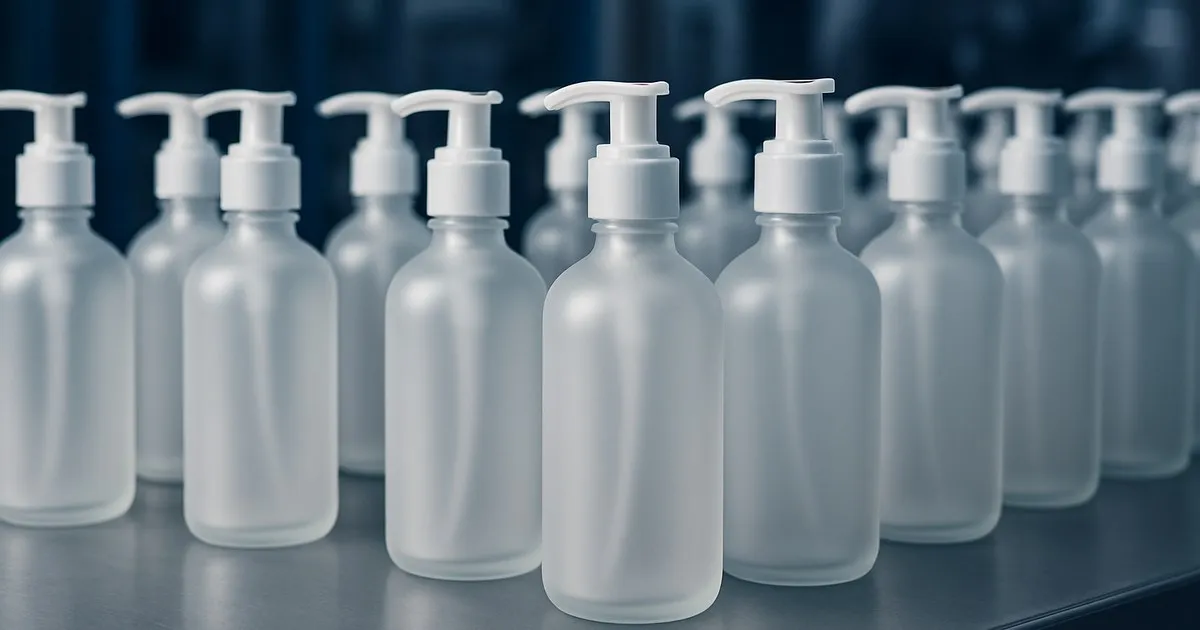
Our own lotion bottle line (model YS-028) is the first category — a standard piston lotion pump on a 15/30/50ml glass or acrylic body, built for lotion, serum and toner formulas in the 500-8,000 cP band. If your formula is a light vitamin C serum under 200 cP or an opaque cream above 10,000 cP, the honest answer is a different pump architecture, not a stronger spring in the same one. We cover the airless side of that decision in our airless cream jar manufacturing guide.
Viscosity: The Spec That Decides Whether Your Formula Actually Dispenses
Every "how to choose a lotion pump" article online tells you to "check your product's viscosity" without saying what to do with the number once you have it. Here is the part that matters mechanically: viscosity determines dip tube inside diameter and pump priming behavior, not just whether the pump "feels right."
- Under 500 cP (thin lotion, toner-like fluids): standard 3-4mm dip tube ID primes in 2-3 strokes. No changes needed.
- 500-4,000 cP (typical body lotion, hand cream): this is the design center for a standard lotion pump — 3.5-4.5mm dip tube, 0.5-1.0ml dose, primes within 5 strokes from dry.
- 4,000-8,000 cP (thick lotion, light cream): needs a wider 5-6mm dip tube ID and a stiffer inlet ball-valve spring, or the pump will lose prime between uses as the thick formula slumps away from the valve seat overnight.
- Above 8,000-10,000 cP (heavy cream, butter): a piston lotion pump will cavitate — the dip tube can't keep the valve seat wetted between strokes. This is where we move customers to an airless pump, which pushes product from above with a rising piston instead of pulling it up a tube.
One detail buyers routinely skip: viscosity isn't fixed. Most lotion and cream formulas thin out under shear (they're shear-thinning/thixotropic) and thicken again at rest, and viscosity also drops as temperature rises. A formula that measures 6,000 cP at a 25°C lab bench can register closer to 9,000 cP after two months in an unheated warehouse in winter. Always send us a sample tested at your actual cold-chain low end, not just room-temperature lab data — a pump that primes fine in the lab and cavitates in a customer's bathroom in January is the single most common warranty complaint we get on lotion pump programs.
Not sure which pump fits your formula? Send us 100-200ml of your actual product and we'll run a prime/dispense test on 2-3 pump configurations before you commit to a mold. Request a compatibility test →
Looking for a reliable spray bottle supplier?
Get free samples and a factory-direct quote within 12 hours.
Get a Free Quote →Neck Finish & Bottle Material: What Fits What
Neck finish is a thread standard, not a size category — a 30ml bottle and a 100ml bottle can share the same 24/410 neck, and a pump built for one will screw onto the other regardless of capacity. Get the neck finish wrong and the pump either won't seat or will leak at the collar under transit vibration. (For end users stuck with a locked or over-tightened collar, our guide on how to open a pump bottle covers lock types and removal.)
| Neck finish | Typical bottle capacity | Common pump type | Notes |
|---|---|---|---|
| 18/410, 20/410 | 15-30ml | Treatment/serum pump | Smallest common cosmetic thread; tight tolerance needed to avoid stripping on assembly |
| 24/410 | 30-60ml | Standard lotion pump | Most common neck for our YS-028 lotion bottle line |
| 28/410, 28/415 | 100-250ml | Standard lotion pump, larger bore | Body lotion, hand cream, shampoo-format bottles |
| 33/410, 43/410 | 200ml+ | Foam pump (different mechanism entirely) | Wide neck houses the air chamber a lotion pump doesn't need — see our foam pump specification guide |
Bottle body material is the bigger cost and positioning lever than the pump itself:
| Material | FOB cost (assembled set, 10,000+ pcs) | Feel/positioning | Chemical resistance | Breakage risk | PCR/recycled option |
|---|---|---|---|---|---|
| PP (polypropylene) | $0.15-$0.30 | Functional, mass-market | Good vs. alcohols and most surfactants | None — unbreakable | Yes, up to 30% PCR without visible haze |
| PETG | $0.20-$0.40 | Clear, mid-tier premium | Moderate — avoid high-alcohol (60%+) formulas long-term | Low | Yes, rPET available |
| Glass | $0.35-$0.90 | Premium, heavy "hand feel" | Excellent — inert to virtually all formulas | Highest; needs a shrink sleeve or silicone sleeve for e-commerce | Recyclable but not PCR-blended at this MOQ |
| Acrylic (frosted) | $0.45-$1.20 | Highest premium positioning | Good, but avoid high-alcohol contact with the frosted finish | Low — more impact-resistant than glass | Limited |
Our YS-028 lotion bottle ships in glass or acrylic body with a PP pump head — the combination our skincare customers order most, because it pairs premium shelf presence with a pump mechanism proven at 500-8,000 cP. For a deeper material breakdown across our full bottle range, see our HDPE vs PET vs PP comparison and glass vs plastic bottle guide.
MOQ, Tooling & Pricing Tiers for OEM Lotion Pump Bottles
MOQ is not one number — it changes depending on how much of the bottle you're customizing. This is the tier structure that applies to our lotion pump bottle programs, FOB Yuyao:
| Scope | MOQ | Tooling cost | Lead time |
|---|---|---|---|
| Stock pump + stock bottle, stock color | 3,000 sets | None | 15-20 days |
| Stock mold, custom color matched to Pantone | 10,000 sets | None | 25-35 days |
| Stock mold + silk-screen or hot-stamp logo | 5,000 sets | $150-$400 plate/film | 25-30 days |
| New custom bottle or actuator mold | 30,000-50,000 sets | $3,000-$12,000 | 45-60 days (incl. T1/T2 samples) |
Add 25-35 days for sea freight to US and EU ports. Sample lead time on our stock lotion bottle configurations is 5-7 days, and we ship samples pre-loaded with your actual formula whenever you can send us 100-200ml ahead of time — that's the fastest way to catch a viscosity mismatch before it becomes a 30,000-unit problem.
Sourcing a new skincare line? Tell us your formula's viscosity (or send a sample), target capacity, and order volume, and we'll come back with a matched pump/bottle combination, sample set, and FOB pricing within 12 hours. Request a Quote for This Product →
Certifications & Compliance Skincare Brands Should Ask For
A lotion pump bottle touches a leave-on cosmetic formula, which puts it under different compliance rules than a household spray bottle. Ask any supplier for these before signing off on a production run:
- ISO 22716 (Cosmetics GMP): the manufacturing-practice standard for facilities producing cosmetic packaging and products. We run production under an ISO 9001 quality system with cosmetic-contact-grade resin lots on request.
- EU Cosmetics Regulation (EC) No 1223/2009: if you're shipping into the EU, your packaging supplier should be able to provide a Certificate of Compliance confirming the resin and colorants used don't introduce restricted substances into a leave-on formula.
- REACH SVHC declaration: confirms none of the Substances of Very High Concern on the current ECHA candidate list are present above the 0.1% w/w threshold in the resin or pigment.
- California Prop 65: relevant mainly for colorants and metallic decoration (hot-stamped logos, metallic caps) — heavy-metal content in pigments and coatings should be documented separately from the base resin cert.
None of these certify a specific viscosity compatibility — that's a mechanical fit question we test per formula, not a paperwork item. Compliance certs tell you the material is safe for cosmetic contact; the sample test tells you the pump will actually work with your product.
Quality Control We Run Before a Lotion Pump Bottle Ships
This is the part a trading company's spec sheet never shows, because they aren't running the tests themselves:
- Prime-up test: full output within 5 strokes from dry, at your formula's actual viscosity, not water.
- Dosage accuracy: ±10% of nominal output across a production run, checked gravimetrically every 500 strokes.
- Stroke life: 3,000 cycles minimum with no loss of prime and no crack at the piston housing.
- Leak/vacuum hold: bottle inverted for 24 hours with zero weep at the pump collar — this is the test that catches a neck-finish tolerance mismatch before it becomes a shipping-carton disaster.
- Torque retention: closure torque checked at 12-18 in-lbf after a 48-hour set so the pump doesn't loosen in an ocean container.
- Chemical compatibility: 7-day immersion of the gasket and valve seat in your actual formula — alcohol-heavy or high-acid formulas (vitamin C, AHA/BHA serums) can swell a standard nitrile gasket within weeks if the elastomer isn't matched to the formula chemistry.
Common Mistakes Brands Make Sourcing Lotion Pump Bottles
- Speccing a pump off a data sheet instead of a real sample. Viscosity on paper and viscosity in a cold warehouse are two different numbers — see the shear-thinning note above.
- Assuming a bigger bottle needs a bigger neck. Neck finish is a thread standard tied to the pump, not the bottle capacity — a 30ml and 100ml bottle can share a 24/410 neck.
- Choosing glass for shelf appeal without budgeting for breakage protection. Glass lotion bottles sold through e-commerce need a shrink or silicone sleeve; skipping it turns a normal transit bump into a returns problem.
- Ordering a new custom mold before validating the formula-pump fit on a stock configuration. Run your compatibility test on a $0 stock sample before committing to $3,000-$12,000 in tooling.
- Not asking whether the gasket elastomer matches the formula chemistry. A vitamin C or AHA serum can degrade a standard gasket within weeks if it isn't specified for low pH.
How to Start an OEM Lotion Pump Bottle Order
- Send your formula viscosity or a 100-200ml sample. This is the single input that determines pump selection — everything else is styling.
- Choose capacity and body material from our cosmetic bottle range — PP, PETG, glass, or acrylic.
- Confirm neck finish and pump dose against the compatibility table above; we'll flag any mismatch before quoting.
- Approve a sample loaded with your actual formula — standard 5-7 day turnaround on stock molds.
- Place your production order at the MOQ tier matching your customization level, with a 45-60 day lead time if a new mold is required.
Frequently Asked Questions
What's the difference between a lotion pump and an airless pump?
A lotion pump draws product up an open dip tube with a piston and ball valve, and works well for 500-8,000 cP formulas. An airless pump has no dip tube — a rising piston or bag pushes product from below, with no air re-entering the container. Airless is for formulas above roughly 2,000 cP that also need oxidation protection (vitamin C, retinol), or very thick creams that would cavitate a standard dip tube.
What neck finish do lotion pump bottles use?
Most 15-60ml lotion and treatment bottles use 18/410, 20/410, or 24/410 necks. Larger 100-250ml body lotion bottles typically use 28/410 or 28/415. Neck finish is a thread standard tied to the pump, not the bottle's capacity — always confirm the pump and bottle share the same finish before ordering.
What's the MOQ for custom lotion pump bottles?
3,000 sets on a stock mold and stock color, 10,000 sets for a Pantone-matched custom color, and 30,000-50,000 sets if you need a new bottle or actuator mold, which runs $3,000-$12,000 in tooling.
Can a standard lotion pump handle thick cream formulas?
Up to about 8,000 cP with a wider 5-6mm dip tube ID and a stiffer inlet valve spring. Above roughly 8,000-10,000 cP, a piston lotion pump will cavitate as the dip tube loses contact with the thick formula between strokes — that's the threshold where we recommend switching to an airless pump instead.
What material is best for lotion bottles — glass, PETG, PP, or acrylic?
PP is the lowest-cost, unbreakable option for mass-market lines ($0.15-$0.30/set FOB). PETG offers a clear, mid-tier look at a modest premium. Glass and frosted acrylic cost 2-4x more than PP but carry the premium shelf presence most skincare brands want — glass needs a protective sleeve for e-commerce shipping due to breakage risk.
What certifications should a lotion bottle supplier provide?
Ask for ISO 22716 (Cosmetics GMP) manufacturing compliance, a Certificate of Compliance against EU Cosmetics Regulation (EC) No 1223/2009 if shipping to the EU, and a REACH SVHC declaration. These confirm material safety for cosmetic contact — they don't certify viscosity compatibility, which needs a formula-specific sample test.
How long does OEM lotion pump bottle production take?
15-20 days for stock pump and bottle in a stock color, 25-35 days for a custom Pantone color or logo decoration, and 45-60 days for a new mold including T1/T2 sample rounds. Add 25-35 days for sea freight to US or EU ports.
Related Guides
- OEM Skincare Bottle & Airless Cream Jar Manufacturing Guide
- Types of Soap Dispensers: 8 Kinds Compared + Cost Per Wash
- HDPE vs PET vs PP Plastic Comparison
- Glass vs Plastic Bottles Comparison
- Cosmetic Spray Bottle Wholesale Supplier Guide
- Cosmetic & Lotion Bottles — Product Range
- Custom OEM Packaging Program
Ready to source lotion pump bottles?
Send us your formula's viscosity, target capacity, and order volume, and we'll match a pump and bottle combination with sample availability and FOB pricing. Request a Quote for This Product →