If you are sourcing an OEM silicone-bristle 3-in-1 scalp massage brush, you have probably already discovered the problem with this category: every supplier page shows the same photo, quotes "low MOQ, high quality," and refuses to put a Shore hardness number or a tooling cost in writing. That makes it impossible to compare quotes, and it is why so many first orders come back with bristles that are either too stiff for a sensitive scalp or so soft they collapse under shampoo.
We manufacture this product. This guide gives you the numbers a real quote should contain — bristle durometer, wall thickness, reservoir valve specs, tooling cost, MOQ, certification scope and container math — so you can specify a scalp massage brush properly instead of buying a photo.
Quick answer
A serviceable OEM 3-in-1 scalp massage brush uses 30–40 Shore A silicone bristles on a PP body, MOQ 3,000 pcs on existing tooling, 15–25 days lead time, and lands at $0.65–1.60 FOB Ningbo depending on reservoir design and packaging. Custom tooling adds $3,000–8,500 and 30–45 days. Insist on FDA 21 CFR 177.2600 and LFGB test reports for the silicone, plus CPSIA and Prop 65 if you sell into the US retail channel.
What "3-in-1" Actually Means — and Why It Changes the Tooling
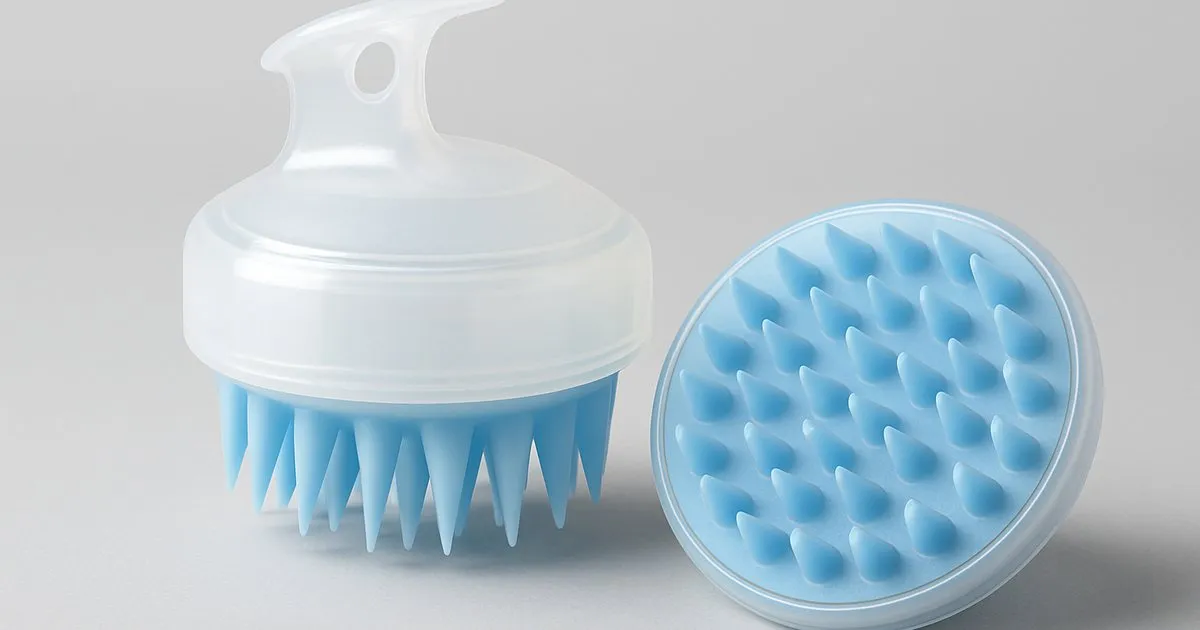
The term gets used loosely. In this category it should mean three distinct functions in one tool:
- Dry scalp massage — silicone bristles used on dry hair to stimulate circulation
- Treatment application — a built-in reservoir dispenses hair tonic, minoxidil, or scalp serum directly at the root through channels between the bristles
- Wet shampoo scrubbing — the same bristles used in the shower to lift product buildup and flakes
That second function is the one that separates a real 3-in-1 from a rebranded shampoo brush, and it is the one that drives your tooling cost. A plain silicone scrubber is a single overmolded part — cheap, fast, forgiving. A reservoir model needs a sealed liquid chamber, a dispensing valve or push-button mechanism, dosing channels through the bristle field, and a leak-tight closure. That is three to four separate parts, each with its own cavity.
When a supplier quotes you $0.40 for a "3-in-1 scalp massager," check whether there is a reservoir at all. Most of the cheapest quotes in this category are for a solid brush with a marketing label.
Bristle Specification: The Number Nobody Quotes
Bristle feel is the single biggest driver of returns and reviews in this product, and it comes down to three measurable parameters. Put all three in your specification sheet.
| Parameter | Too soft | Recommended range | Too firm |
|---|---|---|---|
| Durometer (Shore A) | Below 25 — bristles fold flat under shampoo, no scrubbing action | 30–40 Shore A for general market; 25–30 for sensitive-scalp positioning | Above 50 — scratches, complaints from thin-hair users |
| Bristle diameter at base | Under 2.0 mm — tears at the root after weeks of use | 2.5–3.5 mm tapering to 1.5–2.0 mm at tip | Over 4.5 mm — feels blunt, poor penetration through thick hair |
| Bristle length | Under 8 mm — cannot reach the scalp through medium or thick hair | 10–14 mm, with rounded tips | Over 18 mm — flexes sideways, loses pressure transfer |
| Bristle count | Under 30 — pressure concentrates, feels sharp | 45–70 tips across the brush face | Over 100 — pressure diffuses, users report "it does nothing" |
The reason competitors do not publish these is that most of them are trading, not molding. A factory that owns the tool can tell you the durometer of the compound in the barrel; a trading company cannot. Asking "what Shore A are the bristles?" is the fastest supplier qualification question in this category — you will lose half the shortlist on that single email.
One practical note from our own line: durometer readings drift 2–4 points between a pigmented compound and a clear one, because the pigment masterbatch changes crosslink density slightly. If you are ordering a color assortment, specify durometer per color or accept a small variance in feel across the set.
Looking for a reliable spray bottle supplier?
Get free samples and a factory-direct quote within 12 hours.
Get a Free Quote →Material Stack: Silicone vs TPE vs ABS
Most of this category is built on one of three material combinations. They are not interchangeable, and the choice determines both your unit cost and your certification path.
| Build | Typical FOB | Durability | Best for | Watch out for |
|---|---|---|---|---|
| Food-grade silicone bristles + PP body | $0.65–1.60 | 3–5 years in daily shower use | Premium retail, pharmacy channel, treatment applicators | Requires overmold or mechanical lock — check bond strength |
| TPE bristles + ABS body | $0.35–0.80 | 12–24 months before bristles take a set | Promotional, salon giveaway, entry price points | TPE yellows with sulfate shampoo exposure; can retain odor |
| All-silicone one-piece | $0.55–1.10 | 5+ years, effectively no failure mode | Shower scrubber positioning, no reservoir | Cannot carry a liquid reservoir — not a true 3-in-1 |
Our YC-030 uses a PP body with silicone bristles, which is the standard build for reservoir models because PP holds a sealed chamber and threads reliably while silicone provides the skin contact. TPE is genuinely cheaper, but it is the wrong material for anything sold on a hair-growth or dermatological claim — TPE plasticizers can migrate, and buyers routinely fail REACH SVHC screening on cheap TPE grades.
Comparing quotes and not sure they are for the same product? Send us the competing spec sheet and we will tell you what is missing from it. Get an OEM quote with full specifications →
The Reservoir: Where Cheap Units Fail
If you take one engineering point from this guide, take this one. Reservoir leakage is the leading warranty complaint on 3-in-1 scalp brushes, and it has three causes, all of which you can specify away before production.
1. Valve type
Gravity-feed holes leak in a shower caddy. A silicone duckbill or slit valve holds liquid until squeeze pressure is applied and reseals when released. Duckbill valves add roughly $0.04–0.08 per unit and eliminate the majority of leak returns. Specify it explicitly; it is not the default on low-cost quotes.
2. Closure seal
The fill cap needs a gasket or an interference-fit rib, not a bare thread. Ask for a 24-hour inverted leak test at 100% of a first-article sample lot, and for a report on your production run at AQL 2.5.
3. Chemical compatibility
Hair tonics containing 40–70% alcohol, and minoxidil formulations in propylene glycol, will swell some silicone grades and craze low-grade PP. If your customers will fill the reservoir with an alcohol-based treatment, say so at the RFQ stage — it changes the compound. We run a 7-day immersion test at 40°C against the customer's actual formula before approving mass production, and it has caught incompatibilities that would have surfaced as field failures three months after launch.
MOQ, Tooling and Lead Time — Real Numbers
| Order type | MOQ | Tooling cost | Lead time |
|---|---|---|---|
| Existing tooling, stock color, no branding | 3,000 pcs | None | 15–20 days |
| Existing tooling + logo (pad print or laser) | 3,000 pcs | $120–350 plate/setup | 18–25 days |
| Existing tooling + custom color matching | 10,000 pcs per color | None (masterbatch cost in unit price) | 25–30 days |
| Custom retail box + insert card | 5,000 pcs | $200–600 die and plate | 25–30 days |
| New tooling — modified body, existing bristle field | 10,000 pcs | $3,000–5,000 | 30–40 days + production |
| New tooling — full custom design | 30,000 pcs | $5,500–8,500 | 45–60 days + production |
Two things worth knowing about tooling in this category. First, the mold belongs to whoever paid for it — get that in the contract, along with a clause covering storage and transfer, because a $6,000 tool is worth arguing over three years later. Second, most brands do not need new tooling at all: a color change, a custom bristle durometer and a printed retail box will make a product look proprietary at a fraction of the cost. We recommend buyers run their first 10,000 units on existing tooling and only cut steel once the SKU has proven itself.
Certification Scope by Market
Scalp brushes sit in an awkward regulatory position — they are not cosmetics, not medical devices, but they contact skin and sometimes carry a treatment product. Here is what buyers actually get asked for at customs and by retail accounts.
| Market | Required / expected | Applies to |
|---|---|---|
| United States | FDA 21 CFR 177.2600 (rubber articles), CPSIA lead & phthalates, California Prop 65 | Silicone bristles, any printed surface |
| European Union | REACH SVHC screening, LFGB §30/31, RoHS for any electronic version | Silicone and TPE compounds |
| United Kingdom | UKCA documentation where applicable, REACH UK | Same scope as EU |
| Retail chains (all markets) | ISO 9001 supplier audit, often BSCI or Sedex social audit | The factory, not the product |
A test report is issue-specific and lot-specific. A supplier who sends you a three-year-old LFGB certificate for a different compound has given you nothing. Ask for the report to name the compound grade and be dated within 12 months.
Packaging and Container Math
Scalp brushes are light and awkwardly shaped, so packaging drives your freight cost more than the product does. Our standard export packing for the YC-030 is 500 pcs per carton at 57 x 39 x 42 cm, 9 kg gross.
- Carton volume: 0.0934 CBM → roughly 5,350 pcs per CBM in bulk polybag packing
- A 20ft GP container holds 26–28 usable CBM → approximately 140,000–150,000 pcs bulk-packed
- Add a printed retail box and the same container drops to roughly 35,000–45,000 pcs — a 70% volume penalty
The practical consequence: if you are selling through Amazon or a retail chain, work out whether it is cheaper to ship bulk and box at a domestic 3PL. For most brands shipping under 30,000 units per year, boxing in China is still cheaper. Above that, and especially if you run multiple regional SKUs with different language artwork, bulk-in / box-locally usually wins. The same logic applies across our whole range — see the packaging and shipping guide for the crossover calculation.

How to Write an RFQ That Gets a Comparable Quote
Most buyers in this category send "please quote scalp massager, 5000pcs" and then wonder why the five replies range from $0.32 to $1.90. Those quotes are for five different products. A specification that produces comparable numbers contains eight lines:
- Bristle durometer — e.g. 35 Shore A ±5
- Bristle length and count — e.g. 12 mm, 56 tips
- Reservoir — yes/no, capacity in ml, valve type
- Body material — PP, ABS, or all-silicone
- Intended fill — water, alcohol-based tonic, oil, or dry use only
- Decoration — logo method, position, number of colors
- Packaging — polybag, printed box, blister, with dimensions if known
- Test scope — which certifications you need reports for
Send that to five suppliers and the spread will collapse to something you can actually evaluate. It is the same discipline we recommend for every category we make — our OEM buyer's guide covers the supplier-vetting side in more depth, and the sampling and approval guide covers what to do once quotes come back.
Sampling: What to Test Before You Commit
Order samples from your top three suppliers and run four checks. None of them requires a lab.
- Wet grip test. Lather the brush with shampoo and use it. Cheap TPE units become slippery and rotate in the hand; a properly contoured PP body with a silicone strap does not.
- Bristle set test. Compress the bristle field flat under a book for 24 hours. Good silicone recovers fully within minutes. TPE and low-grade silicone hold a visible set.
- Inverted leak test. Fill the reservoir with water, cap it, leave it inverted overnight on a paper towel. Any mark at all fails.
- Odor test. Seal the sample in a bag for 48 hours at room temperature and open it. A sharp chemical smell indicates incomplete post-curing of the silicone, which is a real quality signal and a common complaint driver.
We ship stock samples free for up to 3 SKUs with the buyer covering courier — typically $35–60 by DHL, arriving in 4–6 days. Custom color or printed samples take 7–12 days with a sample fee credited back against a confirmed order.
Frequently Asked Questions
What is the MOQ for an OEM silicone scalp massage brush?
3,000 pieces on existing tooling in a stock color. Logo printing keeps the same 3,000 pcs minimum; custom Pantone color matching raises it to 10,000 pcs per color, and full custom tooling requires 30,000 pcs to amortize the mold.
What Shore hardness should the bristles be?
30–40 Shore A for a general-market product. Go to 25–30 Shore A if you are positioning for sensitive scalps or post-treatment use, and avoid anything above 50 Shore A — that is where scratching complaints start.
How much does tooling cost for a custom scalp massager?
$3,000–5,000 for a modified body running an existing bristle field, and $5,500–8,500 for a full custom design with a new reservoir. Tooling belongs to the party that paid for it, which should be stated in the purchase contract along with storage and transfer terms.
What is the difference between a 3-in-1 scalp brush and a shampoo brush?
A shampoo brush is a solid silicone scrubber for wet use only. A true 3-in-1 adds a sealed liquid reservoir and a dispensing valve so hair tonic or scalp treatment can be applied at the root while massaging, which requires three to four molded parts instead of one.
Can the reservoir hold alcohol-based hair tonic or minoxidil?
Only with the right compound. Formulations containing 40–70% alcohol or propylene glycol will swell some silicone grades and craze low-grade PP. Declare the intended fill at the RFQ stage and request a 7-day immersion test at 40°C against your actual formula before mass production.
What certifications do I need to sell in the US and EU?
United States: FDA 21 CFR 177.2600 for the silicone, plus CPSIA lead and phthalate testing and California Prop 65 compliance. European Union: REACH SVHC screening and LFGB §30/31. Reports must name the specific compound grade and be dated within 12 months to be useful.
How many scalp massage brushes fit in a container?
Roughly 140,000–150,000 pieces bulk-packed in a 20ft GP at 500 pcs per carton (57 x 39 x 42 cm, 0.0934 CBM). Adding a printed retail box cuts that to approximately 35,000–45,000 pieces, so consider bulk shipping with domestic boxing above 30,000 units per year.
What is the lead time for an OEM order?
15–20 days for stock items on existing tooling, 18–25 days with logo printing, 25–30 days with custom color or retail packaging, and 45–60 days plus production if new tooling is required.
Related Guides
- Best Scalp Massager 2026: Silicone vs Electric vs 3-in-1
- OEM Buyer's Guide: How to Choose a Manufacturer
- Private Label Guide for Personal Care Brands
- Samples, Testing and Approval
- YC-030 Silicone-Bristle 3-in-1 Scalp Massage Brush
Get a Specified Quote
Desiky manufactures the YC-030 3-in-1 scalp massage brush alongside our specialty personal care range in Yuyao, China, under ISO 9001 process control. Send us your bristle durometer, reservoir capacity, intended fill and packaging format and we will return a per-line quote, a carton and CBM plan, and a production date within 12 hours.