Choosing the right spray bottle for your brand is more complex than it appears. The material determines what products you can fill. The nozzle type determines the user experience. The capacity determines your price point and shipping cost. The printing method determines how your brand looks on shelf. And the manufacturer determines whether your bottles arrive on time, within spec, and free of defects.
This OEM buyer's guide walks you through every decision point — from material science to nozzle engineering to production economics. Whether you are launching a new cleaning brand, a skincare line, or a plant care product, this guide gives you the knowledge to specify your spray bottle like a professional and communicate effectively with Chinese manufacturers.
Key Takeaways
- Material choice is driven by your product formulation — PET for water-based, HDPE for chemicals, PP for essential oils, glass for premium.
- Nozzle type determines the spray pattern, output volume, and user experience — match it to your product's application method.
- Standard bottle capacities (100ml, 200ml, 300ml, 500ml, 750ml, 1L) optimize mold availability and shipping efficiency.
- Printing method impacts cost and aesthetics — screen printing for simple designs, shrink sleeves for full-wrap graphics, in-mold labeling for premium.
- Always test your product formulation in the actual bottle material for at least 30 days before committing to production.
Step 1: Choose Your Bottle Material
The bottle material is your first and most critical decision. It must be chemically compatible with your product formulation, meet your market's regulatory requirements, align with your brand positioning, and be cost-effective at your production volume.
PET (Polyethylene Terephthalate)
Best for: Water-based products, beauty sprays, plant misters, light cleaning solutions.
- Pros: Crystal clear transparency, lightweight, good barrier properties, widely recyclable (#1 recycling code), cost-effective.
- Cons: Attacked by essential oils, strong solvents, and high-concentration alcohol (above 30%). Not suitable for hot-fill applications (softens above 60C).
- Typical wall thickness: 0.3-0.5mm for standard bottles.
- Cost range: $0.08-$0.25 per bottle (depending on size and order volume).
HDPE (High-Density Polyethylene)
Best for: Cleaning products, industrial chemicals, bleach, acids, automotive fluids.
- Pros: Excellent chemical resistance, impact-resistant, lightweight, recyclable (#2), cost-effective. The workhorse material for household and industrial cleaning products.
- Cons: Opaque or translucent (not crystal clear), limited aesthetic options compared to PET, can absorb some fragrances over time.
- Typical wall thickness: 0.4-0.8mm.
- Cost range: $0.10-$0.30 per bottle.
PP (Polypropylene)
Best for: Essential oils, alcohol-based sanitizers, hot-fill products, chemical-resistant applications.
- Pros: Superior chemical resistance (handles essential oils that degrade PET), higher heat resistance (suitable for hot-fill up to 100C), good fatigue resistance (hinge caps, flip-tops), recyclable (#5).
- Cons: Less transparent than PET, slightly higher cost, limited availability in some specialty shapes.
- Typical wall thickness: 0.4-0.6mm.
- Cost range: $0.12-$0.35 per bottle.
PETG (Glycol-Modified PET) & Tritan
Best for: Reusable spray bottles, premium brands, BPA-free positioning.
- Pros: Crystal clear like PET but more impact-resistant. BPA-free (important marketing claim). Better chemical resistance than standard PET. Excellent for continuous spray bottles where durability matters.
- Cons: More expensive than PET (1.5-2x). Tritan is a premium material with limited recycling infrastructure.
- Cost range: $0.20-$0.50 per bottle.
Glass
Best for: Essential oils, aromatherapy, premium skincare, natural/organic brands.
- Pros: Complete chemical inertness (compatible with everything), premium aesthetics, perceived quality, infinitely recyclable, amber glass provides UV protection.
- Cons: Heavy (increases shipping cost), breakable, higher per-unit cost, limited shape options without expensive custom molds.
- Cost range: $0.30-$1.50 per bottle (depending on size, color, and finish).
Material Compatibility Quick Reference
| Product Type | PET | HDPE | PP | Glass |
|---|---|---|---|---|
| Water-based cleaners | Yes | Yes | Yes | Yes |
| Bleach / hypochlorite | No | Yes | Yes | No* |
| Essential oils | No | Limited | Yes | Yes |
| Alcohol (>30%) | No | Yes | Yes | Yes |
| Facial toners / mists | Yes | N/A | Yes | Yes |
| Cooking oil spray | Limited | Yes | Yes | Yes |
*Glass is chemically compatible with bleach but the metal spray mechanism may corrode. Use plastic-coated or ceramic nozzle internals.
Step 2: Select Your Nozzle Type
The nozzle (sprayer mechanism) is the most engineered component of your spray bottle. It determines the spray pattern, output volume, spray force, and overall user experience. Here are the main types:
Trigger Sprayers
The standard for cleaning products, garden care, and automotive detailing. The user squeezes a trigger lever to pump liquid through the nozzle.
- Output per stroke: 0.8-1.2ml (standard), 0.3-0.5ml (mini trigger).
- Spray patterns: Adjustable — off / stream / spray. Some models offer foam mode.
- Neck sizes: 28/400 (most common for cleaning bottles), 28/410, 24/410 (personal care).
- Best for: Cleaning products, garden sprayers, automotive care, pet care.
Fine Mist Pump Sprayers
Produce a fine, even mist through a mechanical pump action (press the actuator down with your finger).
- Output per stroke: 0.1-0.2ml (ultra-fine), 0.2-0.5ml (standard mist).
- Spray patterns: Fixed mist pattern. Droplet size: 40-100 microns.
- Neck sizes: 18/410, 20/410, 24/410.
- Best for: Facial mists, setting sprays, perfumes, hair products, plant misters.
Continuous Spray Mechanisms
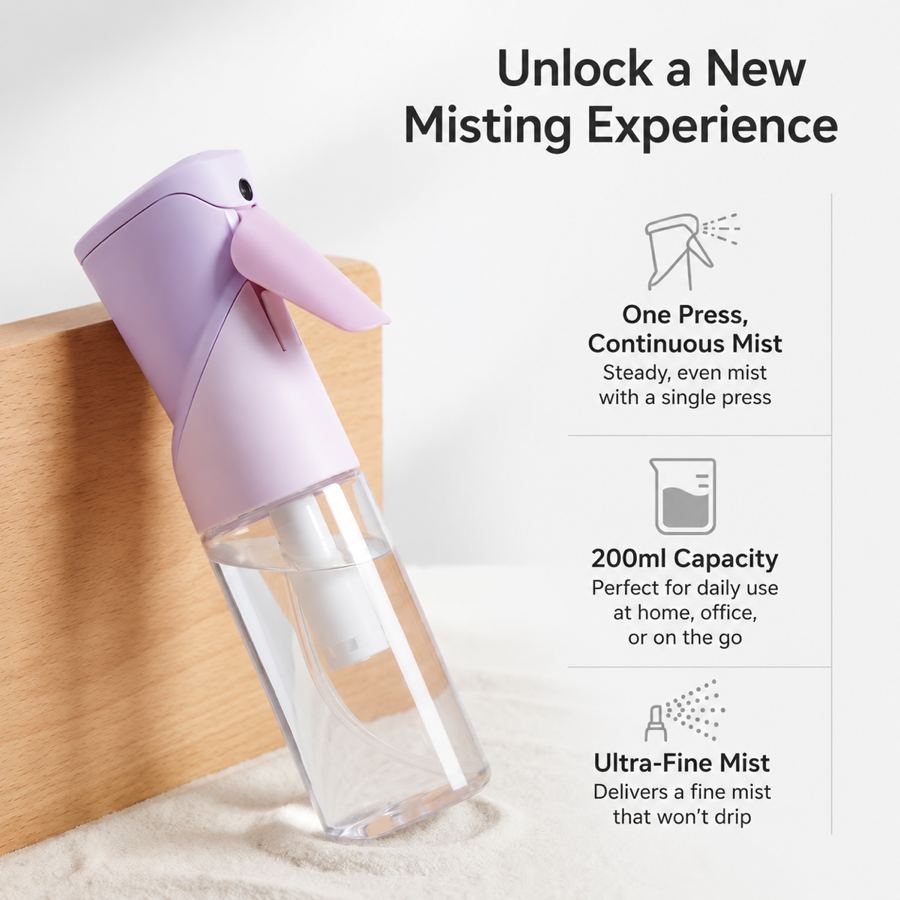
The most advanced spray technology for consumer bottles. A pre-pressurized system that delivers a continuous, aerosol-like mist without propellant gas.
- Output: Continuous fine mist for 3-5 seconds per pump.
- Spray patterns: Ultra-fine mist (20-50 micron droplets), 360-degree spraying capability.
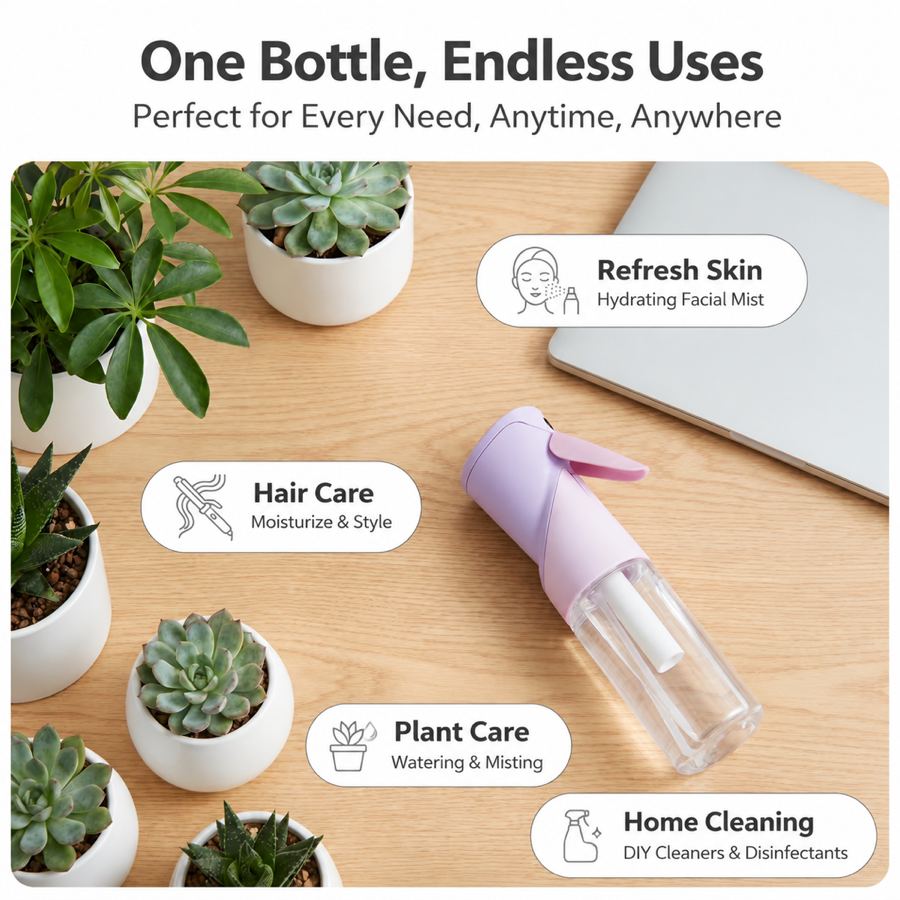
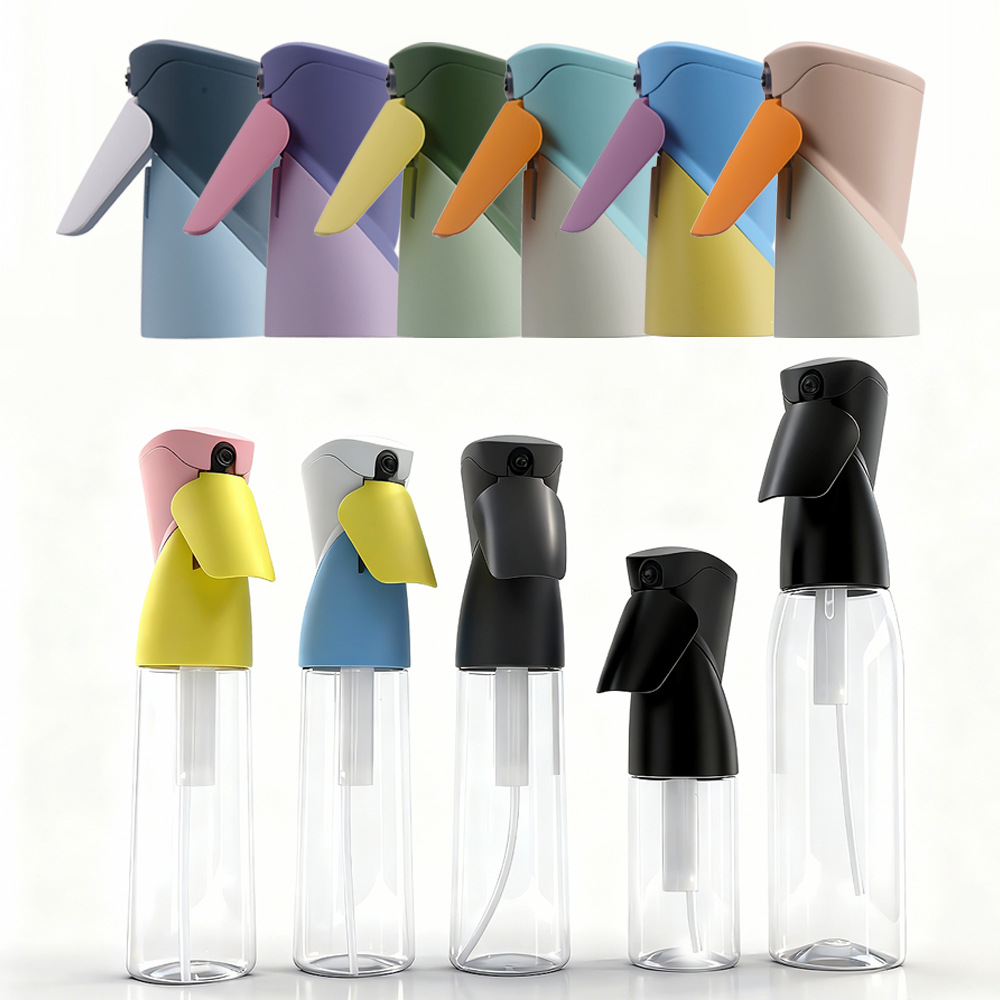
- Best for: Cooking oil sprayers, sunscreen, hair styling, cleaning, plant care. See Desiky's continuous spray collection.
- Key spec: The quality of the internal valve system determines spray consistency and longevity. Premium mechanisms deliver 10,000+ spray cycles without degradation.
Foam Dispensers
Produce rich foam from liquid soap or cleanser formulations. The pump mechanism mixes air with liquid to create foam as it dispenses.
- Output per stroke: 0.4-0.8ml of foam.
- Neck sizes: 28/410, 30/410, 43/410.
- Best for: Hand soap, facial cleansers, pet shampoo, baby products.
Step 3: Determine Your Bottle Capacity
Capacity selection impacts product positioning, shipping cost, and retail pricing. Here is a practical guide:
| Capacity | Best Application | Shipping Impact |
|---|---|---|
| 30-100ml | Travel size, samples, perfume, facial mist | Low — high unit density per carton |
| 100-200ml | Personal care, beauty, small plant misters | Low-medium |
| 200-300ml | Continuous spray bottles, hair care, cooking spray | Medium |
| 500ml | General cleaning, plant care, kitchen spray | Medium |
| 750ml-1L | Heavy-duty cleaning, commercial use | High — fewer units per carton |
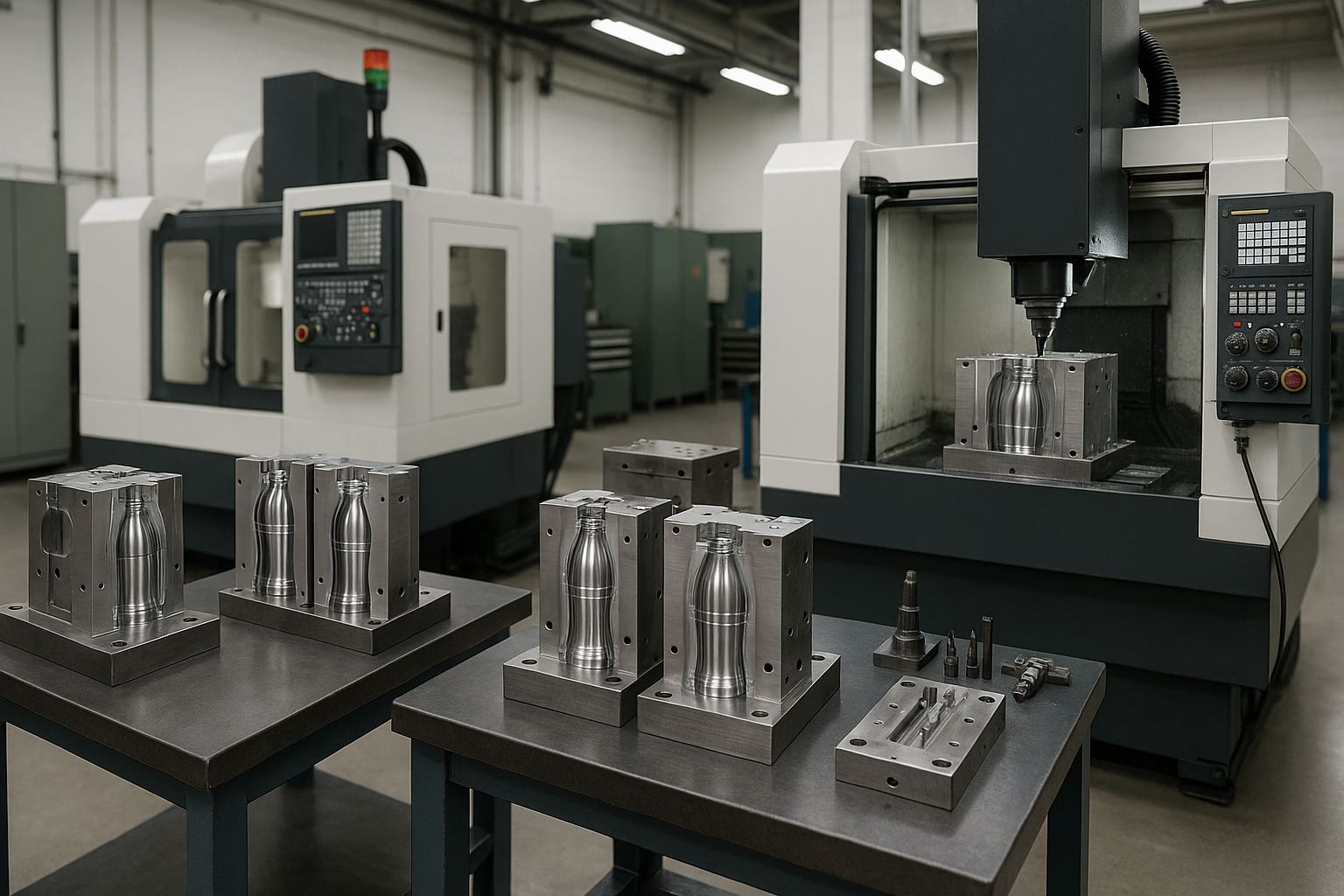
Pro tip: Stick to standard capacities (100, 200, 300, 500, 750, 1000ml) whenever possible. Standard sizes have existing molds at most factories, eliminating mold costs ($2,000-$8,000) and reducing lead time by 3-5 weeks. Custom sizes only make sense at volumes above 50,000 pieces where the mold cost is amortized to under $0.10 per unit.
Step 4: Specify Your Printing and Branding
The printing method determines how your brand appears on the bottle and significantly impacts per-unit cost:
Screen Printing (Silk Screen)
- Description: Ink is pressed through a mesh screen directly onto the bottle surface.
- Colors: 1-4 colors (each color requires a separate screen). Spot color matching (Pantone).
- Cost: $0.02-$0.10 per bottle per color. Screen setup: $50-$100 per color.
- Best for: Simple logos, text, and 1-2 color designs on HDPE and PET bottles.
Heat Transfer Printing
- Description: A pre-printed film is transferred to the bottle surface using heat and pressure. Supports photographic-quality, full-color images.
- Colors: Full color (CMYK process).
- Cost: $0.05-$0.15 per bottle. Film production: $100-$300 per design.
- Best for: Full-color branding with photographic elements, complex graphics, gradient effects.
Shrink Sleeve Labels
- Description: A printed plastic sleeve is placed over the bottle and shrunk to conform to the bottle shape using heat. Provides 360-degree full-wrap coverage.
- Colors: Full color, unlimited.
- Cost: $0.03-$0.12 per sleeve + application. Plate/cylinder cost: $200-$800.
- Best for: Maximum shelf impact, full-wrap designs, complex bottle shapes, tamper-evident functionality.
In-Mold Labeling (IML)
- Description: A pre-printed label is placed inside the mold before injection molding, becoming an integral part of the bottle wall.
- Colors: Full color, high-resolution.
- Cost: $0.08-$0.20 per unit (higher upfront but very durable). Mold modification required.
- Best for: Premium products requiring labels that will never peel, scratch, or fade. Highest durability.
Step 5: Quality Testing Checklist
Before approving production, test your spray bottle assembly rigorously. Here is the testing protocol used by professional buyers:
Mechanical Testing
- Spray count test: Spray the bottle 10,000 times and verify the mechanism still functions without degradation. Premium mechanisms should reach 20,000+ cycles.
- Drop test: Drop the filled bottle from 1.2 meters onto a hard surface (3 drops: bottom, side, top). No cracking, leaking, or mechanism failure should occur.
- Compression test: Stack cartons 5 high to simulate shipping warehouse conditions. Bottom carton bottles should show no deformation after 72 hours.
- Leak test: Fill bottles, close them, and invert for 24 hours. Zero leakage is the standard. Repeat with bottles tilted at 45 degrees.
Material & Chemical Testing
- Compatibility test: Fill the bottle with your actual product formulation and store for 30 days at room temperature + 14 days at 45C (accelerated aging). Check for: bottle deformation, color change, material softening, product discoloration, odor transfer, nozzle clogging.
- BPA/phthalate testing: Independent lab test (SGS, Intertek, or equivalent) to confirm BPA-free and phthalate-free status. Especially important for food-contact and personal care applications.
- FDA/LFGB migration testing: For food-contact bottles, test for migration of substances from the plastic into the product under simulated use conditions.
Performance Testing
- Spray pattern evaluation: Verify the spray pattern (mist width, droplet size, evenness) matches your product's application requirements. Use spray pattern paper or high-speed camera for documentation.
- Output volume consistency: Measure output per stroke across 100 consecutive sprays. Standard deviation should be below 10% for professional-grade mechanisms.
- Priming test: Count the number of pumps required to achieve full spray from a dry mechanism. Should be under 5 pumps for trigger sprayers, under 20 for continuous spray bottles.
Step 6: Understanding MOQ, Pricing, and Lead Times
MOQ Tiers
| Customization Level | Typical MOQ | Mold Cost | Lead Time |
|---|---|---|---|
| Stock bottle + custom label only | 1,000-3,000 | None | 2-3 weeks |
| Stock bottle + custom color + printing | 3,000-5,000 | None | 3-4 weeks |
| Semi-custom (modified existing mold) | 5,000-10,000 | $500-$2,000 | 5-7 weeks |
| Fully custom bottle shape | 10,000-20,000 | $2,000-$8,000 | 8-12 weeks |
Pricing Factors
Your per-unit cost is influenced by:
- Material type and weight: Glass > aluminum > PETG > PP > HDPE > PET (roughly).
- Bottle size: Material cost scales approximately linearly with volume.
- Sprayer mechanism complexity: Continuous spray > fine mist > trigger > simple flip cap.
- Printing method: IML > heat transfer > shrink sleeve > screen print (roughly).
- Order volume: Expect 15-25% price reduction when moving from MOQ to 5x MOQ.
Frequently Asked Questions
How do I know which bottle material is compatible with my product?
The only reliable way to confirm compatibility is a stability test: fill the candidate bottle with your actual product formulation and store it for at least 30 days at room temperature, plus 14 days at 45C for accelerated aging. Check for bottle deformation, material softening, product discoloration, odor changes, and nozzle clogging. As a starting rule: PET works for water-based products, HDPE for cleaning chemicals, PP for essential oils and alcohol-based formulations, and glass for everything but is heavier and more expensive. Your manufacturer should be able to provide material data sheets (MDS) with chemical resistance charts for their specific resin formulations.
What is the difference between 28/400 and 28/410 neck sizes?
The first number (28) indicates the outer diameter of the bottle neck in millimeters. The second number (400 or 410) indicates the thread type (GPI finish). 28/400 has a continuous thread (CT) finish and is most common for cleaning and industrial spray bottles. 28/410 also has a continuous thread but with a different thread pitch and is widely used in personal care packaging. While they look similar, 28/400 and 28/410 closures are NOT interchangeable — a 28/410 sprayer will not seal properly on a 28/400 bottle. Always specify the exact finish when ordering and verify that your bottle and sprayer share the same GPI finish number.
Can I get samples before placing a bulk order?
Yes — and you should always request samples before any production order. Most Chinese spray bottle manufacturers provide samples in two stages: (1) Stock samples showing their standard products — these are usually free or charged at minimal cost ($1-$5 per piece plus shipping). (2) Pre-production samples with your custom specifications (color, printing, material) — these typically cost $50-$200 depending on complexity and are produced after you approve the stock sample concept. Request at least 5 identical samples to assess consistency, not just one perfect piece. Test all samples with your actual product formulation. Contact Desiky for free stock samples of our continuous spray bottles.
What printing method gives the best shelf presence?
For maximum shelf impact, shrink sleeve labels are hard to beat — they provide 360-degree, full-color, photographic-quality graphics that wrap the entire bottle surface. They also provide tamper-evident functionality (the consumer can see if the sleeve has been disturbed). However, shrink sleeves are not the best choice for every product: they hide the bottle material underneath (you lose the "clear bottle" look), they add a recycling complication (sleeve must be removed before bottle recycling), and they have a minimum print run cost that may not suit very small orders. For premium positioning with lower volumes, direct screen printing on a clear PET or glass bottle creates an elegant, minimalist look that many beauty and wellness brands prefer.
How do I ensure quality consistency across multiple production runs?
Consistency across production runs requires: (1) A detailed product specification document that defines every parameter — material grade, color reference (Pantone number), dimensions and tolerances, printing placement, and spray performance requirements. This document becomes the manufacturing standard. (2) A sealed reference sample (approved production sample retained by both you and the factory). Every subsequent production run is compared against this sealed sample. (3) Pre-shipment inspection (PSI) before every shipment — either by your own quality team or a third-party inspection company (SGS, QIMA, V-Trust). The PSI should include visual inspection, dimensional checks, spray function testing, and comparison against the sealed sample. (4) Annual factory audit to verify that production processes, equipment, and materials have not changed. These four measures together create a quality assurance loop that prevents gradual quality degradation.
Ready to Start Your OEM Project?
Explore Desiky's spray bottle collection for inspiration, or contact our team to discuss your custom spray bottle project. We offer free consultation on material selection, nozzle matching, and production planning for brand owners and importers.
Related Articles: How to Choose a Supplier on Alibaba · OEM Custom Manufacturing Guide · Samples Guide: Testing & Approval · Cosmetic Bottle Wholesale Guide