If you sell a bleach cleaner, a degreaser or an acid descaler, your spray bottle is part of the formula. You can get the chemistry right in the lab and still lose the product in the market: the trigger dies after 200 strokes, the bottle bulges on the shelf, or a customer finds rusty flecks in the spray. Almost every one of those failures traces back to a packaging spec that was never written down. The buyer asked for "chemical resistant" and the factory quoted its cheapest general-purpose trigger.
We make trigger sprayers and spray bottles in Yuyao, China, the town that produces most of the world's supply. This guide covers what we actually specify for each cleaning chemistry: the bottle resin, seal elastomer, spring position, venting and test protocol, plus the prices and MOQs you should expect. It is written for brand owners and sourcing managers, not for end users choosing a bottle at a hardware store.
Quick answer
A chemical-duty spray package for cleaning chemicals is an HDPE bottle (fluorinated HDPE or PET for citrus solvents) plus a trigger with EPDM seals for bleach and peroxide or FKM seals for solvents and acids. It also needs a spring kept outside the fluid path, a glass or plastic check ball and a vented closure for any formula that gives off gas. Budget $0.18–0.35 FOB for a chemical-resistant trigger versus $0.07–0.12 for a standard one. Before mass production, qualify it with a 4-week, 50°C storage test in your actual formula.
Why Cleaning Chemicals Destroy Ordinary Spray Bottles
A standard household trigger is built for water-based all-purpose cleaners. It has NBR (nitrile) seals, a 304 stainless steel spring sitting in the liquid path, a stainless check ball and a sealed, unvented closure. Put a real cleaning chemical inside and each of those parts fails in its own predictable way.
| Chemistry | What the customer sees | Root cause |
|---|---|---|
| Sodium hypochlorite (bleach) sprays, pH 11–13 | Trigger weakens, then stops returning; rust-colored specks in the spray; bottle bulges | Hypochlorite pits the 304 spring and ball; NBR seals harden and crack; oxygen from slow decomposition pressurizes a sealed bottle |
| Alkaline degreasers (caustic, glycol ethers, pH 11+) | Hairline cracks at the bottle base or handle after shipping | Surfactants and caustic cause environmental stress cracking (ESCR failure) in thin or low-grade HDPE; PET hydrolyzes at high pH |
| Citrus / d-limonene solvent degreasers | Bottle collapses inward ("paneling"); nozzle weeps continuously | Solvent permeates plain HDPE; swollen gaskets stop sealing |
| Acid descalers (HCl, phosphoric, sulfamic, citric) | Metal staining, discolored trigger, loss of spray force | Acid attacks the metal spring and ball; some pigments shift color |
| Hydrogen peroxide cleaners | Swollen bottle, liquid venting through the threads, weaker product on the shelf | Metal parts in the wet path catalyze decomposition; oxygen has nowhere to go |
| Quat disinfectants and alcohol sanitizers | Usually fine, with an occasional leaking nozzle | Generally compatible with standard parts; alcohol can slowly swell some seal grades |
The pattern matters because it tells you what to put on your specification sheet. "Chemical resistant" is not a specification. "EPDM seals, external spring, glass ball, vented cap, validated in 2% NaOCl at 50°C for 4 weeks" is.
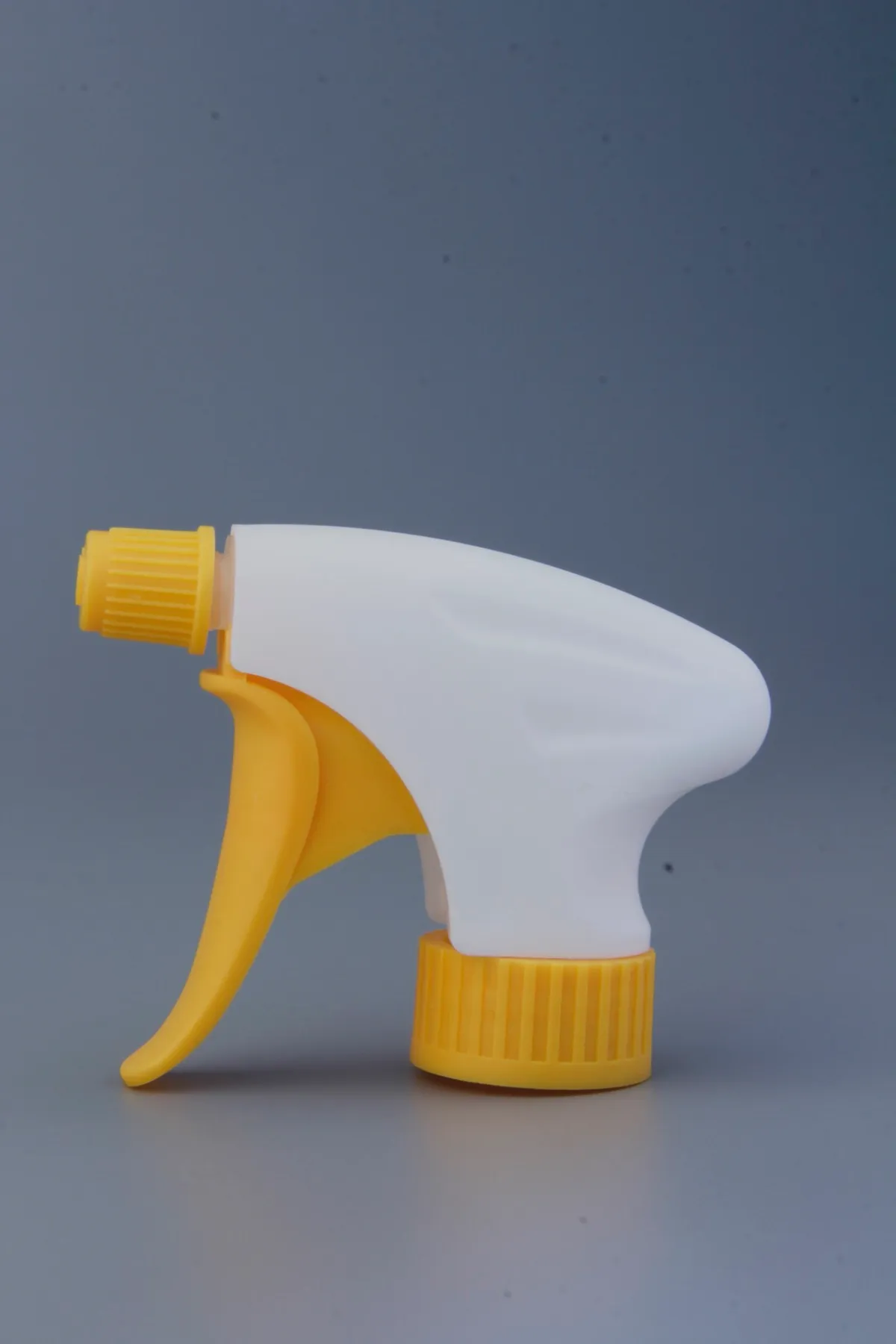
The Chemistry-by-Chemistry Specification Matrix
This is the matrix our engineering team works from when a cleaning brand sends us a formula. It covers every wetted part: every surface the liquid touches between the bottom of the dip tube and the nozzle orifice.
| Formula type | Bottle resin | Seals / gaskets | Spring | Check ball | Venting |
|---|---|---|---|---|---|
| Bleach spray (0.5–3% NaOCl) | HDPE, opaque white or colored (light accelerates hypochlorite breakdown) | EPDM or PE gasket; avoid NBR | External or plastic spring | Glass or PP | Vented closure recommended |
| Alkaline degreaser | HDPE, high-ESCR grade; not PET | EPDM | 316 acceptable for mild formulas; external for pH > 12 | Glass or 316 | Not usually required |
| Citrus / solvent degreaser | Fluorinated HDPE, or PET for low-solvent formulas | FKM (Viton) | External or 316 | Glass | Depends on vapor pressure |
| Acid descaler | HDPE | FKM or EPDM, depending on acid | External or plastic spring | Glass or PP | Not usually required |
| Hydrogen peroxide (3–8%) | HDPE, opaque | EPDM | External; fully metal-free fluid path | Glass or PP | Vented |
| Quat / alcohol disinfectant | HDPE or PET | EPDM or NBR | 304 internal acceptable | Stainless or glass | Not required |
Two notes from our production floor. First, EPDM, not FKM, is the default for bleach. FKM gets specified because it sounds more premium, but it is the better choice for solvents and acids. For a strong oxidizer like hypochlorite, EPDM is usually the safer seal. Second, the matrix is a starting point and not a guarantee. Fragrance oils, co-solvents and surfactant packages change compatibility, which is why the storage test in the next section is not optional.
Looking for a reliable spray bottle supplier?
Get free samples and a factory-direct quote within 12 hours.
Get a Free Quote →Spring, Seal and Check Ball: The Three Parts That Decide Trigger Life
Buyers spend most of their attention on the bottle, which is the part least likely to fail. The trigger has 12–15 components, and three of them decide whether it survives a chemical formula.
1. Spring position: internal vs external
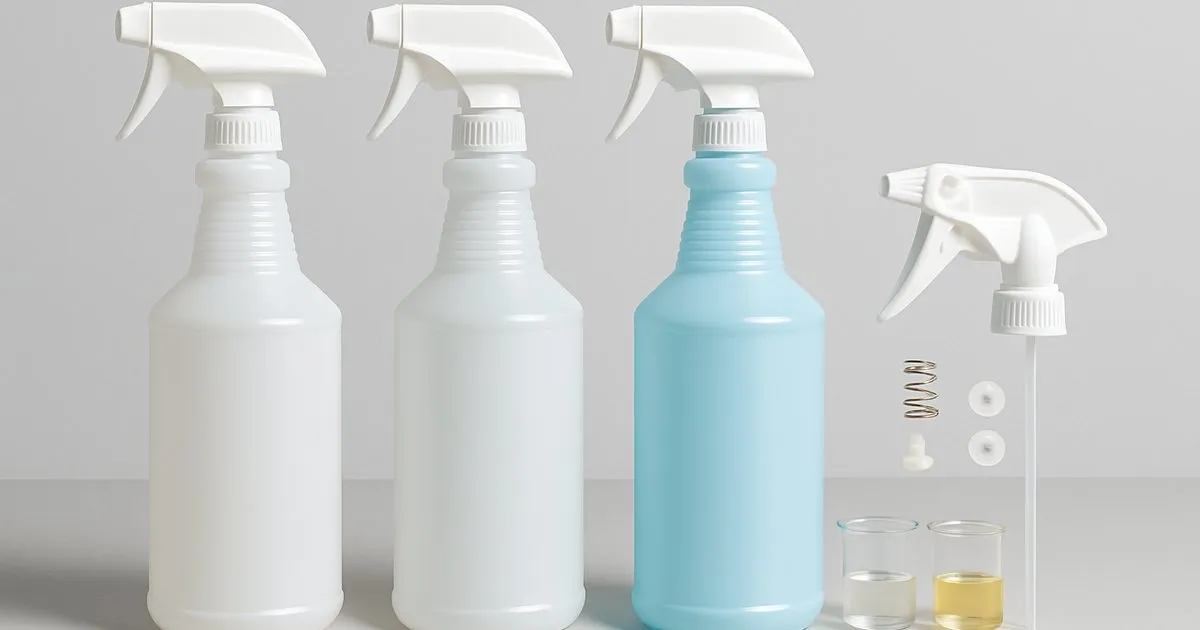
In a standard trigger the return spring sits inside the pump chamber, bathed in liquid on every stroke. That is fine for water. In bleach, even 316 stainless eventually pits, and the corrosion products end up in the spray. An external-spring trigger moves the spring outside the fluid path, so the chemistry never touches metal. For bleach, acid and peroxide formulas we treat external-spring or all-plastic spring designs as the default, not an upgrade.
2. Seal elastomer
The piston seal and the closure gasket are the parts that swell, harden or crack. NBR is cheap and works well with water, oils and isopropyl alcohol, but it degrades in hypochlorite and is only fair with ethanol (see alcohol compatibility of spray bottle seals). EPDM handles bleach, peroxide, caustic and most acids. FKM handles solvents, citrus terpenes and aggressive acids. A trigger with the wrong elastomer will usually pass incoming inspection and then fail on the retailer's shelf 8–12 weeks later.
3. Check ball and valve
The inlet check valve is often a small stainless ball. In corrosive formulas a glass or PP ball removes the last piece of metal from the fluid path. If you also want an anti-drip nozzle and a lockable "OFF" position for shipping, specify both. They add roughly $0.01–0.03 per unit and prevent most in-transit leakage claims.
Not sure which configuration your formula needs? Send us the SDS (safety data sheet) and target pH, and we will recommend a seal, spring and venting spec before you quote anyone. Request a chemical compatibility review →
Bottle Resin and Wall Design
For most cleaning chemicals the answer is HDPE, but "HDPE" covers a wide range of resin grades and wall weights. These are the choices that actually change performance.
| Bottle material | Best for | Avoid with | Typical FOB, 32 oz (946 ml) |
|---|---|---|---|
| HDPE (high-ESCR grade) | Bleach, caustic degreasers, acids, peroxide, quats | High-solvent citrus formulas (permeation and paneling) | $0.15–0.30 |
| Fluorinated HDPE | d-limonene, solvent degreasers, fragranced formulas that lose scent | Budget-driven SKUs; the surface treatment adds cost and lead time | $0.25–0.45 |
| PET | Glass cleaners, quats, alcohol, neutral all-purpose; clear retail look | pH above about 11 (hydrolysis and stress cracking); bleach | $0.14–0.28 |
| PP | Hot-fill, some acids, small sizes | Large squeezable bottles; lower clarity and stiffness | $0.15–0.30 |
Stress cracking deserves more attention than it gets. Surfactant-heavy degreasers are classic stress-cracking agents for polyethylene, and cracks start where the bottle is under the most strain: the base, the handle and the neck. Ask your supplier which resin grade they blow and whether they have ESCR data per ASTM D2561 (the stress-crack test for blow-molded polyethylene containers) or ASTM D1693 (the bent-strip test on the resin). A heavier bottle is not automatically safer. A good resin grade at the right wall distribution beats extra grams of the wrong grade.
If you want a proven 32 oz format without new tooling, standard 28/400 neck finishes accept almost every commercial trigger. Our Type-H trigger sprayer uses that thread, which lets you change bottle suppliers without re-qualifying the head. Our HDPE spray bottle guide covers the resin itself in more depth.
Compatibility Testing: The 4-Week Protocol We Run Before Mass Production
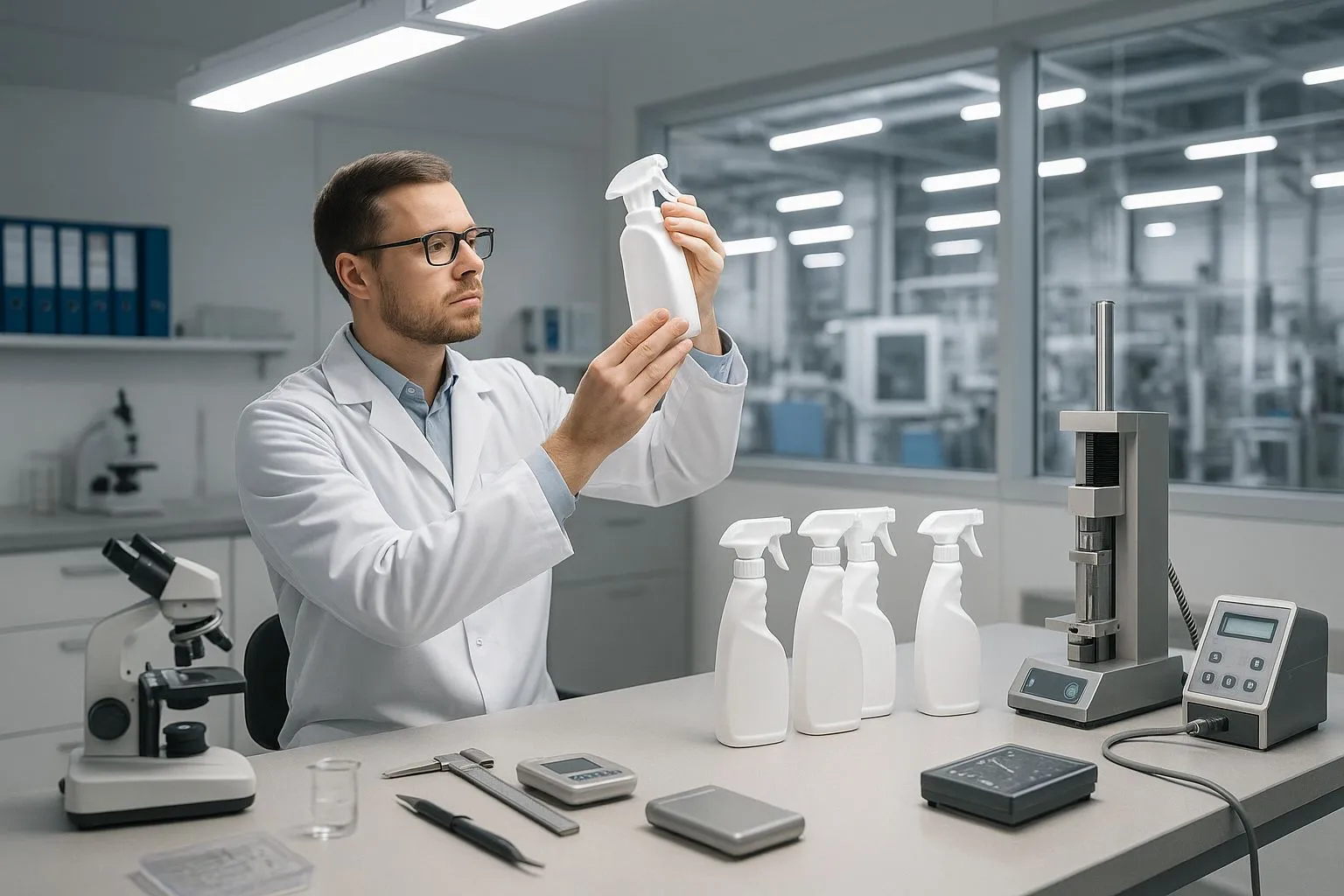
No chart replaces a test in your actual formula. This is the screen we run on customer samples before approving a chemical-duty SKU. Ask any factory you are considering whether it runs something equivalent. Most trading companies will not.
| Test | Condition | Pass criteria |
|---|---|---|
| Accelerated storage | Filled with customer formula, trigger attached, 50°C for 4 weeks (or 40°C for 12 weeks for conservative brands) | No leakage, cracking or visible paneling |
| Weight loss | Weighed before and after storage | Typically under 1% for water-based formulas; set a tighter limit for fragrance-critical products |
| Trigger output drift | ml/stroke measured before and after storage (standard heads deliver 0.8–1.3 ml) | Within ±10% of initial output; primes in 8 strokes or fewer |
| Seal and spring inspection | Trigger disassembled after storage | No seal swelling, no spring discoloration or pitting |
| Leak test | Vacuum leak check on the closure | No bubbles; our production line tests at -60 kPa for 10 seconds on 100% of units |
| Transit simulation | Drop and vibration per ISTA 1A or 3A on a packed carton | No leaks and no cracked bases |
The 50°C / 4-week condition is roughly equivalent to a year at room temperature as an industry rule of thumb, not an exact law. Its real value is that it surfaces the failures that would otherwise show up as returns. We have seen formulas pass a 24-hour soak and then fail in week three because a fragrance co-solvent slowly swelled the piston seal. For a full quality program covering incoming inspection, AQL levels and pre-shipment checks, see our spray bottle quality standards and testing guide.
Regulatory Packaging Requirements by Market
Cleaning chemicals bring packaging obligations that a water-bottle buyer never sees. Most of them fall on your brand, not the factory, but they change what you order.
| Market | Rule | What it means for the bottle and trigger |
|---|---|---|
| United States | FIFRA (EPA registration for disinfectant or sanitizer claims; labeling under 40 CFR Part 156) | Label panel space and durability; the packaging described in the registration must match what you ship |
| United States | PPPA, 16 CFR 1700 (child-resistant packaging for listed hazardous household substances) | Some corrosive formulas need a child-resistant trigger or closure; confirm before you order standard heads |
| United States | OSHA HCS, 29 CFR 1910.1200 (GHS labeling for workplace chemicals) | Janitorial and industrial SKUs need GHS pictograms, so plan the label area on the bottle |
| European Union | CLP Regulation (EC) 1272/2008, Annex II Part 3 | Child-resistant fastenings (EN ISO 8317) and tactile warnings (EN ISO 11683) for certain hazard classes sold to consumers |
| United Kingdom | GB CLP | Same practical requirements as EU CLP |
The practical point: decide on child-resistance before tooling or ordering. Child-resistant triggers and closures exist in standard 28/400 and 28/410 finishes, but they cost more, and adding them after launch means re-qualifying the package. We are a packaging manufacturer, not a regulatory consultant, so confirm the classification of your specific formula with your regulatory advisor.
Price, MOQ and Lead Time: Real Numbers
| Component | Typical FOB China | MOQ | Lead time |
|---|---|---|---|
| Standard 28/400 PP trigger (NBR seals, internal spring) | $0.07–0.12 | 5,000 pcs | 15–20 days |
| Chemical-resistant trigger (EPDM or FKM, external spring, glass ball) | $0.18–0.35 | 5,000–10,000 pcs | 20–30 days |
| Child-resistant trigger or closure upgrade | Add roughly $0.05–0.15 | 10,000 pcs | 25–35 days |
| 32 oz HDPE bottle, stock mold, white or natural | $0.15–0.30 | 5,000–10,000 pcs | 15–25 days |
| Custom trigger color (Pantone match) | Masterbatch cost included in unit price | 10,000 pcs per color | +5–7 days |
| New custom bottle mold | Tooling is a separate quote, driven by size and cavitation | Usually 20,000+ pcs to justify | 35–50 days |
These are indicative ranges at 20,000–50,000 pieces and move with resin prices and specification. Two cost levers matter most. First, the chemical-resistant upgrade is concentrated in the trigger. On a 32 oz package it adds roughly 10–20 cents per unit, which is small next to the retail price of a cleaning SKU and very small next to a recall. Second, use existing bottle tooling for your first runs. A custom color, printed label and branded trigger will make a stock 32 oz bottle look proprietary. Only cut a new mold once the SKU has proven itself. The landed-cost side, including duty, freight and container planning for cleaning brands, is covered in our bulk spray bottle sourcing guide for cleaning product companies.
How to Write an RFQ That Gets a Comparable Quote
"Please quote 32 oz chemical resistant spray bottle, 20,000 pcs" will get you five quotes for five different products. A cleaning-chemical RFQ that produces comparable numbers contains these lines:
- Formula family, active concentration and pH, e.g. "sodium hypochlorite 2%, pH 12.5". Attach the SDS.
- Bottle: volume, resin (HDPE, fluorinated HDPE or PET), color, neck finish (28/400 or 28/410)
- Trigger: output per stroke (e.g. 1.0–1.3 ml), nozzle pattern (spray, stream, foam), lock position
- Wetted materials: seal elastomer, spring position (internal or external), check ball material
- Venting: vented or non-vented closure
- Child-resistance: required or not, and for which market
- Test requirement: e.g. "50°C / 4 weeks in buyer formula, report weight loss and output drift"
- Packing: bottles and triggers shipped separately, or pre-assembled
If a supplier cannot answer line 4, they are reselling someone else's trigger. That single question will shorten a supplier list faster than any factory audit. Our trigger sprayer buying guide covers output and closure specs in more detail. Our list of verified spray bottle manufacturers in China is a useful shortlist if you want to benchmark several factories.
Frequently Asked Questions
What type of spray bottle is safe for bleach?
An opaque HDPE bottle with a trigger that has EPDM seals, a spring outside the fluid path or made of plastic, and a glass or plastic check ball. A vented closure is recommended, because sodium hypochlorite slowly releases oxygen and can pressurize a sealed bottle. Avoid PET bottles and standard triggers with NBR seals and internal 304 stainless springs.
Can I use a PET spray bottle for degreaser?
Only for neutral or mildly alkaline formulas. PET hydrolyzes and can stress-crack at pH above about 11, so strongly alkaline or caustic degreasers belong in high-ESCR HDPE. For citrus or d-limonene solvent degreasers, fluorinated HDPE or PET is used because solvents permeate and panel plain HDPE.
Which seal material should a chemical-resistant trigger sprayer use?
EPDM for bleach, hydrogen peroxide, caustic and most water-based acids. FKM (Viton) for solvents, citrus terpenes and aggressive acids. NBR is acceptable only for water, isopropyl alcohol and oil-based products; use EPDM for high-ethanol formulas. Specify the elastomer by name on your purchase order, because "chemical resistant" alone is not a specification.
Why do trigger sprayers stop working with bleach?
Usually because the internal stainless steel return spring and check ball corrode in hypochlorite, and NBR piston seals harden and crack. The trigger loses return force, the valve stops closing and rust particles appear in the spray. External-spring triggers with EPDM seals and a metal-free fluid path solve this.
How much does a chemical-resistant trigger sprayer cost?
Typically $0.18–0.35 FOB China at 20,000–50,000 pieces, compared with $0.07–0.12 for a standard 28/400 trigger. A 32 oz HDPE bottle adds $0.15–0.30, or $0.25–0.45 for fluorinated HDPE. MOQ is usually 5,000–10,000 pieces, with 20–30 days lead time.
How do I test spray bottle chemical compatibility before ordering?
Fill samples with your actual formula, attach the triggers and store them at 50°C for 4 weeks, or at 40°C for 12 weeks. Then check weight loss, leakage, cracking, paneling, discoloration and trigger output drift, and disassemble one trigger to inspect the seals and spring. A capable factory will run this on your formula before mass production.
Do bleach and disinfectant spray bottles need child-resistant triggers?
It depends on the formula and the market. In the US, certain hazardous household substances require child-resistant packaging under the PPPA (16 CFR 1700). In the EU, CLP Annex II Part 3 requires child-resistant fastenings and tactile warnings for certain hazard classes sold to the public. Confirm your formula's classification before ordering, because child-resistant triggers cost more and must be qualified with the bottle.
Related Guides
- HDPE Spray Bottles: Chemical Resistance and Industrial Applications
- Trigger Sprayer Buying Guide: Output, Closure Sizes and Compatibility
- Bulk Spray Bottles for Cleaning Product Companies
- HDPE vs PET vs PP Spray Bottles
- Spray Bottle Samples: Testing and Approval
- Trigger Sprayers: Full Product Range
Get a Chemical-Duty Spray Package Quoted
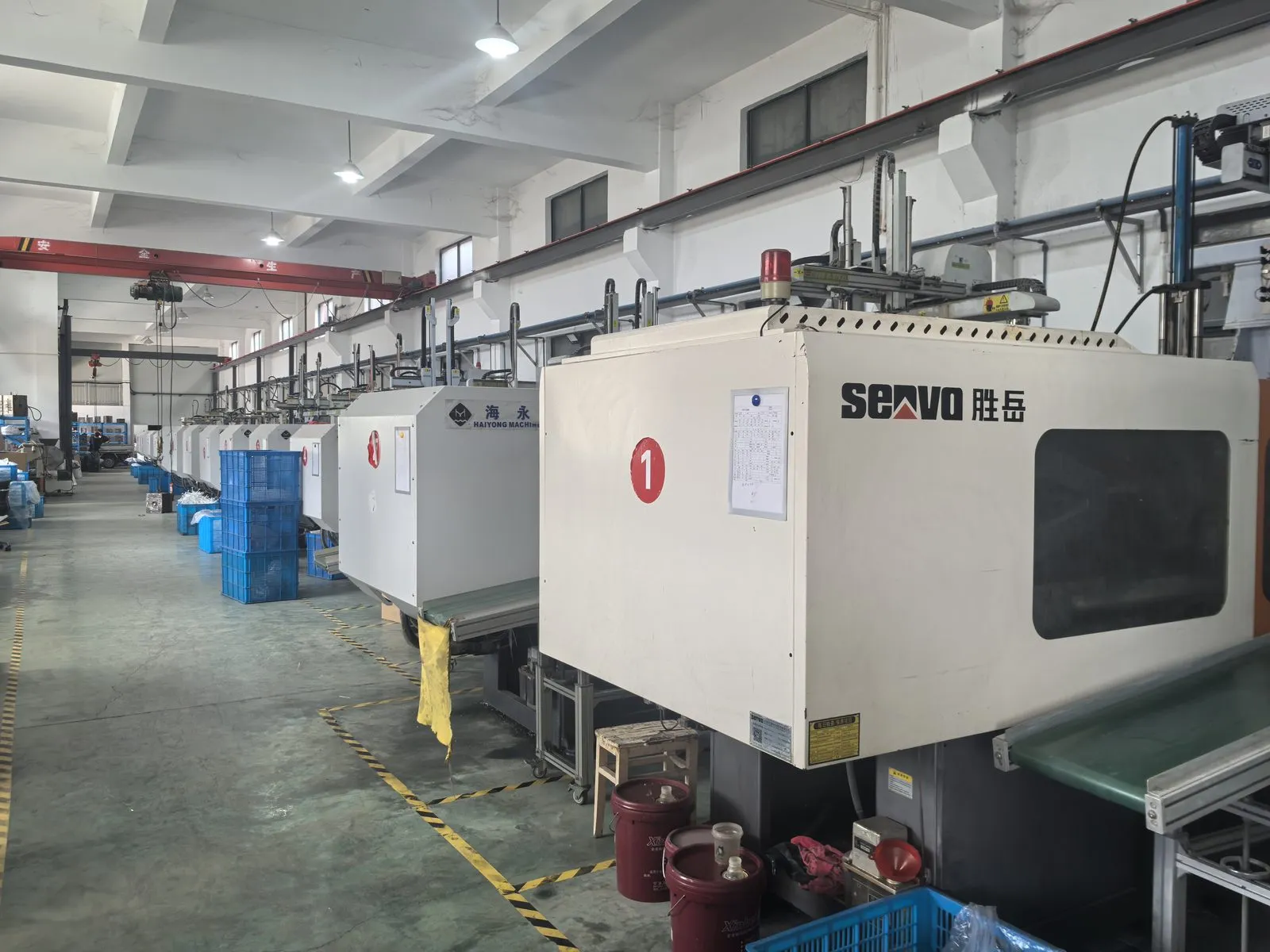
Desiky manufactures trigger sprayers and spray bottles in Yuyao, China, under ISO 9001 process control. We 100% leak-test every unit and have monthly capacity of more than 500,000 units. Send us your formula type, pH, target bottle size and markets. We will recommend the seal, spring and venting configuration, run the compatibility test on your formula, and send a per-component quote within 12 hours.