Quick Answer: Every Soap Dispenser Is Defined by 4 Independent Choices
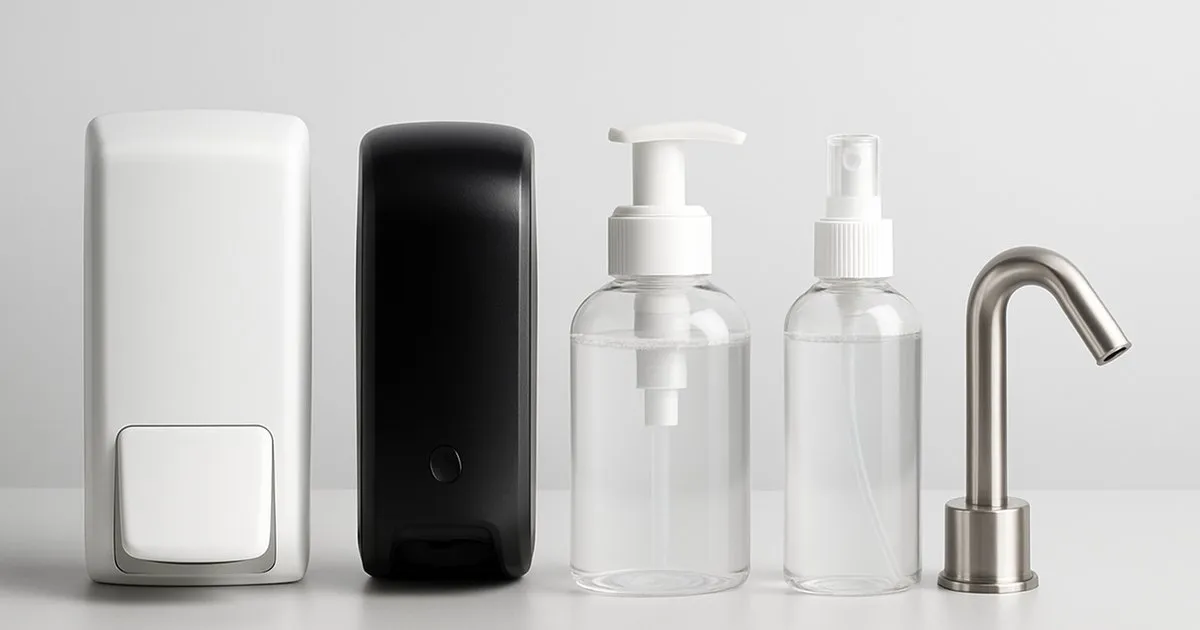
Most "types of soap dispensers" articles hand you one long list and leave you to sort it out. That list is misleading, because a dispenser is not one type — it is four decisions stacked on top of each other, and they can be mixed in almost any combination:
- Dispensing mechanism — liquid pump, foam pump, spray/mist, or automatic (touchless).
- Installation — wall-mounted, deck-mounted, countertop, or free-standing.
- Refill system — bulk-fill (top-off), sealed cartridge, or bottle swap.
- Soap format — liquid, foam concentrate, gel, spray, or abrasive/pumice.
A touchless, wall-mounted, sealed-cartridge foam dispenser and a manual, countertop, bulk-fill foam dispenser are both "foam dispensers" — but they cost different amounts, serve different buildings, and use completely different pump hardware inside.
We make the pumps and bottles that go inside these units at our factory in Yuyao, China, so this guide is written from the component side: what actually differs mechanically, what each combination costs per wash, and which one to specify for your facility or your private-label line.
Types of Soap Dispensers by Dispensing Mechanism
This is the decision that changes the hardware. Everything else is housing and logistics.
1. Liquid Pump Dispensers (Lotion Pumps)
The default. A piston pump with a spring and a ball valve draws soap up a dip tube and pushes a measured slug out the actuator. Standard output is 0.5–2.0 ml per stroke, with 1.0 ml being the most-specified dose for hand soap. Neck finishes are typically 24/410, 28/410 or 28/415.
Liquid pumps handle a wide viscosity band — roughly 500 to 8,000 cP — which is why they also work for lotions, sanitizer gels and shampoos. They are the cheapest mechanism to build and the least likely to clog.
2. Foam Pump Dispensers
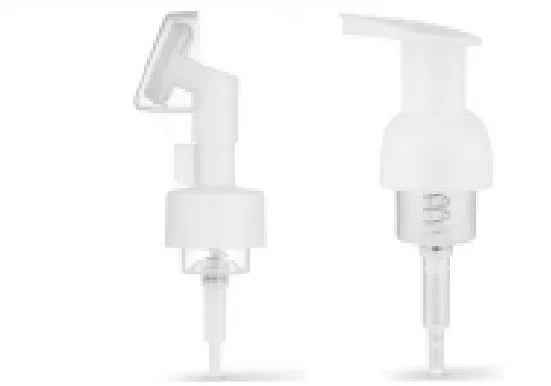
A foam pump is two pumps in one body: a small liquid chamber and a much larger air chamber. On each stroke both fire simultaneously, and the liquid-air mixture is forced through two nylon mesh screens (typically 150–200 mesh) that shear it into microbubbles. The typical air-to-liquid ratio is 1:6 to 1:10, so 0.4–0.8 ml of concentrate becomes 3–8 ml of foam.
Two consequences buyers routinely miss:
- Foam pumps need wide necks. The air chamber does not fit a 28 mm neck. Foamers run on 40/410, 42/410 or 43/410 finishes. You cannot screw a foamer onto a standard lotion bottle.
- Foam pumps need thin soap. Above roughly 200–300 cP the mesh blinds off and the foam collapses. Foam concentrate is a different SKU from liquid soap, not the same soap diluted by accident.
Full specification detail is in our foam pump selection guide, and the mechanism is broken down step by step in how foaming soap dispensers work.
3. Spray / Mist Dispensers
A fine-mist sprayer atomizes soap through a swirl chamber and a 0.15–0.25 mm orifice, delivering 0.10–0.16 ml per stroke — roughly one-tenth of a liquid dose. Spray soap is niche in restrooms but standard in three places: waterless sanitizer stations, food-service hand-sanitizing points, and salon/spa amenity lines where a light film is wanted rather than a lather.
Sprayers are the most clog-prone of the three manual mechanisms because the orifice is the smallest. Any soap with suspended beads, exfoliants or high salt content will eventually block one. Orifice and output data for every nozzle we tool is on our spray nozzle specifications page.
4. Automatic (Touchless) Dispensers
An infrared sensor triggers a small DC motor or solenoid that drives a gear pump or a peristaltic squeeze. Detection range is usually 50–120 mm, with a dispense cycle under one second and a 1–2 second lockout to prevent double-dosing.
Automatic units come in liquid, foam and spray variants — the sensor replaces your hand, not the pump physics. Battery life on 4×AA alkaline runs roughly 8,000–20,000 activations depending on dose size, which is 6–12 months in a moderately busy restroom. Touchless is the only option that eliminates contact with the actuator surface entirely, which is why it dominates healthcare, food processing and airport specifications.
Mechanism Comparison
| Mechanism | Dose per stroke | Neck finish | Viscosity limit | Unit cost (FOB) | Best for |
|---|---|---|---|---|---|
| Liquid pump | 0.5–2.0 ml | 24/410, 28/410, 28/415 | up to ~8,000 cP | $0.09–$0.18 | General purpose, lotions, gels |
| Foam pump | 0.4–0.8 ml → 3–8 ml foam | 40/410, 42/410, 43/410 | ~200–300 cP | $0.16–$0.32 | High-traffic restrooms, kids, cost control |
| Fine-mist sprayer | 0.10–0.16 ml | 20/410, 24/410 | ~100 cP | $0.07–$0.13 | Sanitizer, salon amenity, waterless |
| Automatic (touchless) | 0.4–1.5 ml (programmable) | Unit-specific | Depends on pump fitted | $4.50–$18.00 (full unit) | Healthcare, food plants, public transit |
Pump prices are FOB Ningbo for the pump component at 10,000+ pcs. Automatic prices are for complete assembled units. Request a quote for your exact spec and volume.
Looking for a reliable spray bottle supplier?
Get free samples and a factory-direct quote within 12 hours.
Get a Free Quote →Types of Soap Dispensers by Installation
Installation drives capacity, refill access, and — in North America — accessibility compliance.
| Installation | Typical capacity | Install effort | Theft/tamper risk | Where it wins |
|---|---|---|---|---|
| Wall-mounted | 800–1,600 ml | 2 screws or 3M VHB tape | Low (locked housing) | Public restrooms, schools, offices |
| Deck-mounted | 500–1,000 ml (under-counter reservoir) | Requires a 32–38 mm counter hole | Very low | Hotels, upscale washrooms, new builds |
| Countertop / free-standing | 250–500 ml | None | High | Retail, salons, homes, private-label brands |
| Free-standing floor stand | 1,000–5,000 ml | Assemble base | Medium | Entrances, events, temporary stations |
ADA note for US specifiers: the ADA Standards for Accessible Design require operable parts to be within reach range — no higher than 1,220 mm (48 in) above the finished floor for a forward approach (§308) — and operable with no more than 22.2 N (5 lbf) of force, with no tight grasping, pinching or wrist twisting (§309.4). Push-bar and touchless dispensers pass this comfortably; some stiff-spring countertop pumps do not.
Types of Soap Dispensers by Refill System
This is where facilities managers lose or save the most money, and it is the axis competitors' guides describe but never cost out.
Bulk-Fill (Top-Off)
You open the housing and pour soap from a jug into an open reservoir. Lowest soap cost per litre by a wide margin. Two real costs sit behind that: refill labor, and contamination risk. In a widely cited survey of more than 500 bulk-fill dispensers in public washrooms, roughly 25% carried bacterial contamination above accepted safe limits — because an open reservoir topped off with a jug is, functionally, an open container.
Sealed Cartridge
A pre-filled, factory-sealed pouch or cartridge carries its own pump or valve. You drop it in and close the lid. Soap costs roughly 2–3× more per litre, but the reservoir is never opened to air, and a swap takes about 6 seconds versus ~30 seconds for a bulk top-off — with no spills to wipe up. In a portfolio of dozens of restrooms serviced daily, that difference compounds into real headcount.
Bottle Swap
The whole bottle-and-pump assembly is replaced. Common in retail and private-label consumer products rather than institutional settings — this is the format most of our brand customers order, because the bottle is the shelf presence.
Cost Per 1,000 Hand Washes — The Real Math
| System | Dose | Soap used / 1,000 washes | Soap price | Soap cost | Refill labor |
|---|---|---|---|---|---|
| Bulk-fill liquid | 1.0 ml | 1,000 ml | ~$3.20 / L | $3.20 | ~1 top-off × 30 s |
| Bulk-fill foam | 0.5 ml | 500 ml | ~$3.70 / L | $1.85 | ~0.5 top-off × 30 s |
| Sealed cartridge foam | 0.4 ml | 400 ml | ~$9.00 / L | $3.60 | ~0.4 swap × 6 s |
| Touchless bulk foam | 0.4 ml | 400 ml | ~$3.70 / L | $1.48 | + battery replacement 1–2×/yr |
Read that table honestly and two conclusions fall out. Switching from bulk liquid to bulk foam cuts soap spend by about 42% — the single highest-return change most facilities can make, and it costs nothing but a pump changeover. And sealed cartridges cost roughly as much per wash as bulk liquid, so the case for cartridges is never the soap bill; it is labor hours and contamination liability. If your janitorial labor is expensive or your building is a hospital, cartridges win. If you are a school district with in-house custodial staff, bulk foam wins.
We break down unit economics and dispenser hardware pricing further in our commercial soap dispenser pricing guide.
Types of Soap That Go Into Them (and What Fits What)
The "explain the different types of soap for commercial dispensers" question is really a compatibility question. Putting the wrong soap in the right dispenser is the most common failure we get sent samples for.
| Soap format | Typical viscosity | Liquid pump | Foam pump | Sprayer | Notes |
|---|---|---|---|---|---|
| Liquid hand soap | 1,000–3,000 cP | ✅ Ideal | ❌ Blinds the mesh | ❌ Too thick | Most common institutional soap |
| Foam concentrate | 50–200 cP | ⚠️ Works but runs/drips | ✅ Ideal | ⚠️ May foam in the nozzle | Must be low-viscosity and low-salt |
| Gel soap | 3,000–8,000 cP | ✅ Ideal | ❌ No | ❌ No | Also standard for sanitizer gel |
| Spray / liquid sanitizer | 1–20 cP | ⚠️ Will siphon out | ❌ No | ✅ Ideal | High alcohol needs EPDM/PP-compatible seals |
| Creme / lotion soap | 4,000–10,000 cP | ✅ With 2.0 ml pump | ❌ No | ❌ No | Needs a wider dip tube ID |
| Pumice / abrasive | Suspension | ❌ Abrades the seal | ❌ No | ❌ No | Requires a dedicated heavy-duty pump |
One compatibility warning worth its own line: alcohol-based sanitizers attack the wrong elastomers. If you are filling with 60–80% ethanol or IPA, specify gaskets and valve seats rated for it and verify with an ASTM D543 chemical-resistance immersion test before you commit to a production run. Standard nitrile gaskets swell and start weeping within weeks.
How to Tell If a Soap Dispenser Is Foaming — the 30-Second Test
Buyers ask us this constantly, usually because they inherited a building full of unlabeled dispensers. Three checks, no tools:
- Look at the neck diameter. A foamer's collar is visibly wider — 40 mm or more across, versus about 28 mm for a liquid pump. Side by side the difference is unmistakable.
- Look up the spout. A foamer has a visible white or off-white mesh disc set back inside the outlet. A liquid pump is a plain open bore.
- Pump it dry. Remove the dip tube from the soap and stroke it. A foam pump moves a noticeable volume of air and hisses. A liquid pump pulls a partial vacuum and goes almost silent after two or three strokes.
A fourth clue: if the label says "foaming hand soap" and the dispenser produces a thin runny stream instead of lather, the soap and pump are mismatched — that is a wrong-refill problem, not a broken dispenser. Our complete foam soap dispenser guide covers the troubleshooting sequence.
What We Test Before a Dispenser Pump Ships
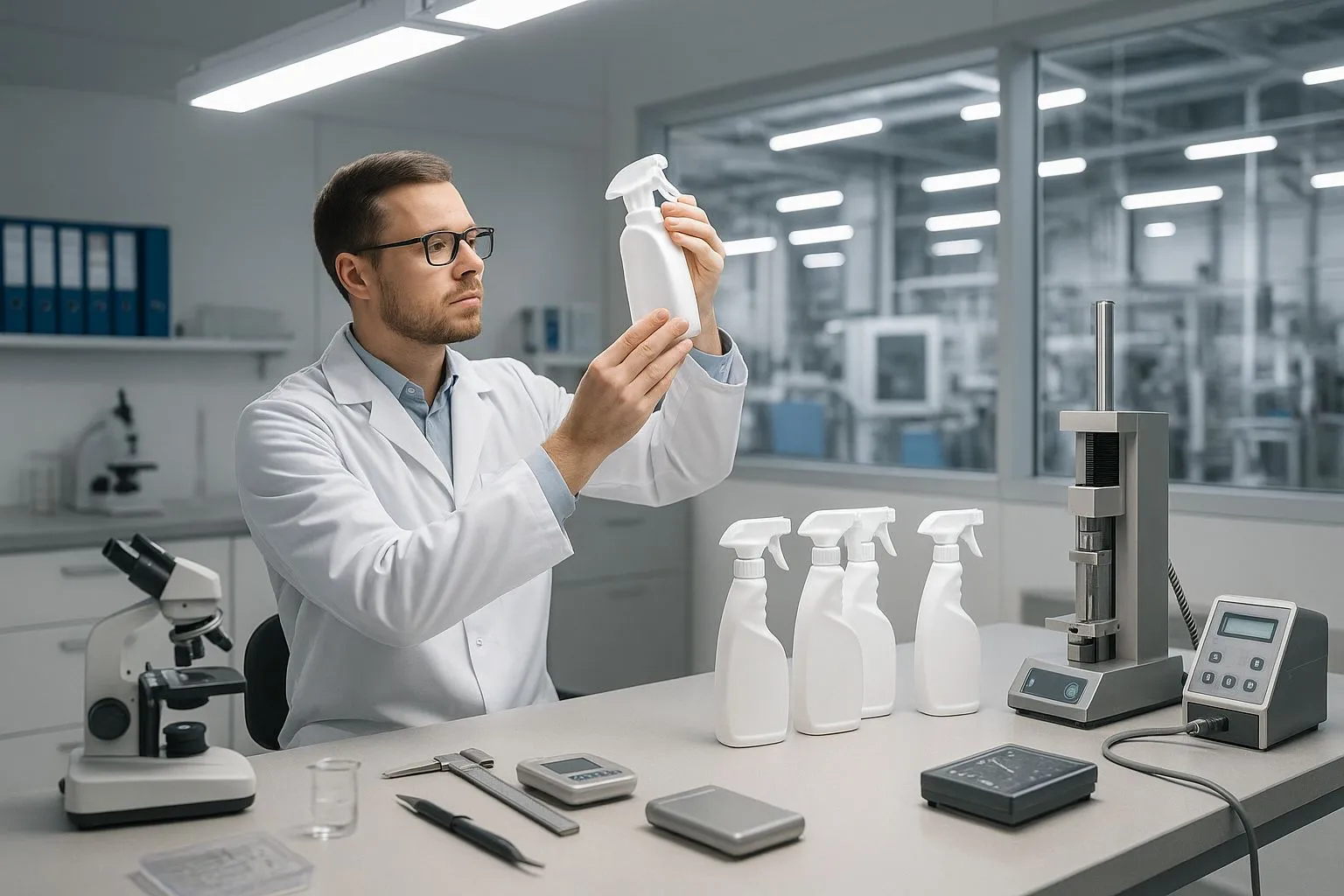
This is the part no retail guide will tell you, and it is exactly what separates a $0.16 foam pump from a $0.32 one. Our standard QC protocol on every soap dispenser pump program:
- Stroke life: 3,000 cycles minimum for consumer bottle-swap programs, 10,000 cycles for institutional wall units, with no loss of prime and no housing crack.
- Dosage accuracy: ±10% of nominal output across the run, measured gravimetrically every 500 strokes.
- Prime-up: full output within 5 strokes from dry.
- Leak/vacuum: inverted 24-hour hold with zero weep at the closure.
- Torque retention: closure torque checked at 12–18 in-lbf after a 48-hour set, so units do not loosen in transit.
- Chemical compatibility: 7-day immersion in the customer's actual formulation per ASTM D543 — we ask every customer to send 500 ml of their real soap, not a substitute.
Production runs under an ISO 9001 quality system, with food-contact-grade resin options available on request for food-service and personal-care applications.
Choosing by Facility Type
| Facility | Mechanism | Install | Refill | Why |
|---|---|---|---|---|
| Hospital / clinic | Touchless foam | Wall | Sealed cartridge | Contamination control outranks soap cost |
| School / university | Manual foam | Wall | Bulk-fill | Foam cuts waste from over-pumping; in-house custodial labor |
| Restaurant / food service | Touchless foam | Wall | Sealed cartridge | Health-code inspection exposure |
| Office building | Manual or touchless foam | Wall or deck | Bulk-fill | Moderate traffic, cost-driven |
| Hotel guest bath | Liquid or foam | Deck or countertop | Bottle swap | Guest-facing aesthetics lead |
| Manufacturing / workshop | Heavy-duty pumice | Wall | Bulk-fill | Grease and particulate removal |
| Retail private label | Foam or liquid | Countertop | Bottle swap | The bottle is the product |
MOQ, Pricing and Lead Times for OEM Dispenser Programs
If you are sourcing dispensers or dispenser components rather than buying them at retail, these are our current terms, FOB Ningbo:
| Scope | MOQ | Tooling cost | Lead time |
|---|---|---|---|
| Stock pump + stock bottle, stock color | 3,000 sets | None | 15–20 days |
| Stock mold, custom color matched to Pantone | 10,000 sets | None | 25–35 days |
| Stock mold + silk-screen or heat-transfer logo | 5,000 sets | $150–$400 plate/film | 25–30 days |
| New custom bottle or actuator mold | 30,000–50,000 sets | $3,000–$12,000 | 45–60 days (incl. T1/T2 samples) |
Add 25–35 days for sea freight to US and EU ports. Sample lead time on stock items is 5–7 days; we ship samples in your intended soap formulation whenever you can supply it. Request samples here.
Common Mistakes We See in Dispenser Specs
- Speccing a foamer without checking the bottle neck. A 43/410 pump will not fit a 28/410 bottle. This kills more programs at the sample stage than any other single error.
- Using liquid soap in a foam dispenser to "save money." It blinds the mesh in days and generates warranty returns that cost far more than the soap saved.
- Buying touchless for a low-traffic restroom. Below roughly 50 washes/day, the battery and electronics cost never pays back against a $2 manual unit.
- Ignoring the ADA reach range on wall installs. Retrofitting mounting heights across a building is far more expensive than getting it right on the drawing.
- Approving a sample without a 24-hour inverted leak test. Pumps that pass on a bench routinely weep in an ocean container.
Frequently Asked Questions
What are the main types of soap dispensers?
By mechanism there are four: liquid pump, foam pump, spray/mist, and automatic touchless. Each of those can then be wall-mounted, deck-mounted, countertop or free-standing, and fed by bulk-fill, sealed cartridge or bottle swap. Most real-world products are a combination of one choice from each of those three axes.
How do soap dispensers work?
A manual dispenser uses a spring-loaded piston pump. Pressing the actuator compresses a chamber, closes an inlet ball valve and forces soap out through the outlet; releasing it reopens the inlet and draws the next dose up the dip tube by vacuum. A foam pump adds a parallel air chamber and pushes the air-soap mixture through two mesh screens. An automatic dispenser replaces the hand pressure with an infrared sensor triggering a small motor.
Is a foam or liquid soap dispenser better?
For hand washing in commercial restrooms, foam is better on cost and waste — it uses 0.4–0.8 ml of concentrate per dose versus 1.0–2.0 ml of liquid, cutting soap spend roughly 40–60%. Liquid is better where you need a thicker product, a moisturizing creme, or a sanitizer gel, and where the soap supply chain is already standardized on liquid.
What is the difference between a bulk-fill and a sealed cartridge dispenser?
Bulk-fill has an open reservoir you pour soap into; sealed cartridge uses a pre-filled, factory-sealed pouch you drop in. Bulk-fill soap costs roughly one-third as much per litre, but takes about 30 seconds per refill and carries measurable contamination risk. Cartridges swap in about 6 seconds, stay sealed, and cost 2–3× more per litre of soap.
How can I tell if a soap dispenser is foaming?
Check three things: the neck collar is 40 mm or wider (versus ~28 mm for liquid), there is a visible mesh disc inside the spout, and pumping it dry moves audible air. If all three are true it is a foamer and needs low-viscosity foam concentrate, not standard liquid soap.
What soap can I use in an automatic dispenser?
Whatever the internal pump is built for — touchless units come in liquid, foam and spray versions. Check the label or the refill part number. Filling a touchless foam unit with thick liquid soap will stall the motor and drain the batteries, which is one of the most common "the sensor broke" service calls.
What is the MOQ for OEM soap dispenser bottles and pumps?
3,000 sets on stock molds in stock colors, 10,000 sets for a custom Pantone-matched color, and 30,000–50,000 sets if a new mold is required. Tooling for a new bottle or actuator runs $3,000–$12,000 depending on cavitation and complexity.
How long do soap dispenser pumps last?
We validate consumer-grade pumps to 3,000 strokes and institutional wall-unit pumps to 10,000 strokes with no loss of prime. At a typical 20 washes per day, a 10,000-stroke pump has well over a year of service life; institutional dispensers usually outlive several refill cycles and fail at the housing or hinge before the pump does.
Related Guides
- Foam Soap Dispenser: How It Works, 7 Types Compared & 60% Soap Savings
- Foam Pump Selection Guide: Specifications & Sourcing
- Commercial Soap Dispenser Pricing Guide
- How Do Foaming Soap Dispensers Work?
- Spray Nozzle Specifications & Output Data
- Foam Pumps — Product Range
- Cosmetic & Personal Care Bottles
Get a Quote on Soap Dispenser Bottles and Pumps
Desiky manufactures foam pumps, lotion pumps, fine-mist sprayers and the PET, PP and HDPE bottles they mount on, from our factory in Yuyao, China. If you are specifying a dispenser program — private label, institutional, or a component swap on an existing bottle — send us the soap formulation, the target dose and the neck finish you are working with, and we will come back with matched hardware, a sample set and FOB pricing.