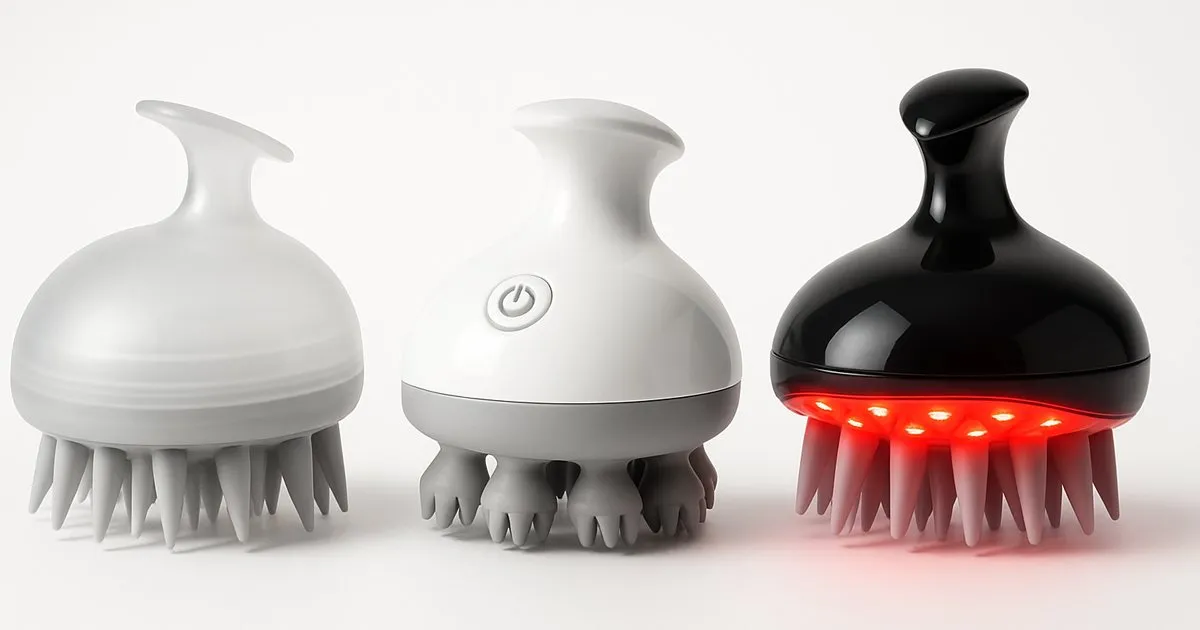
Search "3-in-1 scalp massage brush" and the results blur three completely different products into one listing style: a soft silicone dome with a liquid reservoir, a battery-powered brush that buzzes when you press a button, and a brush with a ring of red LEDs glowing under the bristles. Alibaba galleries mix all three under the same title. Amazon reviews for one variant get left on listings for another. Buyers assume it is one product with optional add-ons.
It is not. These are three different manufacturing categories — injection-molded silicone, battery/motor electronics, and LED-driven electronics — built on different tooling, by suppliers with different core competencies, at different price points and different regulatory exposure. We manufacture the first type, the passive silicone-bristle 3-in-1 brush, in Yuyao, China. We do not build the electronic versions, and that is exactly why we can tell you plainly what separates them and what to check before you commit a PO to any of the three.
Quick Answer
- Silicone-bristle brush: injection-molded PP body + overmolded silicone bristles (typically 30–40 Shore A), no battery, no moving parts. MOQ from 3,000 pcs, tooling $3,000–8,500, FOB commonly $0.35–0.90/pc at volume.
- Vibration-motor brush: coreless DC micro-motor + lithium battery or AAA cells + PCBA, IPX7 shower-safe housing. MOQ typically 500–1,000 pcs from electronics-capable factories, FOB commonly $1.80–3.50/pc.
- Red-light / LED brush: 3–6 red LEDs (commonly 650–660 nm) plus driver PCB, often combined with a vibration motor. FOB commonly $3.00–6.00/pc, and it carries the highest regulatory exposure of the three.
- "Promotes hair growth" is the phrase that changes everything. In the US, red/near-infrared devices marketed to treat androgenetic alopecia — HairMax, Theradome, Capillus, iGrow — are cleared by FDA as Class II medical devices under 510(k). A supplier or brand making that claim without clearance is taking on real regulatory risk.
- The MOQ and tooling gap is the fastest way to spot a reseller. A factory that quotes 500 pcs on a silicone-only brush, or 3,000 pcs on a lithium-battery version with no PCBA lead time, is almost never the one running the tooling.
One Listing Name, Three Different Bills of Materials
Strip away the marketing and each "3-in-1 scalp massage brush" is defined by what sits under the bristles:
- Nothing — the bristles themselves do the massaging, and the "3-in-1" refers to massage + product application (via a built-in reservoir) + shampooing.
- A motor — a small DC vibration motor adds mechanical stimulation on top of the bristles, powered by a battery.
- A motor and LEDs — the same electronics core, plus a driver circuit for a ring of red or red/blue LEDs under the bristle bed.
Each of those three bills of materials sits inside a different production line. A silicone-bristle brush is two processes — injection molding the PP shell, then either overmolding or press-fitting the silicone bristle mat — run entirely inside a plastics factory. A vibration or LED version adds SMT (surface-mount PCB assembly), motor or LED sourcing, battery integration, and IPX waterproofing testing — a different skill set that most plastics-only factories subcontract rather than run in-house.
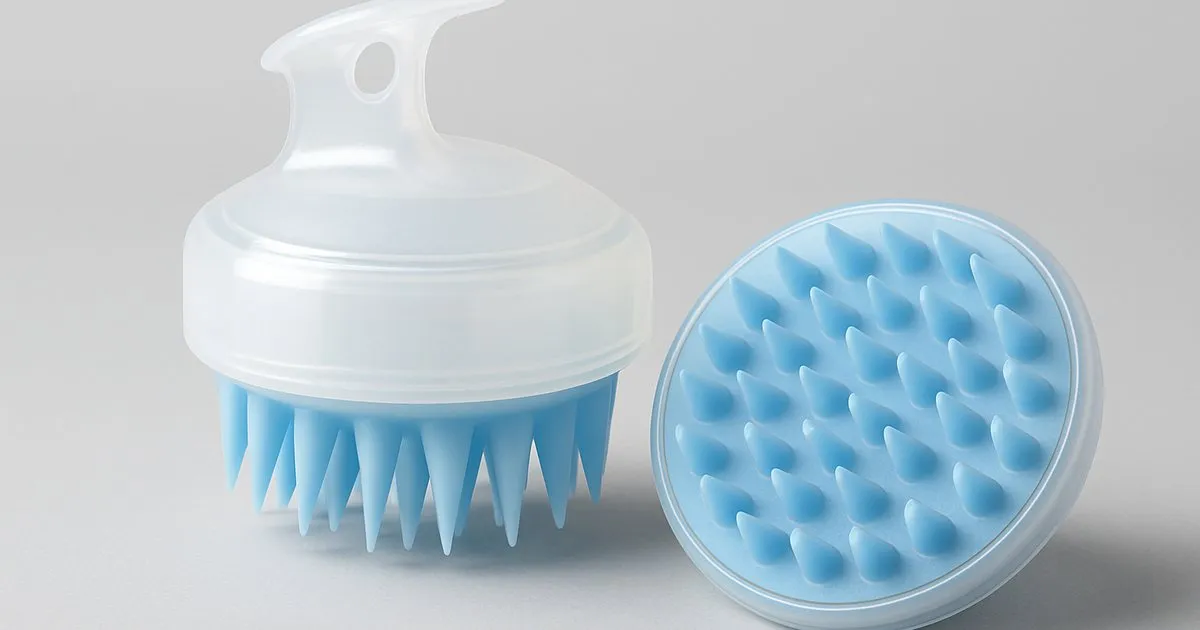
Type 1: Passive Silicone-Bristle Brush
This is what we manufacture. The body is PP; the bristles are silicone, typically specified between 30 and 40 Shore A — soft enough to feel gentle on the scalp, firm enough to hold their shape through thousands of shampoo cycles. A hollow reservoir behind the bristles lets the user fill it with shampoo, scalp tonic, or medicated oil and dispense it through the bristle tips while massaging, which is the actual meaning of "3-in-1": massage, apply, and cleanse in one motion.
There is no motor, no battery, no circuit board, and nothing to charge. Our own YC-030 runs a 3,000-piece MOQ, a 15–25 day lead time, and a tooling cost commonly in the $3,000–8,500 range depending on cavity count and whether the reservoir needs a secondary core. Because the only material in contact with the liquid is PP and silicone, food-contact-grade compliance (FDA 21 CFR 177.2600 for silicone, LFGB in the EU) is the extent of what a buyer needs to request — there is no electronics compliance chain at all.
Looking for a reliable spray bottle supplier?
Get free samples and a factory-direct quote within 12 hours.
Get a Free Quote →Type 2: Battery-Powered Vibration-Motor Brush
Add a coreless DC vibration motor — commonly rated in the low thousands to around 8,000 RPM in listings we reviewed — a lithium battery or a pair of AAA cells, a small PCB to switch between 2–3 intensity modes, and a sealed, IPX7-rated housing so the unit survives shower use. The silicone bristles are usually similar to Type 1, but they are now mounted around a rigid electronics core instead of a hollow reservoir, which is why most vibration versions drop the liquid-dispensing function.
Because this is an assembled electronic product, MOQs from capable factories commonly start lower in unit count but higher in dollar commitment — 500–1,000 pcs is typical, since PCBA runs have their own minimum panel sizes independent of the plastic tooling. Tooling for the shell mold plus the electronics fixturing and test jig commonly runs higher than a silicone-only mold, and FOB unit pricing moves accordingly, commonly landing in the $1.80–3.50 range depending on battery type and whether the housing is USB-rechargeable or disposable-battery.
Type 3: LED / Red-Light Therapy Brush
This is the same electronics core as Type 2 with one addition: a ring of LEDs — most commonly 650–660 nm red, sometimes paired with 460–470 nm blue — driven by a small constant-current circuit, positioned so the light reaches the scalp through the bristle bed. Some listings combine light and vibration in a single unit, which stacks both BOMs into one product and pushes both tooling complexity and unit price higher again, commonly $3.00–6.00/pc FOB.
This is also the version that carries real regulatory weight the other two do not. Low-level light therapy devices marketed in the US to treat androgenetic alopecia — the FDA-cleared category that includes the HairMax Laser Comb, Theradome, Capillus caps, and iGrow — are registered as Class II medical devices through the 510(k) pathway. A brand that puts "stimulates hair growth" or "treats hair loss" on packaging or a listing for an uncleared device is not making a marketing choice, it is making an unapproved medical claim. A brand that instead markets the same hardware as "scalp relaxation" or "massage with LED glow" — without a treatment claim — stays in general-wellness territory and avoids that exposure. The hardware can be identical; the claim on the box is what changes the regulatory category.
| Spec | Silicone-bristle | Vibration-motor | Red-light / LED |
|---|---|---|---|
| Core mechanism | Manual, bristle contact only | DC vibration motor, battery-powered | Motor + LED driver, battery-powered |
| Manufacturing category | Injection molding + silicone overmold | Injection molding + SMT/PCBA assembly | Injection molding + SMT/PCBA + LED integration |
| Typical MOQ | 3,000 pcs | 500–1,000 pcs | 500–1,000 pcs |
| Tooling cost (new mold) | $3,000–8,500 | $8,000–15,000+ | $10,000–18,000+ |
| Typical FOB unit price | $0.35–0.90 | $1.80–3.50 | $3.00–6.00 |
| Liquid reservoir | Yes, standard | Rare (electronics core) | Rare (electronics core) |
| Compliance to request | Food-contact silicone (FDA 21 CFR 177.2600, LFGB) | IPX7 test report, IEC 62133 cell safety, UN38.3 (if lithium, for air/sea transport) | All of vibration-type, plus written confirmation of what claim the packaging makes |
| Common failure mode | Bristle tear-out at the base if bonded, not overmolded | Water ingress at the seam after repeated shower use | LED dead-band after 3–6 months if driver circuit is undersized |
Request samples of the silicone-bristle version we manufacture →
Why "3-in-1" Listings Blur the Three Together
Two things cause the confusion, and neither is an accident. First, "3-in-1" describes a different set of three functions depending on which type you are looking at — massage + apply + cleanse for the silicone version, versus massage + vibrate + stimulate for the electronic ones — but the phrase reads the same in a listing title, so search engines and shoppers treat it as one category. Second, a meaningful share of listings for all three types are posted by trading companies, not factories, and a trading company sourcing multiple product lines will use whichever product photo tests best, then fulfil the order from whichever factory currently has stock — sometimes switching the actual product between batches without changing the listing.
That second point is the one that costs buyers money. A brand that samples a vibration-motor unit, approves it, and places a bulk PO can receive a mix of vibration and silicone-only units in the same shipment if the intermediary is juggling suppliers — because to a reseller, they are "the same product" with the same keyword profile, even though they are not the same manufacturing category at all.
How to Verify What Your Supplier Actually Manufactures
Four questions separate a factory from a reseller on this category, in order of how hard they are to fake:
- Ask which of the three types they manufacture in-house. A real factory will name one, maybe two — plastics-only shops do not also run SMT lines, and SMT-capable electronics assemblers rarely also run silicone overmolding. A supplier claiming all three in-house, with no subcontracting mentioned, is worth a second question.
- Ask for a video of the actual tooling or SMT line, not a stock factory photo. For the silicone version, that means the injection press and the mold cavity. For the electronic versions, that means the PCBA line or the reflow oven, plus the battery/motor assembly station.
- Ask for the test report that matches the type. IPX7 test reports and IEC 62133 battery-safety documentation exist only if a factory has actually run those tests — a supplier who cannot produce one for a battery-powered product is not testing, and neither is anyone downstream of them.
- Check the business license scope. Chinese business licenses state registered production scope; a license scoped to "plastic products manufacturing" with no electronics category is a legitimate silicone-only producer, but it also means any vibration or LED SKU they offer is being subcontracted or resold, which is fine to know — as long as you know it before you approve the sample.
Which One Should You Source?
The right type depends on price point and channel, not on which one "sounds more premium":
| Channel / retail price | Best-fit type | Why |
|---|---|---|
| Mass retail, private label, $6–15 | Silicone-bristle | Lowest landed cost, no battery compliance chain, doubles as a product-applicator brush |
| Beauty-box, gifting, $15–30 | Vibration-motor | Perceived-value step-up justifies the price jump; moderate, well-understood compliance burden |
| Premium, hair-loss-adjacent, $30+ | Red-light / LED | Highest margin ceiling, but requires legal review of the packaging claim before launch |
- Mass retail, private label, $6–15 retail price: the silicone-bristle version. Lowest landed cost, no battery compliance chain, no returns from motor or water-seal failures, and it doubles as a product-applicator brush for shampoo or scalp-treatment brands — a use case the electronic versions cannot serve since they have no reservoir.
- Beauty-box, gifting, $15–30 retail price: vibration-motor. Enough of a step up in perceived value to justify the price jump, moderate compliance burden, and the failure mode (water ingress) is manageable with a properly tested IPX7 seal and a supplier who can show the test report.
- Premium, hair-loss-adjacent positioning, $30+ retail price: red-light/LED — but only with legal review of the packaging claim before launch. This is the segment where the product cost is the smaller risk; an unsubstantiated treatment claim is the larger one.
If your brand is building a line around scalp treatment, hair tonic, or medicated oil application — where the product needs to reach the scalp through the bristles, not just vibrate against it — the silicone-bristle version is also functionally the only one of the three that does that job, independent of price positioning.
Get a Package That Matches What You Actually Need
Desiky manufactures the silicone-bristle 3-in-1 scalp massage brush — PP body, silicone bristle overmold, built-in liquid reservoir — from our facility in Yuyao, China, about 40 minutes from Ningbo Port. MOQ starts at 3,000 pieces, lead time is 15–25 days, and full OEM customization (bristle color, body color, logo, retail packaging) is available. We do not build the vibration or LED versions, and we would rather tell you that up front than quote a product we would have to subcontract and hope holds up.
Request a Quote for This Product →
Frequently Asked Questions
What is the difference between a silicone scalp brush and a vibrating scalp massager?
A silicone scalp brush is a passive, manually operated tool — soft silicone bristles molded onto a PP body, often with a built-in reservoir to dispense shampoo or scalp treatment while massaging. A vibrating scalp massager adds a battery-powered DC motor that provides mechanical vibration on top of the bristle contact. The silicone version has no electronics, no battery, and no waterproofing requirement beyond normal shower splash; the vibrating version requires IPX-rated sealing, a tested battery, and typically drops the liquid reservoir.
Do red light scalp massagers actually work for hair growth?
Some low-level light therapy devices — such as the HairMax Laser Comb, Theradome, Capillus, and iGrow — have gone through FDA's 510(k) clearance process as Class II medical devices specifically for treating androgenetic alopecia, based on clinical data submitted for that clearance. That clearance applies to the specific cleared device and claim, not to red-light hardware in general. A generic OEM scalp brush with red LEDs added has not gone through that process, and marketing it with a hair-growth or hair-loss-treatment claim without clearance carries real regulatory risk in the US and comparable risk under EU medical device rules.
What MOQ should I expect for a vibration or LED scalp massager?
Electronics-capable factories commonly quote 500–1,000 pieces for a vibration or LED scalp massager, lower in unit count than a typical silicone-only MOQ but higher in total order value because of PCBA panel minimums and battery-sourcing lot sizes. A quote below that range from a supplier who cannot show an SMT line or a battery test report is a signal to ask who is actually assembling the unit.
Does a battery-powered scalp massager need certification to import into the US or EU?
If it uses a lithium battery, a UN38.3 test report is required for air or sea transport regardless of destination market. In the EU, the product needs CE marking under the EMC Directive; batteries under roughly 75V DC generally fall outside the Low Voltage Directive's mandatory scope, but cell-level safety is commonly demonstrated via IEC 62133 regardless. In the US, a simple motor-only device is typically an unintentional radiator under FCC Part 15 Subpart B, requiring a compliance test report rather than a formal FCC ID grant — an FCC ID is only required if the device adds wireless features like Bluetooth.
Why does the same "3-in-1 scalp massage brush" search return such different products?
Because "3-in-1" describes three different sets of functions depending on the product type — massage, apply, and cleanse for the silicone version, versus massage, vibrate, and (sometimes) illuminate for the electronic versions — and search engines index the phrase, not the underlying mechanism. Many listings for all three types are also posted by trading companies sourcing from multiple factories, which further blurs the category in search results and on marketplaces.
Can one factory make all three versions?
It is uncommon. Silicone-bristle brushes are produced by plastics and silicone-molding factories; vibration and LED versions require SMT/PCBA assembly, motor and battery sourcing, and waterproofing testing — a different core competency that most plastics-only factories subcontract rather than run in-house. If a supplier claims all three as in-house capability with no subcontracting disclosed, ask to see the tooling or SMT line on a video call before sampling.
Related Guides: OEM Silicone Scalp Massage Brush: Specs, MOQ & Tooling Cost | Custom Plastic Bottle Manufacturing: OEM Production Process | Bottle OEM vs ODM: Which Manufacturing Model Fits Your Brand? | Spray Bottle Quality Standards & Testing Guide | Silicone-Bristle 3-in-1 Scalp Massage Brush