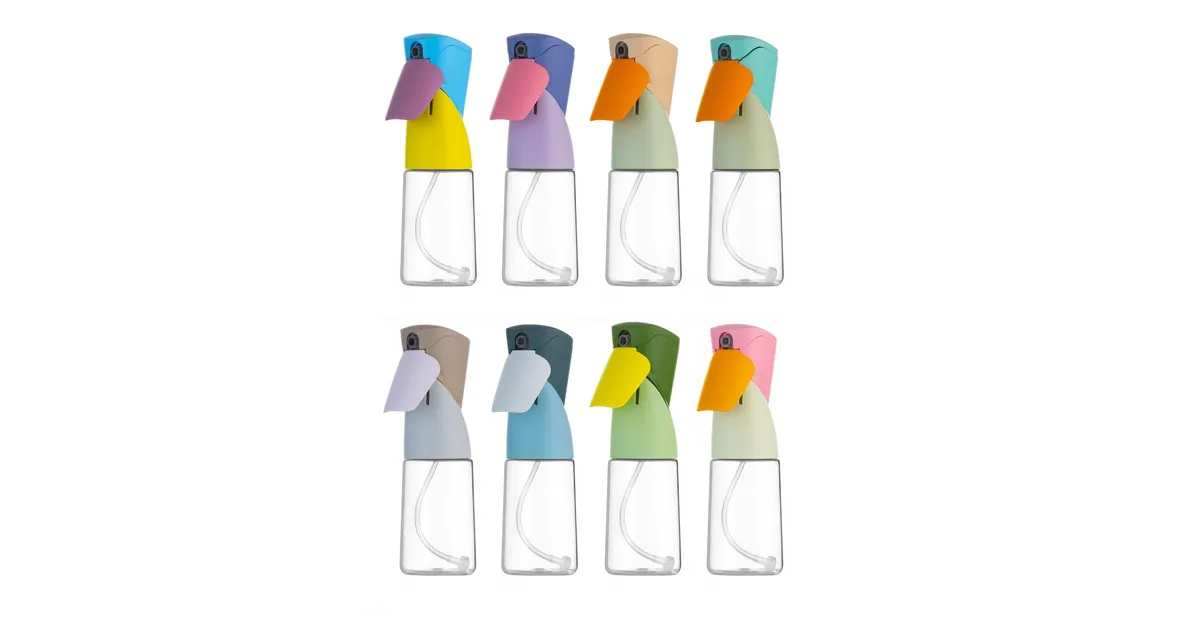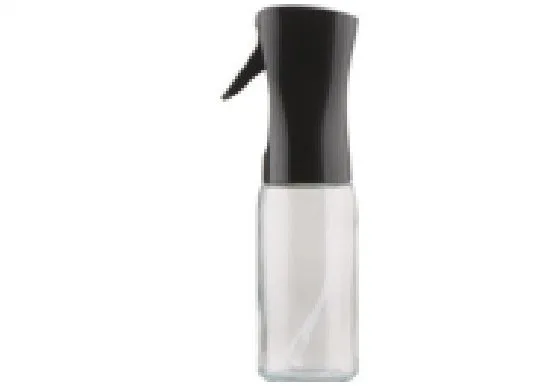
Fine mist sprayers and trigger sprayers both dispense liquid from a bottle, but they solve different problems. A fine mist sprayer atomizes liquid into a cloud of tiny droplets (40–80 µm) for even, light coverage — ideal for hair care, facial toners, plant misting, and cleaning glass. A trigger sprayer delivers a heavier spray pattern or stream for higher-volume, targeted application — cleaning surfaces, garden care, and industrial use.
Choosing wrong means your product underperforms at the point of use: a heavy trigger spray on a $30 facial toner wastes product and frustrates the customer. A fine mist on an industrial degreaser takes 10x longer to apply the necessary coverage. This guide compares the two mechanisms from our factory floor in Yuyao.
How They Differ Mechanically
Fine mist sprayer: Uses a finger-operated pump with a small cylinder (0.1–0.3 mL per stroke). The nozzle contains a swirl chamber — a tiny cavity with tangential inlet channels that spin the liquid into a thin conical sheet. As this sheet exits the orifice, it breaks into fine droplets. The result is a wide, even mist cone with droplets small enough to float in air briefly before settling.
Trigger sprayer: Uses a hand-grip lever operating a larger cylinder (0.8–2.0 mL per stroke). The nozzle is adjustable — rotating between fine spray, coarse spray, stream, and off positions. At the stream setting, liquid exits as a solid jet. At the spray setting, the nozzle geometry creates a fan or cone pattern with larger droplets (100–300 µm) than a mist sprayer.
Side-by-Side Comparison
Output per stroke: Fine mist: 0.1–0.3 mL. Trigger: 0.8–2.0 mL. A trigger delivers 4–10x more liquid per activation.
Droplet size: Fine mist: 40–80 µm (feels like a cloud). Trigger mist setting: 100–300 µm (feels like wet spray). Trigger stream: solid jet, no atomization.
Spray pattern: Fine mist: fixed cone pattern, typically 30–45° angle. Trigger: adjustable from wide fan to narrow stream.
Neck finish: Fine mist: 18/410, 20/410, 24/410 (smaller bottles). Trigger: 28/400, 28/410 (larger bottles).
Bottle size: Fine mist: typically 30–250 mL. Trigger: typically 250 mL–1 liter.
Cost per unit: Fine mist: $0.05–0.12 at OEM volume. Trigger: $0.08–0.20 at OEM volume.
Looking for a reliable spray bottle supplier?
Get free samples and a factory-direct quote within 12 hours.
Get a Free Quote →Application Matching
Use fine mist when: The product is applied to skin (facial mist, sunscreen, body spray), hair (leave-in conditioner, heat protectant, styling water), plants (indoor misting), or any surface where even, light coverage matters and waste must be minimized.
Use trigger sprayer when: The product is applied to surfaces (cleaning spray, kitchen degreaser, bathroom cleaner), gardens (weed killer, fertilizer spray), automotive (tire cleaner, windshield spray), or any application where volume matters more than fineness.
Gray area — glass cleaner: Both work. Fine mist provides streak-free, even coverage but requires more pumps to cover a large window. Trigger spray covers faster but risks over-application and dripping. Premium glass cleaners use fine mist; economy products use trigger. The right choice depends on your price point and brand positioning.
OEM Sourcing Tips
When sourcing either type, request samples with your actual formula — viscosity affects spray quality dramatically. A fine mist sprayer designed for water will not atomize a high-viscosity serum. A trigger sprayer tuned for thin cleaner may drip with a thick garden formula.
Desikyspray manufactures both fine mist and trigger sprayers in-house. MOQ: 5,000 pieces for standard models. Request samples with your formula →