Types of spray bottles extend far beyond "a bottle with a sprayer on top." There are at least six different types of spray bottles, each engineered for different liquids, viscosities, spray patterns, and end-user expectations — and each using a distinct spray bottle mechanism. Choosing the wrong type means returns, complaints, and lost shelf space. Choosing the right one means repeat orders and brand loyalty.
This guide breaks down every major spray bottle type — from the classic trigger sprayer to the increasingly popular continuous mist bottle — with real specifications, material considerations, and application mapping so you can make sourcing decisions with confidence. Looking for tested recommendations? Jump to our best spray bottle comparison.
Key Takeaways
- Trigger spray bottles dominate the cleaning product segment (60%+ market share) due to high output volume and adjustable nozzle patterns.
- Continuous mist spray bottles are the fastest-growing type, with 40%+ YoY search growth driven by hair care, plant care, and cooking oil applications.
- Material choice (PET, PP, HDPE, glass) affects chemical compatibility, weight, cost, and perceived quality — there is no universal "best" material.
- Matching spray type to liquid viscosity is the single most important sourcing decision: water-thin liquids need fine mist, viscous liquids need trigger or foam mechanisms.
The 6 Main Types of Spray Bottles
Every spray bottle consists of two core components: the container (body) and the dispensing mechanism (pump, trigger, or valve). The spray bottle mechanism determines the spray pattern, output volume, and user experience — learn how each mechanism works in our spray bottle mechanism guide. Here are the six primary types of spray bottles you will encounter in B2B sourcing, along with specs to help you find the best spray bottle for your application:
1. Trigger Spray Bottles
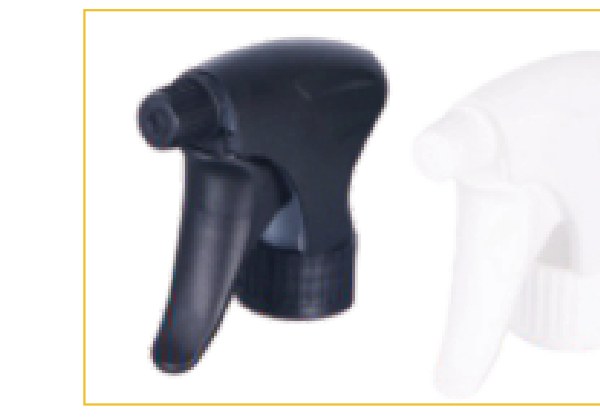
The trigger sprayer is the workhorse of the spray bottle world. Users squeeze a lever (trigger) that actuates a piston pump, drawing liquid from a dip tube and expelling it through an adjustable nozzle. Most models offer at least two settings: a focused stream for spot cleaning and a wide fan pattern for surface coverage.
- Output per stroke: 1.0-1.6 ml (compared to 0.1-0.3 ml for fine mist)
- Typical capacity: 500 ml - 1000 ml
- Nozzle options: Stream, fan, foam, and off (lock)
- Common materials: HDPE or PET body, PP trigger mechanism
- Best for: Household cleaners, glass cleaners, degreasers, garden pesticides, automotive detailing
- Pros: High volume output, adjustable patterns, chemical resistant, ergonomic for repetitive use
- Cons: Bulky mechanism, not suitable for fine mist applications, hand fatigue during extended use
Trigger sprayers account for an estimated 60% of the global spray bottle market by volume, driven by the massive cleaning products industry. For a deeper comparison of trigger vs. continuous models, see our trigger spray vs. continuous spray comparison guide.
2. Continuous Mist Spray Bottles
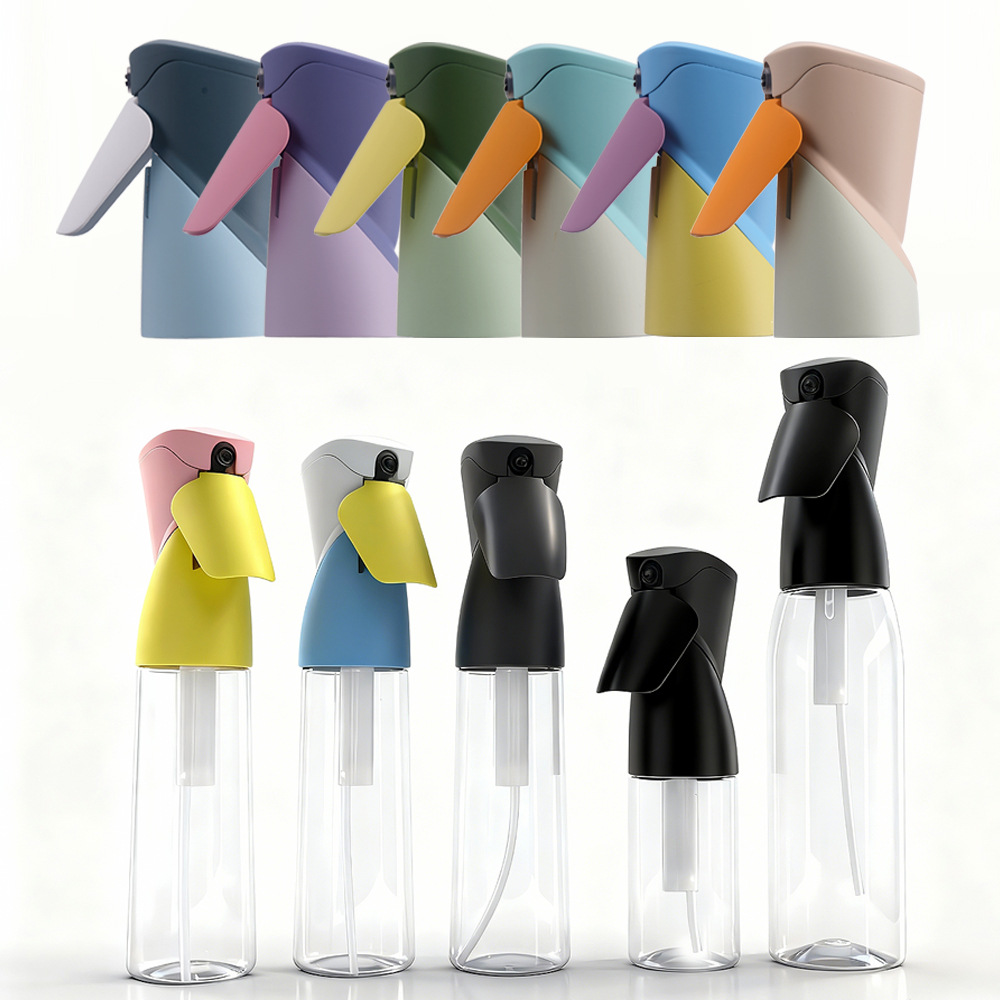
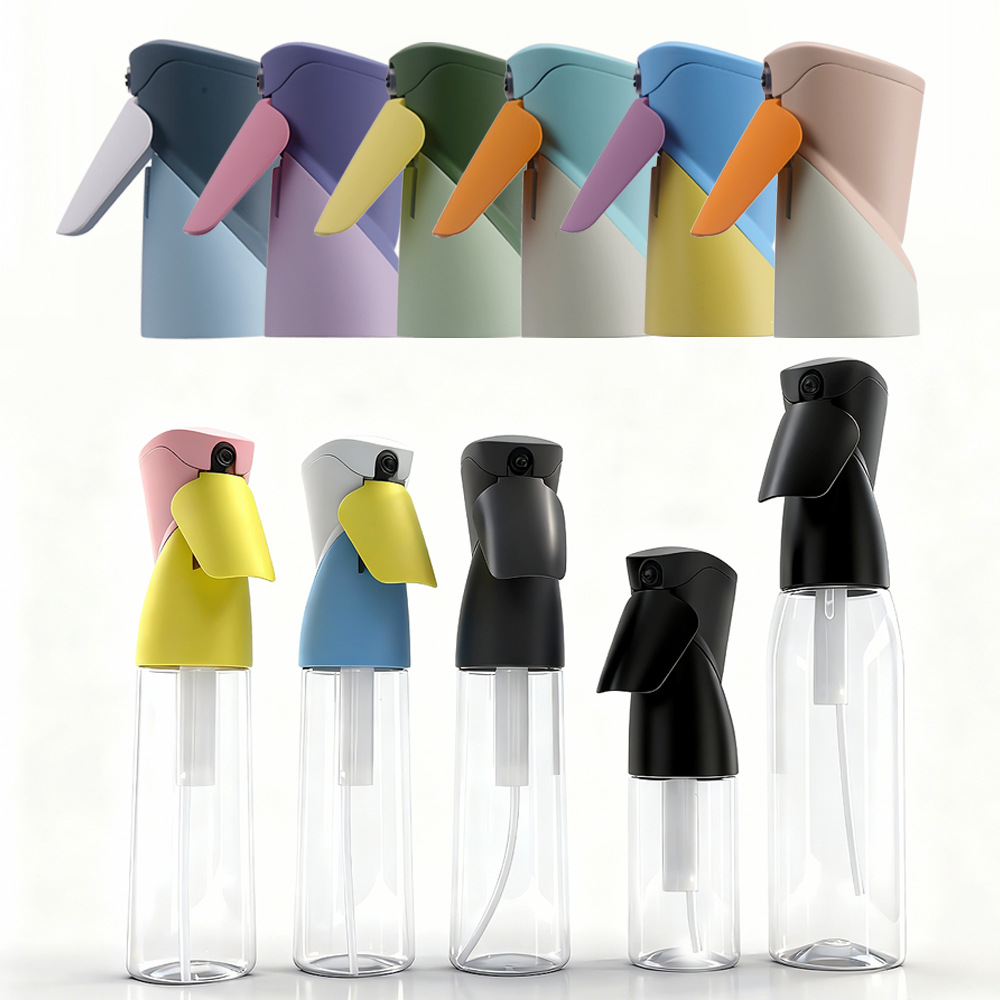
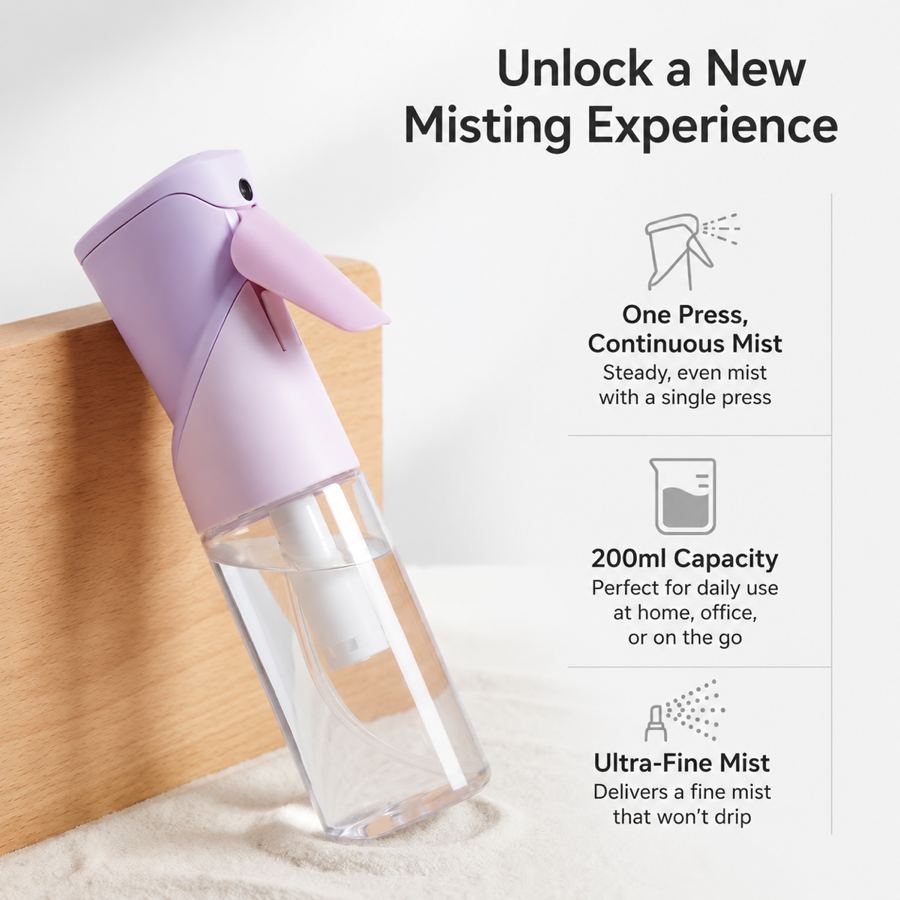
Continuous mist bottles use a pre-compression pump mechanism that builds pressure before releasing a sustained, ultra-fine mist lasting 3-5 seconds per pump. The droplet size ranges from 50 to 100 microns — fine enough to dampen without soaking, creating a salon-quality mist effect.
- Mist duration: 3-5 seconds continuous spray per pump
- Droplet size: 50-100 microns (vs. 200-400 microns for standard pump sprayers)
- Typical capacity: 150 ml - 500 ml
- Common materials: PET body, PP pump mechanism
- Best for: Hair styling, plant misting, cooking oil spraying, facial toners, ironing
- Pros: Ultra-fine even mist, works at any angle (360°), minimal hand fatigue, premium feel
- Cons: Lower output volume per stroke, not suitable for thick liquids, higher unit cost than trigger sprayers
Continuous mist is the fastest-growing spray bottle type, with search volume up 40%+ year-over-year. Read our full continuous vs. regular spray bottle comparison for detailed test results.
3. Pump Spray Bottles (Standard Mist)
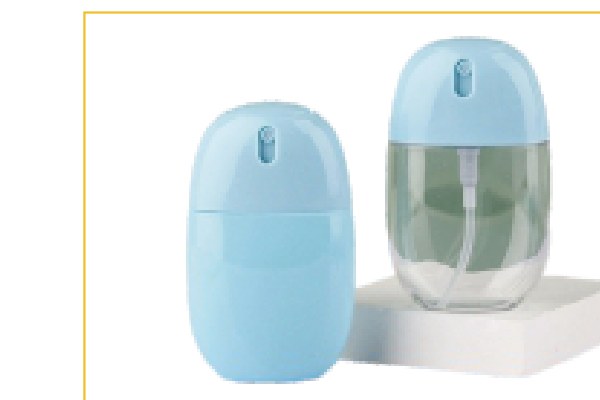
The classic pump spray (also called "finger pump" or "standard mist") is the most recognizable spray bottle design. Press the actuator down with one or two fingers, and a single burst of mist is released. Unlike continuous mist bottles, the spray stops the instant you release pressure.
- Output per stroke: 0.1-0.3 ml
- Droplet size: 100-200 microns
- Typical capacity: 30 ml - 500 ml
- Common materials: PET, glass, or aluminum body; PP pump
- Best for: Perfumes, facial mists, hand sanitizers, room sprays, pharmaceutical sprays
- Pros: Precise dosage control, compact and lightweight, works with a wide range of liquids, low cost
- Cons: Single burst per pump (no continuous spray), can cause hand fatigue with repeated pumping, mist less fine than continuous type
4. Foam Spray Bottles (Foamer Pumps)
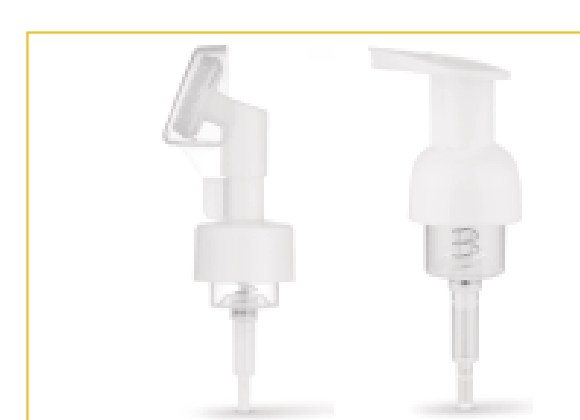
Foam dispensers mix air with a diluted liquid soap (typically 1:4 soap-to-water ratio) as it passes through a mesh screen, producing pre-foamed output that requires no lathering. This design uses 2-3x less product per wash than liquid dispensers, making it popular for high-traffic restrooms and eco-conscious brands.
- Output per stroke: 0.4-0.8 ml of foam
- Foam expansion ratio: 8:1 to 12:1 (air to liquid)
- Typical capacity: 250 ml - 500 ml
- Common materials: PET or HDPE body, PP pump with mesh screen
- Best for: Hand soap, facial cleansers, shaving foam, car wash foam, pet shampoo
- Pros: Reduces product consumption 2-3x, no lathering required, gentle on skin, appealing user experience
- Cons: Only works with diluted or foaming-specific formulations, mesh screen can clog, not suitable for thick liquids
For a complete overview of foam dispensers including sizing, formulation tips, and wholesale pricing, see our foam soap dispenser complete guide.
5. Fine Mist Spray Bottles
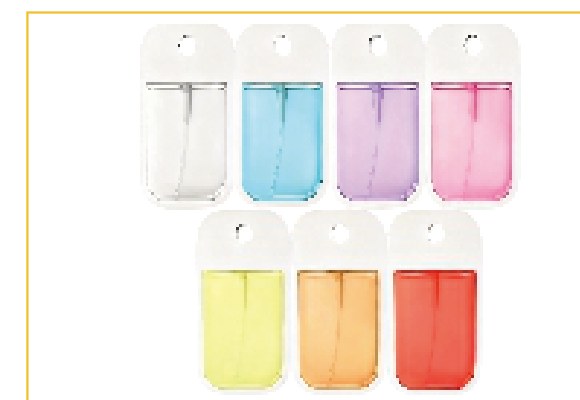
Fine mist bottles are a premium subcategory of pump sprayers engineered for extremely small droplets (30-80 microns). They use precision-machined nozzle orifices and higher-pressure pump mechanisms to atomize liquids into a near-invisible fog. The result is a luxurious, even application ideal for cosmetics and skincare.
- Droplet size: 30-80 microns (finer than standard pump at 100-200 microns)
- Output per stroke: 0.08-0.15 ml
- Typical capacity: 30 ml - 200 ml
- Common materials: Glass or acrylic body, aluminum or PP pump, stainless steel spring
- Best for: Facial mists, setting sprays, toners, aromatherapy, premium perfumes
- Pros: Ultra-fine atomization, premium aesthetic, precise application, no dripping
- Cons: Higher cost per unit, smaller capacity range, not compatible with viscous liquids
6. Specialized Types: Oil Sprayers, Watering Bottles & Powder Sprayers
Beyond the five main categories, several specialized spray bottle types serve niche markets:
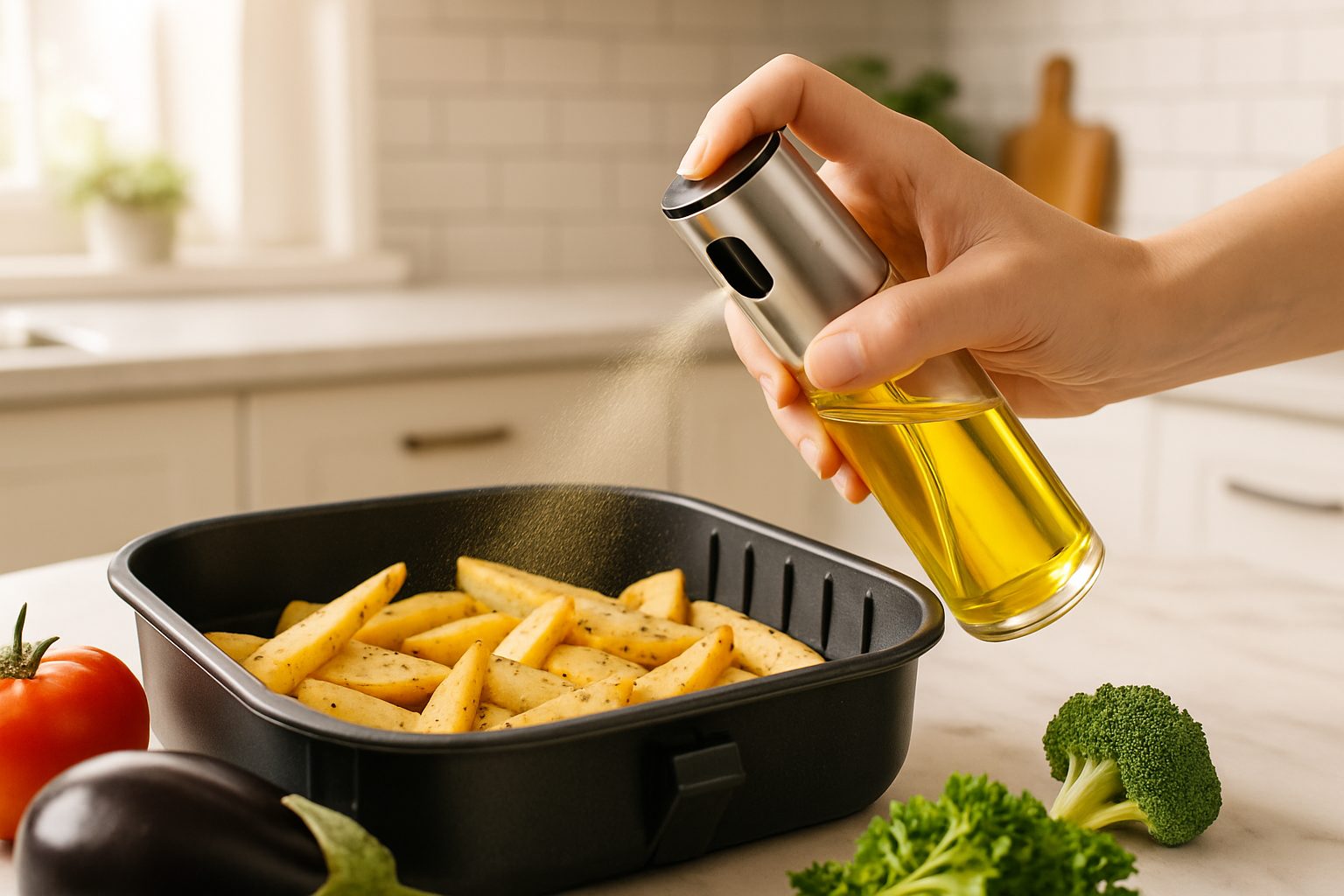
- Oil sprayers: Designed for cooking oils (viscosity 40-80 cP vs. 1 cP for water). Feature wider nozzle orifices (0.3mm+), oil-resistant silicone seals, and food-grade PP/PET construction. Capacity 150-300 ml. Growing rapidly due to the air fryer trend — see our oil spray bottle for air fryer guide.
- Watering/plant mist bottles: Long-neck designs with adjustable nozzles, often 500-1000 ml capacity. Feature bent-neck or angled spray heads to reach hanging plants.
- Powder sprayers: Dry powder dispensers that use air pressure to spray talc, dry shampoo, or insecticide powder. Completely different mechanism from liquid sprayers.
Spray Bottle Types Comparison Table
This table summarizes the key specifications across all major types of spray bottles, making it easy to compare at a glance:
| Spray Bottle Type | Droplet Size | Output/Stroke | Capacity Range | Best Applications | Unit Cost (FOB) |
|---|---|---|---|---|---|
| Trigger Spray | 200-500 µm | 1.0-1.6 ml | 500-1000 ml | Cleaning, garden, auto | $0.30-0.80 |
| Continuous Mist | 50-100 µm | 0.3-0.5 ml | 150-500 ml | Hair, plants, cooking oil | $0.80-1.50 |
| Pump Spray (Standard) | 100-200 µm | 0.1-0.3 ml | 30-500 ml | Personal care, sanitizer | $0.15-0.50 |
| Foam Dispenser | N/A (foam) | 0.4-0.8 ml | 250-500 ml | Hand soap, cleanser, pet care | $0.40-0.90 |
| Fine Mist | 30-80 µm | 0.08-0.15 ml | 30-200 ml | Cosmetics, perfume, skincare | $0.50-2.00 |
| Oil Sprayer | 80-150 µm | 0.2-0.5 ml | 150-300 ml | Cooking, air fryer, BBQ | $0.60-1.20 |
Note: FOB pricing is based on MOQ 3,000-5,000 units. Actual pricing varies by customization, material, and order volume.
Material Comparison: PET vs. PP vs. HDPE vs. Glass
The bottle body material affects chemical compatibility, weight, cost, and perceived quality. Here is what you need to know for each:
PET (Polyethylene Terephthalate)
Crystal-clear transparency, lightweight, good barrier properties. The most popular material for cosmetic and personal care spray bottles. Limitation: not compatible with essential oils or strong solvents (causes stress cracking). Recyclable (resin code #1). Learn more in our PET spray bottles guide.
PP (Polypropylene)
Excellent chemical resistance, handles temperatures up to 120°C, slightly translucent. The standard material for pump mechanisms and trigger sprayer components. Also used for bottle bodies when chemical resistance is priority. Limitation: less transparent than PET. Recyclable (resin code #5). See our PP spray bottles guide for details.
HDPE (High-Density Polyethylene)
Toughest of the three plastics — excellent impact resistance, chemical resistance, and moisture barrier. Standard for cleaning product bottles and industrial sprayers. Opaque white or colored. Limitation: no transparency, less premium appearance. Recyclable (resin code #2). Read our HDPE spray bottles guide.
Glass
Premium look and feel, 100% chemically inert (compatible with essential oils, acids, and solvents), infinitely recyclable. Used for premium cosmetics, aromatherapy, and decorative packaging. Limitation: heavy, fragile, higher shipping costs. See our glass spray bottles complete guide for sourcing details.
How to Choose the Right Spray Bottle Type for Your Business
Follow this decision framework when selecting which type of spray bottle to source:
Step 1: Identify Your Liquid's Viscosity
This is the single most important factor. Water-thin liquids (1-5 cP) work with any spray type. Oils (40-80 cP) need wider nozzles and oil-specific pumps. Viscous soaps (100-500 cP) require trigger sprayers or foam pumps. Trying to push thick liquid through a fine mist nozzle leads to clogging and customer complaints.
Step 2: Define the Desired Spray Pattern
- Even surface coverage (cleaning, gardening): Trigger spray with fan nozzle
- Fine, even dampening (hair, plants, cooking): Continuous mist
- Precise, small-area application (perfume, toner): Fine mist or standard pump
- Pre-foamed output (hand wash, facial cleanser): Foam pump
Step 3: Match Capacity to Usage Frequency
Daily-use products (cleaners, hair sprays) need 300-500 ml to avoid frequent refills. Travel or occasional-use products do well at 30-100 ml. Professional products (salon, automotive) may need 750-1000 ml to get through a full workday.
Step 4: Check Material Compatibility
Essential oils and acidic formulations degrade PET — use glass or HDPE. Alkaline cleaners work with HDPE or PP. Food-contact applications require FDA/LFGB-certified materials. Always request a compatibility test sample before committing to volume production. Read our food-grade compliance guide for regulatory details.
Sizing Guide: Common Spray Bottle Capacities by Type
Capacity selection directly impacts user experience, shelf presence, and shipping cost. Here are the most popular sizes by bottle type:
- 30-100 ml: Travel sprays, perfume atomizers, sample sizes — fine mist and pump spray types
- 150-200 ml: Personal care sprays, facial mists, travel continuous mist — compact for single-hand use
- 250-300 ml: Hair styling, cooking oil, plant misting — the most popular continuous mist size segment
- 500 ml: Standard household cleaner size — trigger sprayers and multipurpose pump bottles
- 750-1000 ml: Professional cleaning, garden sprayers, salon use — almost exclusively trigger sprayers
For a detailed sizing breakdown with dimensional specs and MOQ data, see our spray bottle size guide.
Industry Trends Shaping Spray Bottle Type Selection in 2026
Three trends are shifting buyer demand across spray bottle types:
- Continuous mist adoption is accelerating. Originally popular in salons, continuous mist bottles now outsell standard pump sprayers in the hair care and plant care categories on Amazon. The mechanism's "one pump, 3-5 seconds of mist" user experience is a clear upgrade from finger-fatiguing pump bottles.
- Sustainability is favoring refillable systems. Brands are moving away from single-use aerosol cans toward refillable spray bottles with PCR (post-consumer recycled) plastic. This benefits trigger sprayers and continuous mist bottles that support durable, reusable designs.
- Food-grade spray bottles are a growth category. The air fryer boom has created mainstream demand for oil spray bottles that previously existed only as niche kitchen accessories. This is pulling continuous mist technology into the food-grade segment.
Understanding the Spray Bottle Mechanism Behind Each Type
Each type of spray bottle relies on a fundamentally different spray bottle mechanism to convert your hand motion into a spray pattern. Understanding these mechanisms helps you diagnose why bottles fail and what separates cheap bottles from reliable ones:
- Trigger sprayers use a direct piston pump — squeeze the trigger, and the piston immediately forces liquid through the nozzle. Simple, powerful, but coarse droplets.
- Continuous mist bottles use a pre-compression chamber — the pump builds air pressure in a sealed chamber before a valve releases it, creating sustained ultra-fine mist. This is why they produce finer droplets and spray at any angle.
- Standard pump sprayers use a finger-actuated piston — similar principle to trigger sprayers but smaller scale, producing a single burst of mist per press.
- Foam dispensers use a dual-chamber air-mixing mechanism — liquid passes through mesh screens that fold air into it at a 1:10 ratio, converting liquid soap into instant foam.
For a detailed technical breakdown of every component — nozzle, dip tube, piston, spring, check valves — see our spray bottle mechanism and parts guide with labeled diagrams. And for tested recommendations on which type performs best in real-world use, read our best spray bottle comparison.
Why Source Your Spray Bottles from Desiky
As a manufacturer based in Yuyao, China — the global capital of spray bottle production — Desiky produces all six spray bottle types covered in this guide. Our capabilities include:
- Full-range manufacturing: Continuous mist, trigger sprayers, pump bottles, foam dispensers, fine mist, and oil sprayers — all from one factory
- In-house mold design: Custom bottle shapes, sizes, and nozzle configurations with EU/US design patent support
- OEM/ODM services: Custom colors, logo printing, packaging design — see our custom bottles page
- MOQ from 3,000 units: Flexible minimums for testing new product lines
- Quality certifications: FDA, LFGB, BPA-free, SGS testing for all food-contact products
Related Guides: Best Spray Bottle in 2026 — 9 Types Tested | How Spray Bottles Work (Parts Diagram) | Parts of a Spray Bottle Explained
Ready to source the right type of spray bottle for your product line? Request a free sample and quote — or browse our full continuous spray bottle catalog to see our best-selling models.