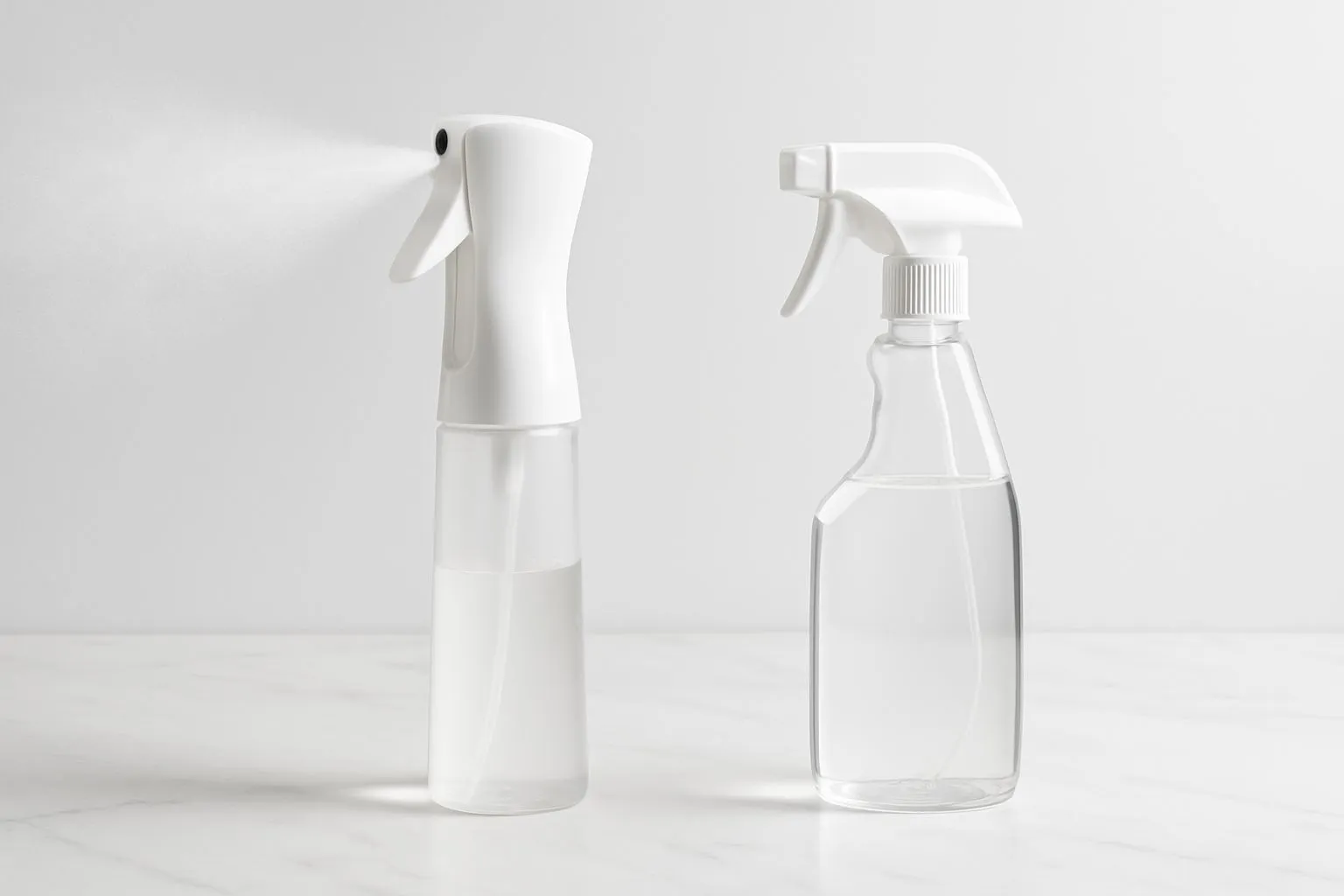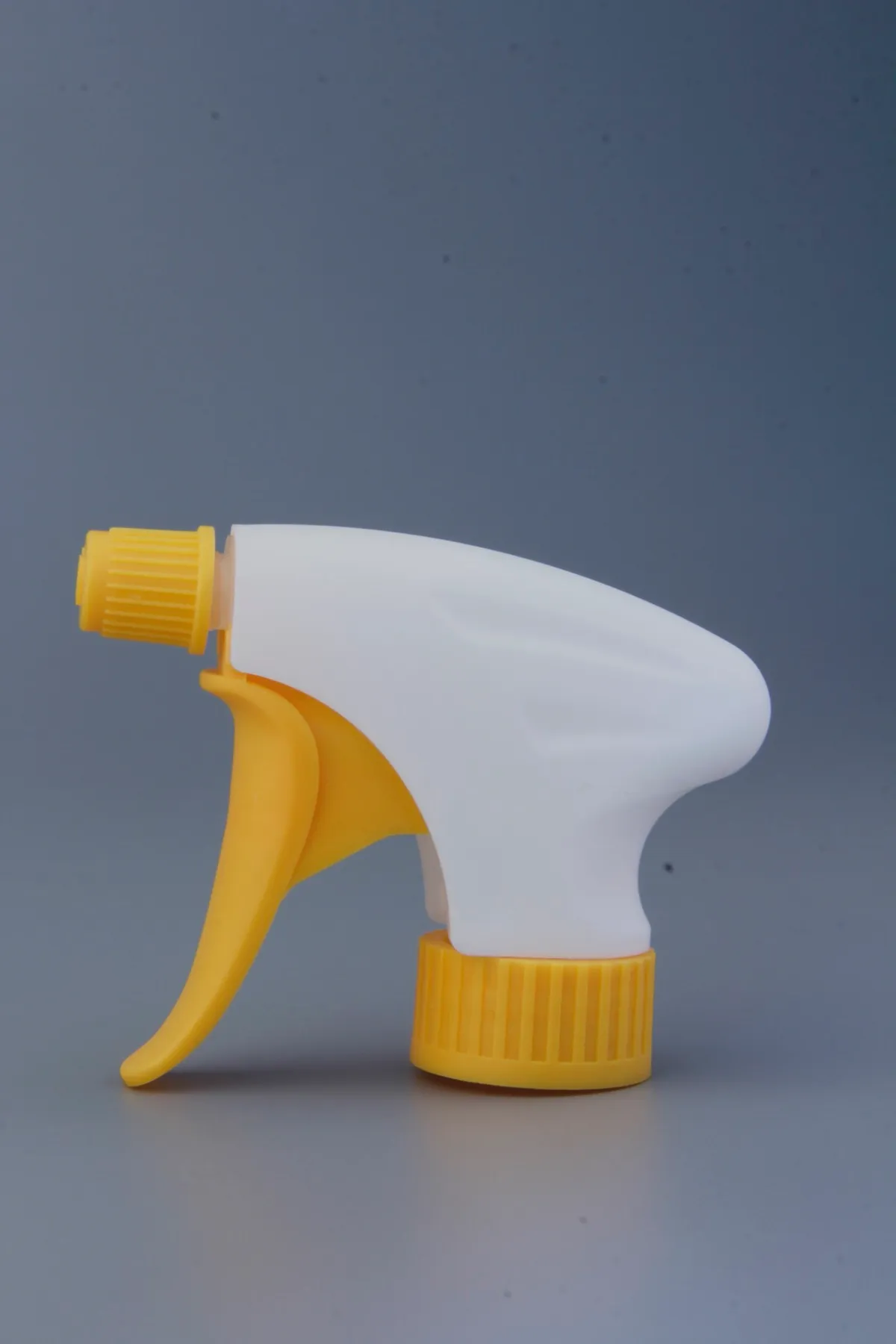
A trigger sprayer is one of the most engineered disposable components in consumer packaging. It has a piston, a cylinder, a check valve, a spring, a nozzle with adjustable orifice, and a dip tube — all assembled into a unit that costs under $0.15 at volume and needs to work reliably for 2–3 years of household use.
We manufacture trigger sprayers in Yuyao, China — the global capital of spray packaging — and this guide covers the specifications that matter when sourcing: output per stroke, spray patterns, neck finish compatibility, material options, and the quality markers that separate a 50,000-cycle sprayer from one that leaks after 500.
Key Specifications at a Glance
- Output per stroke: 0.8–1.4 mL (standard), 1.6–2.0 mL (industrial)
- Spray pattern: Fine mist (60–80 µm) to stream (3–4 m reach)
- Neck finishes: 28/400, 28/410 (most common), 24/410
- Cycle life: 30,000–50,000+ strokes
- MOQ: 5,000 pcs standard, 20,000 pcs custom
How a Trigger Sprayer Works
When the lever is squeezed, it pushes a piston forward inside a cylinder, pressurizing the liquid in the chamber. This pressure opens the nozzle valve and atomizes the liquid. When released, the spring returns the piston, creating suction that pulls liquid up through the dip tube and refills the chamber through a one-way check valve.
Every performance characteristic — output volume, spray quality, priming strokes, leak resistance — traces back to tolerances in this mechanism. The piston-to-cylinder fit determines seal integrity. The spring force determines trigger feel and return speed. The nozzle geometry determines atomization quality.
Trigger Sprayer Types
Standard Household Trigger Sprayers
The workhorse of cleaning and garden care. Output per stroke: 0.8–1.4 mL, with an adjustable nozzle (mist/stream/off). Available in 28/400 and 28/410 neck finishes. PP bodies with PE or PP pistons. Carbon steel springs (economy) or stainless steel (premium). Stainless springs last 5–10x longer in water-based formulas and resist rust staining — the single easiest quality indicator when evaluating suppliers.
Foam Trigger Sprayers
A foam trigger incorporates a mesh screen at the nozzle that mixes liquid with air to produce rich, clinging foam — useful for bathroom cleaners, tire foam, glass cleaners, and pet shampoos. Cost premium: +15–25% due to mesh assembly. The mesh is the wear point — specify mesh density (40–80 mesh) based on formula viscosity.
Industrial / Heavy-Duty Trigger Sprayers
Larger cylinders (1.6–2.0 mL per stroke), reinforced levers, chemical-resistant seals (Viton or EPDM), and stronger springs. Often include a shroud or guard and a lock-out mechanism. Designed for janitorial, auto detailing, and agricultural use.
Looking for a reliable spray bottle supplier?
Get free samples and a factory-direct quote within 12 hours.
Get a Free Quote →Neck Finish Compatibility
28/410: The dominant standard worldwide — approximately 70% of all trigger sprayers. The "28" is 28 mm outer thread diameter; "410" is the GPI thread style (specific pitch, turn count, root diameter).
28/400: Same diameter, different thread pitch. A 28/400 trigger will NOT seal properly on a 28/410 bottle — cross-threading causes leaks. This is the most common sourcing mistake.
24/410: Smaller diameter for bottles under 500 mL where 28 mm looks oversized. Common for personal care spray bottles.
Material Specifications
Body: Polypropylene (PP) standard. Good chemical resistance for water-based and mildly alkaline formulas. For aggressive solvents, request a chemical resistance chart.
Piston/seals: PE or PP standard. Viton (FKM) for solvents. EPDM for hot water. Always run a 30-day immersion test with your actual formula.
Spring: Carbon steel (economy), stainless 304 (water-based standard), stainless 316 (salt/acid formulas). Spring material is rarely specified by buyers, which is why so many sprayers develop internal rust after 6 months.
Dip tube: PP or PE. Length = bottle depth minus 1–2 mm. A tube cut too long bottoms out and levers the closure off the sealing land — the #1 cause of "leaks at correct torque" complaints.
Quality Markers: What to Check in Samples
1. Priming strokes. Quality = 3–5 strokes from dry. If 8–10 strokes needed, the check valve is loose.
2. Spray pattern. 10 consecutive sprays on mist should produce consistent, centered patterns. Irregular patterns = nozzle burrs or worn tooling.
3. Spring return. Crisp snap-back. Sluggish = weak spring or excessive friction, both degrade with use.
4. Leak test. Fill, tighten to spec, invert 24 hours. Then test at 150% torque — over-torque resistance separates factory-grade from consumer-grade.
5. Nozzle shutoff. "Off" position, squeeze 10 times, check for drip. Proper shutoff uses a gasket-sealed rotation stop, not just a mechanical block.
OEM Pricing (Factory Direct, Yuyao)
Standard 28/410 (carbon steel spring): $0.08–0.12 at 50K+ pcs
Standard 28/410 (stainless spring): $0.10–0.15 at 50K+ pcs
Foam trigger (mesh nozzle, SS spring): $0.14–0.20 at 20K+ pcs
Industrial (reinforced, chem-resistant): $0.18–0.30 at 10K+ pcs
Customization: color matching (Pantone), logo printing, custom nozzle geometry, child-resistant lock, foam/no-foam dual-mode. Tooling: $2,000–5,000 amortized over first order.