Choosing the wrong spray bottle costs more than the bottle itself — it costs you returns, customer complaints, and reorders that eat your margin. After 20 years of manufacturing 53 spray bottle models at our Yuyao factory, we have seen every buying mistake in the book: a cosmetic brand that put an acidic toner in a PET bottle and watched it craze in 8 weeks, a cleaning company that specified a fine mist nozzle for a viscous degreaser and got a dribble instead of a spray, a garden startup that ordered 10,000 trigger sprayers without checking the closure size and found they did not fit their bottles.
This sprayer buying guide gives you a systematic framework so you never make those mistakes. We cover the five decision factors in the order they matter most: liquid compatibility first, then spray mechanism, material, capacity, and finally supplier qualification. By the end, you will know exactly how to specify a spray bottle that works for your product, your market, and your budget.
Key Takeaways
- Start with the liquid, not the bottle. Viscosity, pH, chemical composition, and alcohol content determine which spray mechanism, material, and seal type will work.
- 6 spray bottle types serve different applications. Trigger sprayers for cleaning, continuous mist for hair/plants, foam pumps for soap, fine mist for cosmetics, oil sprayers for cooking, and pump sprayers for general use.
- Material choice is a compatibility decision, not an aesthetic one. HDPE resists chemicals, PET offers clarity, glass is inert, PP handles heat.
- Closure size must match. A 28/410 trigger will not fit a 24/410 bottle. Cross-specify bottle neck and pump closure before ordering.
- Quality shows in the spring. Stainless steel springs last 30,000-50,000 actuations. Carbon steel corrodes in 6 months with water-based products.
Step 1: Identify Your Liquid Type
This is the single most important step in choosing a spray bottle — and the one most buyers skip. Your liquid determines everything downstream: which materials are safe, which spray mechanism will atomize it properly, and which seals and springs will survive long-term contact.
| Liquid Type | Key Properties | Compatible Materials | Recommended Spray Type | Watch Out For |
|---|---|---|---|---|
| Water-based cleaners | pH 6-10, low viscosity, surfactants | HDPE, PET, PP | Trigger sprayer (1.0-1.6ml output) | Alkaline cleaners (pH >10) degrade PE over time |
| Alcohol-based (10-70%) | Low viscosity, volatile, flammable | PET, glass, HDPE | Fine mist or trigger | LDPE seals swell; use PP/silicone gaskets |
| Bleach / oxidizers | Strong oxidizer, corrosive to metals | HDPE (best), PP | Chemical-resistant trigger | Corrodes carbon steel springs in <6 months |
| Essential oils / terpenes | Aromatic hydrocarbons, solvent action | Glass, aluminum (lined) | Fine mist pump | PET crazes, HDPE absorbs odor, NBR gaskets swell |
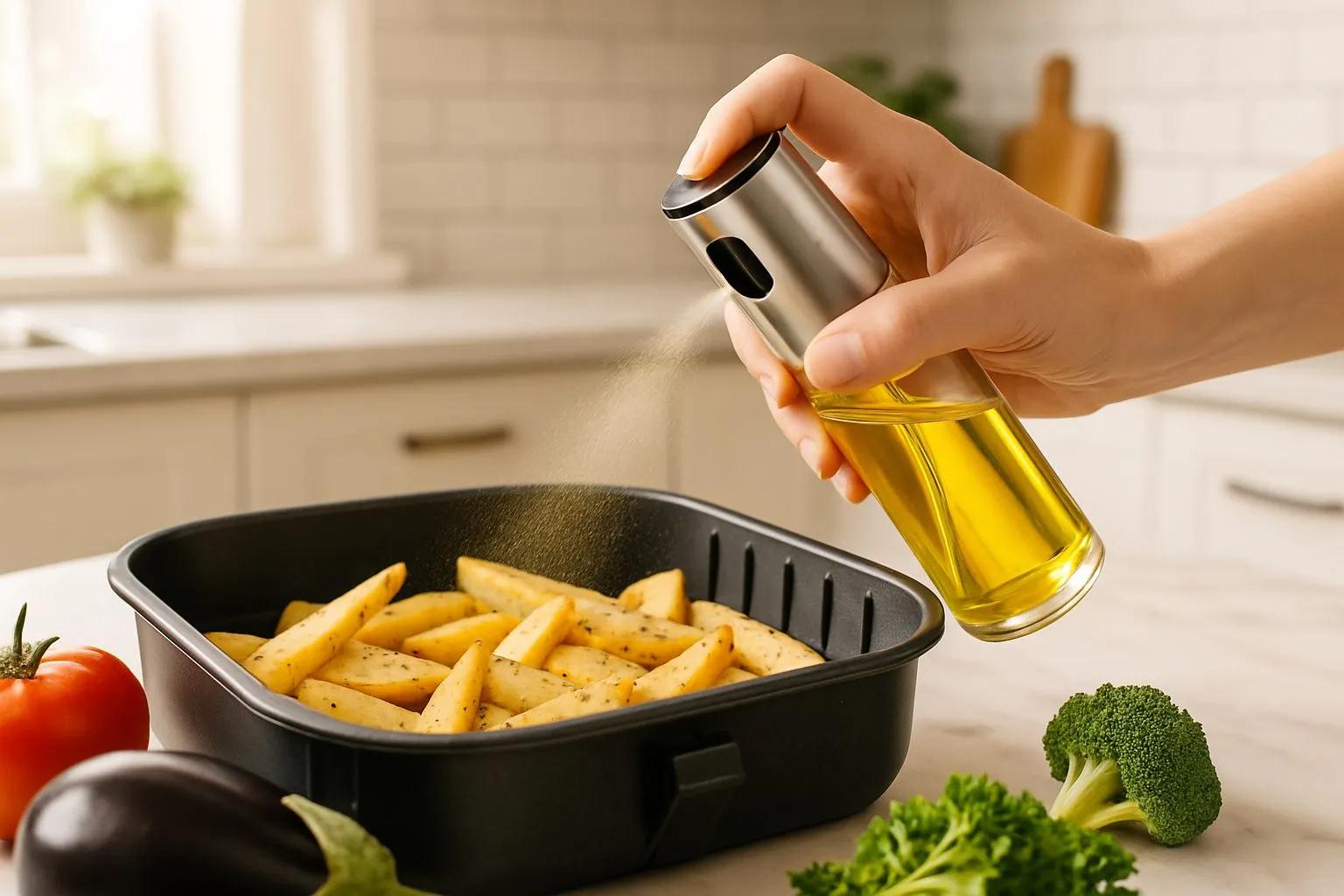
| Cooking oils | High viscosity (40-80 cP), food contact | Glass, food-grade PET | Oil sprayer (wide orifice) | Standard fine mist nozzles clog within days |
| Cosmetic formulations | Varies widely — emulsions, toners, serums | Glass, acrylic, airless | Fine mist or airless pump | UV-sensitive ingredients need amber/opaque bottles |
| Diluted soap | Low viscosity with surfactant | PET, HDPE | Foam pump (mesh screen) | Thick soap clogs mesh; dilute 1:3 to 1:4 |
If you are unsure about compatibility, request a 4-week filled-bottle storage test from your supplier. At Desiky, we run these tests at 45 degrees C with the customer's actual formula — accelerated aging that reveals crazing, seal degradation, and discoloration before you commit to a production run. For details on how different spray mechanisms handle different liquids, see our parts of a spray bottle guide.
Step 2: Choose the Right Spray Mechanism
Once you know your liquid type, narrow down the spray mechanism. Each type is engineered for a specific output volume, droplet size, and viscosity range. Choosing the wrong mechanism means poor spray quality, user complaints, and returns.
| Spray Type | Output/Stroke | Droplet Size | Viscosity Limit | Best Applications | FOB Unit Cost |
|---|---|---|---|---|---|
| Trigger Sprayer | 1.0-1.6 ml | 200-500 um | Water-like to light | Cleaning, garden, auto detailing | $0.30-0.80 |
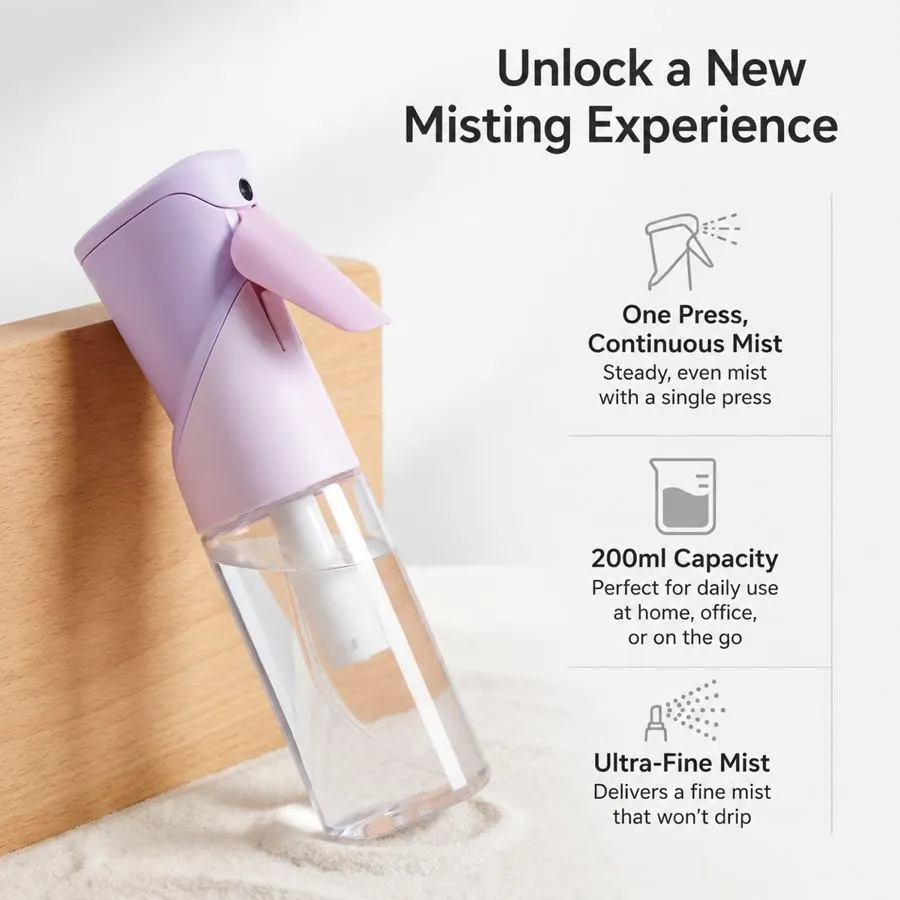
| Continuous Mist | 0.3-0.5 ml | 50-100 um | Water-like only | Hair styling, plant care, cooking oil | $0.80-1.50 |
| Pump Spray (Standard) | 0.1-0.3 ml | 100-200 um | Water-like to light | Perfume, toner, hand sanitizer | $0.15-0.50 |
| Foam Pump | 0.4-0.8 ml foam | Foam (not droplets) | Must be diluted (<50 cP) | Hand soap, facial cleanser, pet shampoo | $0.25-0.60 |
| Fine Mist (Cosmetic) | 0.08-0.15 ml | 30-80 um | Water-like only | Facial mist, setting spray, toner | $0.40-1.20 |
| Oil Sprayer | 0.2-0.4 ml | 100-300 um | Up to 80 cP | Cooking oil, vinegar, marinades | $0.60-1.80 |
For a detailed comparison of all six types with pros, cons, and real-world application examples, see our complete guide to types of spray bottles. If you are specifically deciding between trigger and continuous mechanisms, our trigger spray vs continuous spray comparison includes side-by-side lab test results.
Looking for a reliable spray bottle supplier?
Get free samples and a factory-direct quote within 12 hours.
Get a Free Quote →Step 3: Select the Right Material
Material is a compatibility decision, not just a look-and-feel choice. The wrong material leads to chemical degradation, odor absorption, or structural failure that appears weeks after delivery — when your bottles are already on shelves.
| Material | Strengths | Weaknesses | FOB Range (500ml body) | Best For |
|---|---|---|---|---|
| HDPE | Chemical resistant, impact resistant, recyclable (#2) | Opaque only, absorbs odors, permits gas permeation | $0.06-0.16 | Cleaning products, chemicals, industrial |
| PET | Glass-like clarity, lightweight, recyclable (#1) | Sensitive to solvents, essential oils cause crazing | $0.06-0.18 | Personal care, general purpose, display |
| PP | Heat resistant (120 C), chemical resistant, autoclavable | Semi-translucent, less rigid than PET | $0.08-0.20 | Hot-fill, sterilizable, medical |
| Glass | Chemically inert, premium appearance, UV protection (amber) | Heavy, fragile, higher shipping cost | $0.18-0.45 | Essential oils, luxury cosmetics, tinctures |
Need a deeper dive on plastics? Our HDPE vs PET vs PP comparison guide covers everything from gas permeability to recycling codes. For glass versus plastic specifically, see our glass vs plastic spray bottles comparison.
Step 4: Specify Capacity, Closure, and Dip Tube
These three specifications are where "almost right" causes real problems:
Capacity
- 30-100 ml: Travel, sample, and trial sizes. TSA limit is 100 ml for carry-on — see our travel spray bottle guide
- 200-300 ml: Personal care sweet spot. Hair spray, kitchen oil spray, facial mist
- 500 ml: Household standard. Cleaning products, garden sprayers
- 750-1000 ml: Commercial and industrial. Professional cleaning, salon use
Closure Size (Critical)
The closure size (neck finish) determines whether the pump fits the bottle. Get this wrong and you have two incompatible parts. The three most common sizes:
- 24/410: Small bottles (100-250 ml), personal care, travel
- 28/410: Standard bottles (250-750 ml) — the most common size globally
- 28/400: Less common, slightly different thread profile — not interchangeable with 28/410
Rule: Always cross-specify the bottle neck finish and pump closure in the same purchase order. Send the pump to the bottle supplier (or vice versa) for a fit test before production. For detailed closure specifications, see our trigger sprayer specifications guide.
Dip Tube Length
The dip tube must reach within 2-3 mm of the bottle bottom without touching it. Too short: 10-15% of liquid is unreachable. Too long: the tube curls, creating an air pocket. Always specify dip tube length per bottle height, not as a generic "standard" length.
Step 5: Evaluate Your Supplier — The 5-Point Quality Checklist
A spray bottle that passes visual inspection on arrival can still fail in the field. Here are the five quality indicators that separate a reliable manufacturer from a trading company reselling commodity products:
- Spring material: Ask "what is the spring made of?" A manufacturer will say "304 stainless steel" or "music wire carbon steel with zinc plating." A trader will say "standard." Stainless steel springs last 30,000-50,000 actuations in water-based products. Carbon steel corrodes in 6 months.
- Leak test protocol: Ask for the production leak test method. A quality factory vacuum-tests every batch (not just sampling). Our factory tests 100% of continuous spray bottles at -0.08 MPa for 5 seconds.
- Nozzle orifice tolerance: Fine mist quality depends on the nozzle orifice diameter — typically 0.3-0.5 mm with +/-0.02 mm tolerance. Ask for the specification. If they cannot provide it, the nozzle is generic and uncontrolled.
- Material certificates: Request 21 CFR, REACH, or LFGB test reports that name the specific resin grade and batch — not a generic supplier-wide certificate from three years ago.
- Filled-bottle aging test: The single best test. Fill 10 sample bottles with your actual product, store at 45 degrees C for 4 weeks, then inspect for crazing, seal degradation, discoloration, and odor. Any factory confident in their product will offer this test. Read more in our quality standards and testing guide.
For additional supplier vetting strategies, including how to evaluate Alibaba suppliers, see our supplier selection guide for Alibaba buyers.
Decision Flowchart: Choosing Your Spray Bottle in 5 Questions
- What is the liquid? → Determines material and seal compatibility
- What spray pattern does the user need? → Determines mechanism type (trigger/mist/foam/continuous)
- What capacity? → Determines bottle size and weight class
- What market? → Determines documentation (21 CFR for US, REACH for EU, LFGB for Germany food contact)
- What volume do you need? → Determines MOQ tier and whether custom tooling is justified
Run through these five questions with specific answers and you will arrive at a spray bottle specification that any competent manufacturer can quote accurately. No ambiguity, no mismatched quotes, no surprises at delivery.

MOQ, Pricing Tiers, and Lead Times
| Order Type | MOQ | Lead Time | Notes |
|---|---|---|---|
| Stock product, standard color | 3,000 pcs | 10-15 days | Lowest cost, fastest turnaround |
| Stock product + logo printing | 3,000 pcs | 15-20 days | Pad print or screen print, 1-3 colors |
| Custom Pantone color | 10,000 pcs per color | 20-25 days | Color matching fee waived on orders >20K |
| Custom bottle shape (new tooling) | 30,000 pcs | 45-60 days | Tooling $3,000-$8,000, owned by buyer |
Pricing decreases 8-15% at 10,000 units and another 5-10% at 50,000 units. All prices are FOB Ningbo. Samples ship free (3 SKUs, buyer covers courier, typically $35-60 by DHL, 4-6 days).
Ready to Source the Right Spray Bottle?
Tell us your liquid type, target application, and volume — we will recommend 2-3 models with samples and pricing within 24 hours.
Frequently Asked Questions
How do I choose between a trigger sprayer and a continuous mist bottle?
Choose a trigger sprayer if your product needs high output volume (1.0-1.6 ml per stroke), adjustable spray patterns, or is used for cleaning and garden applications. Choose a continuous mist bottle if you need an ultra-fine, sustained mist (50-100 micron droplets, 3-5 seconds per pump) — ideal for hair styling, plant misting, and cooking oil. Read our detailed comparison for lab test results.
What spray bottle material is most chemical resistant?
HDPE is the most chemically resistant common plastic — it handles acids, bases, bleach, and most solvents without degradation. Glass is chemically inert and handles everything including essential oils and terpenes. PET offers clarity but is vulnerable to solvents and aromatic compounds. See our material comparison guide for detailed compatibility charts.
What is the minimum order quantity for custom spray bottles?
Stock products with logo printing start at 3,000 pieces. Custom Pantone colors require 10,000 pieces per color. Fully custom bottle shapes with new tooling start at 30,000 pieces with $3,000-$8,000 tooling investment. Tooling is owned by the buyer.
How do I test spray bottle quality before committing to a large order?
Order samples from 3-5 suppliers and run these tests: (1) fill with your actual product and store at room temperature for 4 weeks — check for crazing, leaks, and odor; (2) pump 500 times and check spray consistency; (3) drop the filled bottle from 1 meter onto concrete 3 times — check for cracks and leaks; (4) leave filled bottles inverted overnight on paper towels — any moisture means the seal fails. Read our sampling and approval guide for the complete testing protocol.
What certifications do I need for spray bottles in the US and EU?
For the US: US food-contact compliance for food/cosmetic contact, CPSIA for children's products, California Prop 65. For the EU: REACH SVHC screening (mandatory), EU 10/2011 for food contact, LFGB for German market. For both markets: material test reports must name the specific resin grade and be dated within 12 months.
Related Guides: 6 Types of Spray Bottles Compared | Best Spray Bottles 2026 — 9 Types Tested | How to Fix a Spray Bottle | Parts of a Spray Bottle Diagram | Wholesale Price Guide 2026