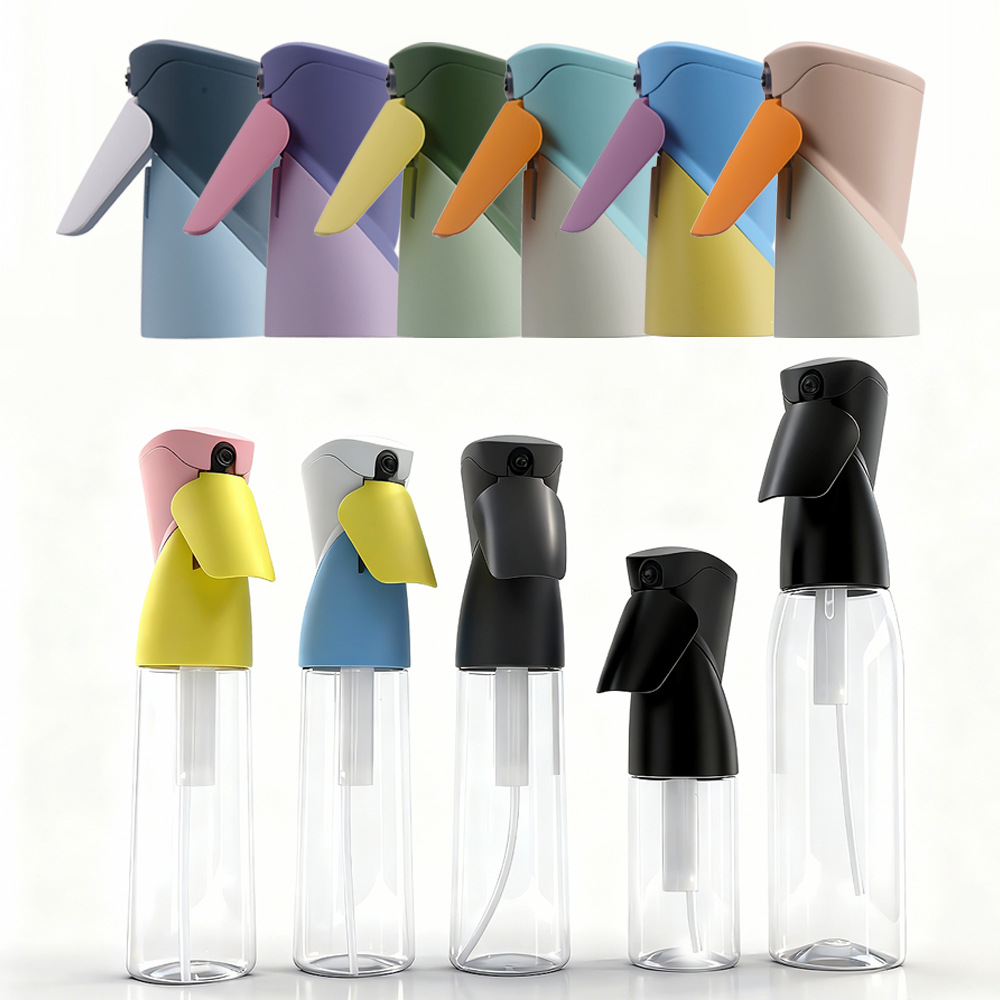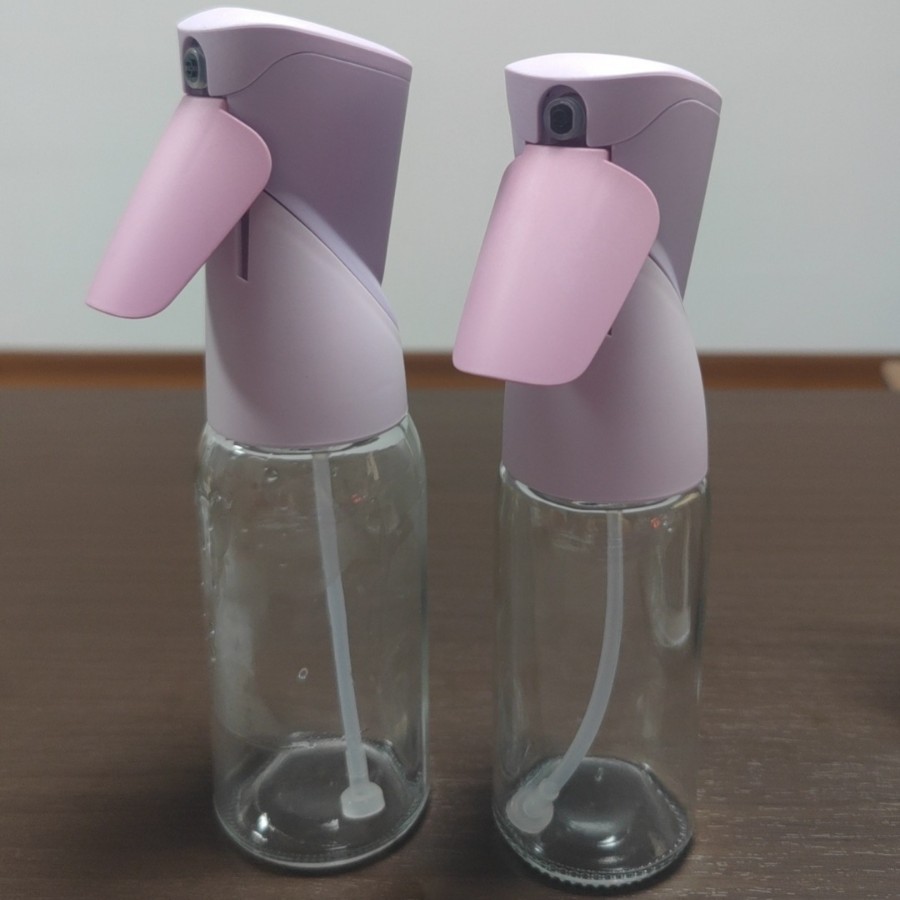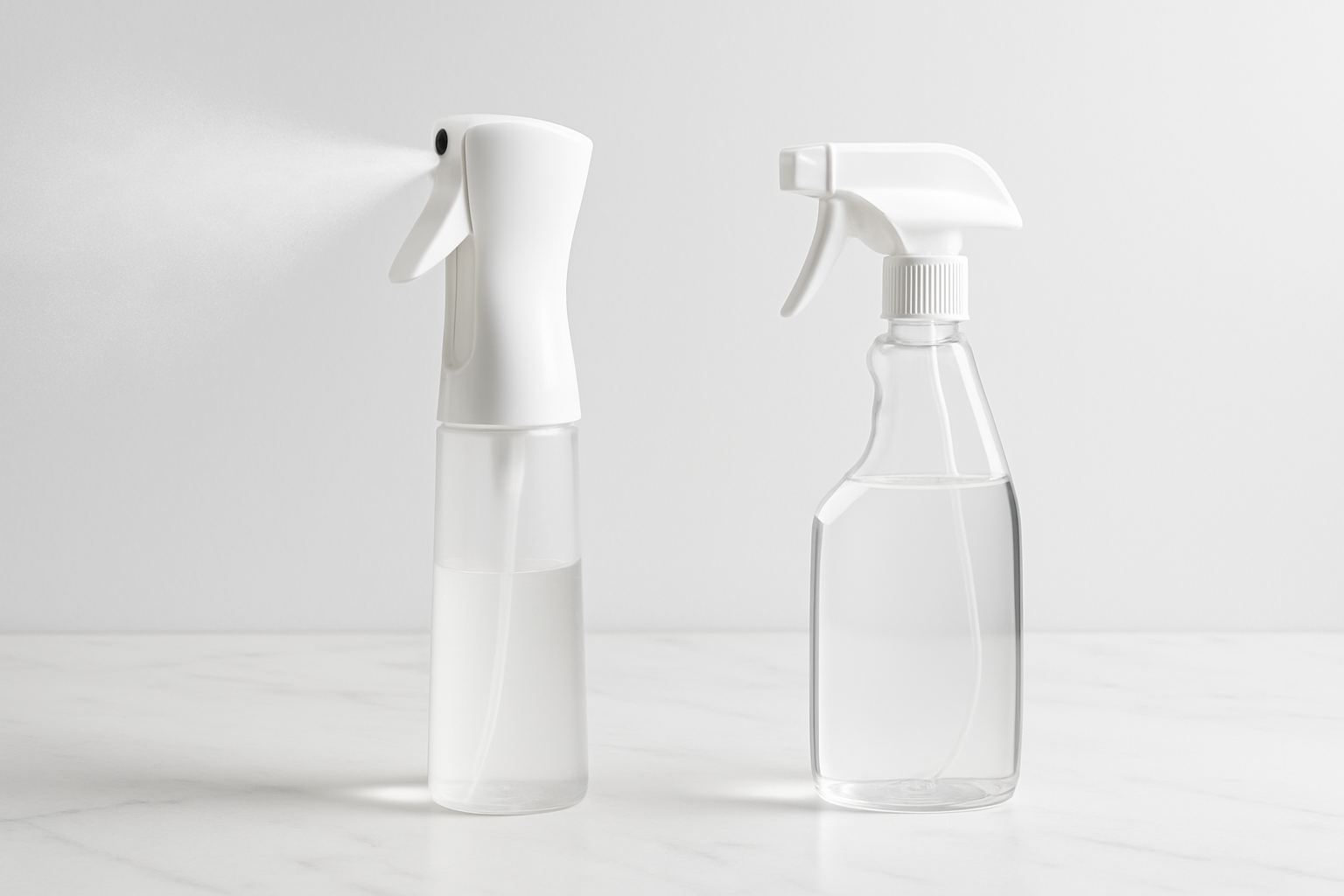
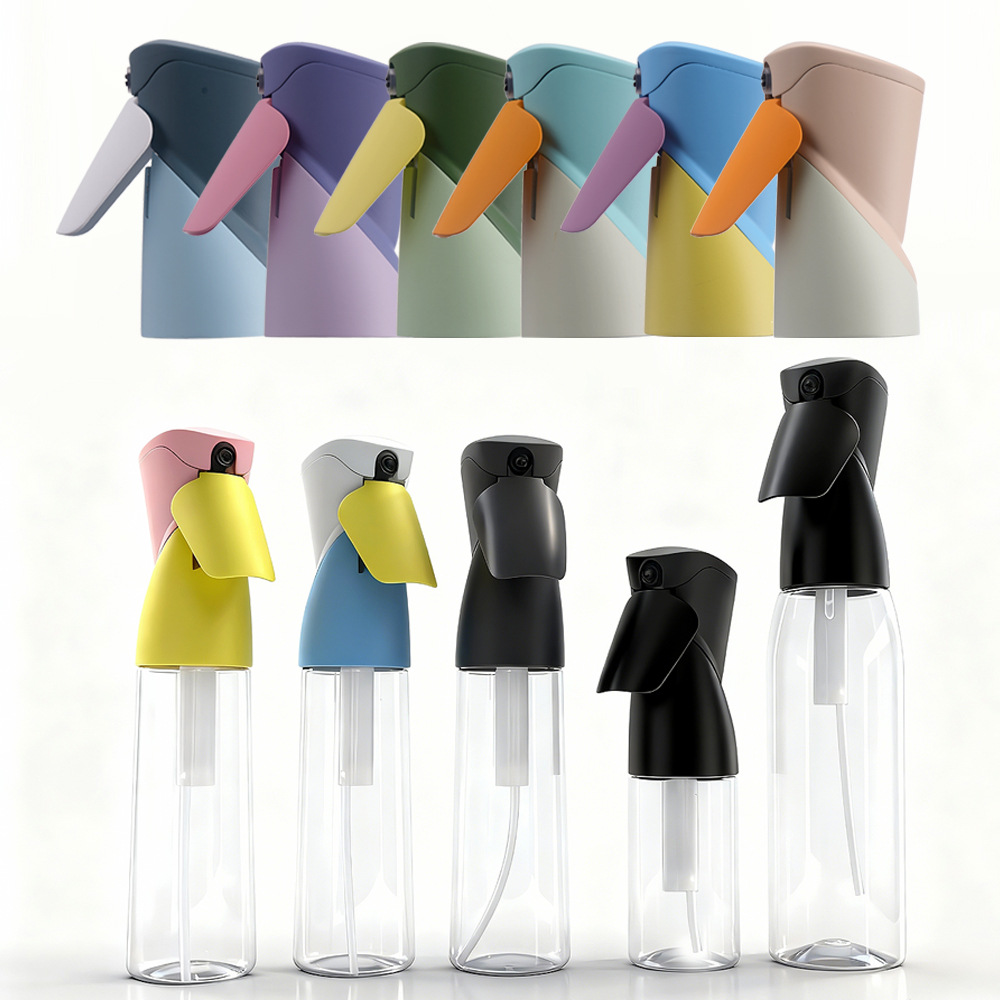
If you have ever shopped for a spray bottle, you have likely noticed two fundamentally different types: the classic trigger spray bottle and the newer continuous spray bottle (also called a continuous mist sprayer). They look similar on the outside, but the internal mechanism — and the user experience — are dramatically different.
So which one should you choose? The answer depends on your application, budget, and what kind of spray performance you need. In this guide, we compare continuous spray bottles and regular spray bottles across every metric that matters: spray quality, ease of use, durability, cost, and best applications. By the end, you will know exactly which type is right for your situation.
Key Takeaways
- Continuous spray bottles deliver 6-12 seconds of uninterrupted ultra-fine mist per press, covering 3-5x more area per pump cycle than trigger sprayers.
- Regular trigger sprayers deliver a single burst per squeeze and offer adjustable stream-to-mist settings.
- For even, gentle coverage (hair, plants, cosmetics), continuous spray bottles are clearly superior.
- For heavy-duty targeted application (degreasers, thick solutions), regular trigger sprayers are better.
- Continuous spray bottles cost 20-40% more upfront but deliver significantly better performance for mist applications.
How Each Type Works: The Mechanism Explained
Regular Trigger Spray Bottles
A standard trigger spray bottle uses a simple piston-pump mechanism. When you squeeze the trigger, a piston inside the cylinder pushes liquid out through the nozzle. When you release the trigger, a spring returns the piston, creating a vacuum that draws more liquid up through the dip tube. Each squeeze produces one burst of spray lasting less than a second.
The nozzle typically has an adjustable ring that lets you switch between a focused stream and a wider mist pattern. This versatility is one of the trigger sprayer's main advantages — you can switch from a pinpoint stream (for targeting stains) to a broad mist (for general coverage) without changing bottles.
Continuous Spray Bottles
A continuous spray bottle uses a pressurized chamber mechanism that is fundamentally different from a trigger sprayer. When you pump the actuator (top button or trigger), you are not directly pushing liquid out — instead, you are pressurizing an internal air chamber. This stored pressure then forces liquid through an ultra-fine nozzle in a sustained, uninterrupted mist that lasts 6-12 seconds per press.
The mist produced by a continuous spray bottle is significantly finer than what a trigger sprayer can achieve. The droplet size is typically 20-50 microns (compared to 100-400 microns for trigger sprayers), creating a fog-like mist that floats and settles gently rather than shooting and spattering. Additionally, many continuous spray bottles operate at any angle — including upside down — because the pressurized system does not rely on gravity to feed liquid to the nozzle.
Head-to-Head Comparison
Let us compare the two types across every factor that matters for choosing the right spray bottle.
| Feature | Continuous Spray Bottle | Regular Trigger Spray Bottle |
|---|---|---|
| Spray Duration | 6-12 seconds of continuous mist per press | Single burst (~0.3s) per squeeze |
| Mist Quality | Ultra-fine (20-50 micron droplets), even coverage | Coarser (100-400 micron), may drip |
| Spray Pattern | Consistent fine mist only | Adjustable: stream, cone, mist |
| 360-Degree Use | Yes — works at any angle, including upside down | No — must be upright or slightly tilted |
| Hand Fatigue | Low — one press delivers sustained output | Higher — repeated squeezing required |
| Coverage per Pump | 3-5x more area covered per pump cycle | Small area per squeeze |
| Best Liquid Types | Water, water-based solutions, light liquids | Any viscosity — water to thick solutions |
| Priming Needed | Yes — 20-30 initial pumps to pressurize | Minimal — 3-5 pumps to prime |
| Ideal Fill Level | 30-80% capacity (needs air space) | Any level — works until empty |
| Mechanism Complexity | More complex — pressurized system | Simple — piston and spring |
| Price Point | 20-40% higher | Lower — simpler mechanism |
| Durability | High with quality manufacturing | High — fewer parts to fail |
Spray Quality: Where Continuous Bottles Shine
The single biggest advantage of a continuous spray bottle is spray quality. The ultra-fine mist (20-50 micron droplets) creates an effect similar to professional-grade airbrush equipment — a gentle, even coat that settles uniformly without dripping, pooling, or streaking.
This matters most in applications where coverage uniformity is critical:
- Hair styling and care: A continuous mist dampens hair evenly without saturating sections or leaving dry spots. Hairdressers report that continuous spray bottles reduce styling time by 15-20% because they spend less time re-wetting dry patches.
- Plant misting: The ultra-fine mist mimics natural humidity rather than simulating rain. This prevents leaf burn, overwatering, and the soil displacement that coarse sprays cause.
- Cosmetic application: Setting sprays, facial mists, and toner sprays deliver a more even, comfortable application with the fine mist from continuous bottles.
- Cleaning glass and mirrors: The fine mist distributes cleaning solution in a thin, even layer, reducing streaking and the need for re-wiping.
Regular trigger sprayers, in contrast, produce larger droplets that tend to concentrate in the center of the spray pattern. This creates wet spots and dry spots, requiring you to move the bottle continuously for even coverage — and even then, the results are less uniform than a continuous mist.
Ease of Use and Ergonomics
Hand Fatigue
This is where continuous spray bottles deliver their second major advantage. With a trigger sprayer, you need to squeeze repeatedly — sometimes hundreds of times in a single session. For professional users (hairdressers, cleaners, gardeners), this repetitive motion contributes to hand fatigue, repetitive strain, and even carpal tunnel symptoms over time.
A continuous spray bottle requires fewer pump actions for the same coverage. One press delivers 6-12 seconds of continuous mist, equivalent to roughly 10-15 individual trigger squeezes. Over a full working day, that is a dramatic reduction in hand strain.
360-Degree Operation
Most continuous spray bottles can spray at any angle, including upside down. This is because the pressurized chamber pushes liquid out regardless of gravity. Regular trigger sprayers rely on the dip tube being submerged in liquid, so they only work reliably when the bottle is upright or at a slight tilt.
This 360-degree capability is particularly useful for:
- Spraying the underside of plant leaves (pest control)
- Reaching awkward angles during cleaning (under counters, behind fixtures)
- Hair styling where you need to mist from below or at the back of the head

Best Applications for Each Type
Choose a Continuous Spray Bottle For:
- Hair care and styling — even dampening, setting sprays, leave-in conditioners
- Plant misting — gentle humidity without overwatering
- Cosmetics and skincare — facial mists, setting sprays, toner application
- Light cleaning — glass, mirrors, stainless steel where even coverage matters
- Ironing and fabric care — even dampening before pressing
- Kitchen oil spraying — even, controlled oil coating for cooking
- Any task requiring extended spraying — the sustained mist reduces hand fatigue
Choose a Regular Trigger Spray Bottle For:
- Heavy-duty cleaning — degreasers, bathroom cleaners, bleach solutions where targeted application is needed
- Thick or viscous liquids — solutions with particles, thick detergents, or suspensions
- Targeted spot treatment — stain removal, weed killing, where you need a focused stream
- Industrial applications — lubricants, solvents, and chemical applications
- Budget-conscious purchasing — when unit cost is the primary concern
Cost Analysis: Upfront vs. Long-Term Value
Continuous spray bottles typically cost 20-40% more than comparable trigger sprayers due to the more complex internal mechanism. However, the cost analysis is not as straightforward as comparing unit prices:
Efficiency Savings
Because continuous spray bottles deliver finer, more even coverage, users typically use 15-30% less liquid to achieve the same coverage. The ultra-fine mist distributes solution more efficiently than the coarser output of trigger sprayers. For businesses purchasing cleaning solutions, hair products, or other consumable liquids in bulk, this reduced consumption translates to meaningful cost savings over time.
Productivity Gains
In professional settings, the time saved by continuous spray bottles adds up. Hairdressers report styling sessions that are 15-20% faster. Cleaning crews report that glass and mirror cleaning is 20-25% faster due to reduced streaking and re-wiping. For B2B buyers, the productivity gain often outweighs the higher unit cost within the first month of use.
Durability and Lifespan
A well-manufactured continuous spray bottle should last just as long as a quality trigger sprayer — 1-3 years with daily use. The key word is well-manufactured. Because the pressurized mechanism has tighter tolerances, quality control matters more. A cheap continuous spray bottle with poorly fitted seals will fail faster than a cheap trigger sprayer. But a quality continuous bottle — manufactured with precision molding and 100% leak-tested — matches or exceeds trigger sprayer durability.
Desiky's continuous spray bottles are built with this principle in mind. Every bottle undergoes 100% vacuum leak testing, uses patented pump designs with precision-fitted seals, and maintains a defect rate below 0.5%. The result is a continuous spray bottle that performs reliably from the first press to the last — delivering the premium spray experience without the premium failure rate.
Common Misconceptions
"Continuous spray bottles are fragile"
This misconception comes from early, poorly-made continuous spray bottles that entered the market before manufacturing quality caught up with the design concept. A properly engineered continuous spray bottle is no more fragile than a trigger sprayer. The pressurized mechanism has fewer moving parts than a trigger mechanism (no spring, no lever, no hinge), which actually means fewer potential failure points.
"You cannot use anything except water in a continuous spray bottle"
Not quite. Continuous spray bottles are designed for water-like viscosity liquids. This includes water, water-based cleaning solutions, diluted essential oils, hair styling products, facial toners, and many other formulations. The key constraint is viscosity — thick liquids and suspensions with particles will clog the ultra-fine nozzle. As long as the liquid flows like water, a quality continuous spray bottle will handle it.
"Trigger sprayers give better coverage"
The opposite is true for mist applications. Trigger sprayers deliver more liquid per squeeze, but the coverage is less even. The larger droplets concentrate in the center of the spray pattern and tend to drip and run on vertical surfaces. Continuous spray bottles deliver less liquid per press but distribute it more uniformly across a wider area, achieving better effective coverage with less waste.
Making the Decision: A Practical Framework
Ask yourself these three questions:
- Do I need fine, even mist coverage? If yes, choose continuous. If you need targeted streams or heavy application, choose trigger.
- Will I be spraying for extended periods? If yes, choose continuous for reduced hand fatigue. If spraying is brief and occasional, trigger is fine.
- What type of liquid will I use? If water-like viscosity, either type works (but continuous is superior for mist). If thick, viscous, or particle-laden, choose trigger — it is the only option that will work reliably.
For many users, the best approach is to have both types available. Use continuous spray bottles for misting tasks (hair, plants, cosmetics, light cleaning) and trigger sprayers for heavy-duty applications (degreasers, bathroom chemicals, industrial liquids).
Frequently Asked Questions
What is a continuous spray bottle?
A continuous spray bottle is a spray bottle that uses a pressurized internal chamber to deliver an uninterrupted stream of ultra-fine mist for 6-12 seconds per press. Unlike traditional trigger sprayers that produce a single burst per squeeze, continuous spray bottles build up air pressure and release it steadily through a fine-mist nozzle, creating a fog-like spray with droplets as small as 20-50 microns.
Are continuous spray bottles worth the extra cost?
For applications that benefit from fine, even mist — hair care, plant misting, cosmetics, glass cleaning — yes, absolutely. The superior spray quality, reduced hand fatigue, and lower liquid consumption typically offset the 20-40% higher unit cost within weeks of regular use. For heavy-duty cleaning with thick chemicals, trigger sprayers remain more cost-effective.
Can I use cleaning solutions in a continuous spray bottle?
Yes, as long as the cleaning solution has a water-like viscosity and does not contain suspended particles. Diluted all-purpose cleaners, glass cleaners, and disinfectant solutions all work well. Avoid thick degreasers, bleach concentrates, and solutions with abrasive particles — these can clog the fine-mist nozzle.
How long does the continuous mist last per press?
Most quality continuous spray bottles deliver 6-12 seconds of continuous mist per press, depending on the bottle size and internal pressure design. Desiky's continuous spray bottles deliver a consistent 6-12 seconds of ultra-fine mist per press, with the exact duration depending on the model and how many priming pumps are applied.
Do continuous spray bottles work upside down?
Yes — most quality continuous spray bottles feature 360-degree spraying capability. The pressurized chamber mechanism pushes liquid out regardless of bottle orientation, unlike trigger sprayers that rely on gravity to keep the dip tube submerged in liquid. This makes continuous bottles ideal for spraying plant undersides, hard-to-reach areas, and overhead surfaces.
Which type of spray bottle is best for hair?
For hair care and styling, continuous spray bottles are the clear winner. The ultra-fine mist dampens hair evenly without saturating or creating dripping wet spots. The sustained spray reduces hand fatigue during styling sessions, and the 360-degree capability makes it easy to mist from any angle. Professional hairdressers increasingly prefer continuous spray bottles over traditional trigger sprayers for these reasons.
Conclusion
The choice between a continuous spray bottle and a regular trigger spray bottle ultimately depends on what you are spraying, how you are spraying it, and how often you use it. For fine mist applications — hair, plants, cosmetics, light cleaning — continuous spray bottles are objectively superior in spray quality, ergonomics, and coverage efficiency. For heavy-duty, targeted applications with thick liquids, traditional trigger sprayers remain the right tool for the job.
If you are a B2B buyer looking to offer your customers a premium spray experience, continuous spray bottles represent a significant upgrade over standard trigger sprayers — and the market is moving in that direction. Consumer demand for fine mist sprayers has grown steadily as awareness of continuous spray technology increases.
Desiky's continuous spray bottle collection — available in Penguin and Slim Waist series, in 200ml, 300ml, and 500ml sizes — delivers patented pump designs, 6-12 second continuous mist, and a defect rate below 0.5%. Every bottle is 100% leak-tested before shipment. Contact us for samples, pricing, and full OEM customization options.
Related Articles: Spray Bottle Size Guide · Best Spray Bottle · Continuous vs Trigger Spray Comparison · Spray vs Pump vs Dropper Comparison