Professional spray bottles are non-negotiable equipment in any modern hair salon. Whether you're running a boutique salon with 5 stylists or a large-scale beauty operation, the right spray bottle impacts both efficiency and client experience. This guide covers everything salon owners and purchasing managers need to know about choosing, sourcing, and scaling professional spray bottles for continuous daily use.
Quick Answer: Professional salons prefer continuous mist spray bottles in 200ml–300ml capacity with 0.25–0.30cc/s spray output, MOQ starting at 3,000 units, and wholesale pricing ranging from $0.45–$0.80 per unit at scale. Lead time is typically 20–25 days from confirmation to shipping.
---Why Salons Choose Continuous Spray Bottles Over Manual Pumps
Continuous spray technology fundamentally changes salon workflow. Unlike traditional trigger-pump bottles that require repeated hand compression for each mist, continuous sprayers deliver consistent mist with a single press lasting 1.2–3.0 seconds—with some premium models extending to 5 seconds per trigger.
Hand Fatigue Reduction: Stylists using manual spray bottles compress the trigger 300–500 times per day across cutting, styling, and chemical treatments. This repetitive motion causes wrist strain and hand fatigue. Continuous spray bottles reduce compression frequency by 60–70%, cutting hand strain significantly over an 8–10 hour salon day.
Mist Coverage Consistency: Continuous sprayers produce ultra-fine mist (0.25–0.30cc per second) that distributes evenly across hair sections. Manual pumps create uneven spray patterns—some areas oversaturated, others dry. Stylists report that continuous sprayers require 40% fewer misting passes to achieve the same hydration level.
Precision for Chemical Treatments: When applying color, perms, or chemical relaxers, even distribution is critical for consistent results. Over-saturation in one section causes uneven processing; under-saturation creates patchy color. Continuous sprayers solve this by mimicking aerosol performance without propellant chemicals.
Reduced Product Waste: Fine, controlled mist means less liquid per application. Salons report 15–20% reduction in spray bottle solution consumption when switching from manual to continuous spray technology.
Professional Client Perception: Clients notice the difference. Continuous misting appears more professional and salon-grade compared to manual pump bottles. This detail contributes to perceived value and supports premium pricing.
---200ml vs 300ml vs 500ml: Capacity Comparison for Salon Use
Choosing the right bottle size depends on salon workflow, staff count, and product usage frequency. Here's how salon professionals use each size:
| Capacity | Ideal Scenario | Spray Time per Fill | Refill Frequency | Best For | Price Range (OEM) |
|---|---|---|---|---|---|
| 200ml (6.8oz) | Solo stylists, mobile/traveling stylists, specialty treatments | 8–12 minutes continuous spray | Every 3–4 hours | Boutique salons (1–3 chairs), barber shops, precision work (perms/color) | $0.45–$0.65 |
| 300ml (10oz) | Small to mid-size salons (5–8 chairs) | 12–16 minutes continuous spray | Every 4–5 hours (full shift) | Standard salon use, general styling, water + conditioner mixes | $0.55–$0.75 |
| 500ml (16.9oz) | High-volume salons (8+ chairs), color stations | 20–25 minutes continuous spray | Mid-shift refill | Production salons, chemical treatment stations, salon chains | $0.70–$0.95 |
Practical Insight: Most professional salons operate with a mix—300ml bottles at every station for daily water misting, plus 200ml bottles reserved for color/perm stations where product precision is critical. Large chains often stock 500ml bottles for wash stations to reduce refill frequency.
MOQ Logistics: If sourcing from manufacturers, MOQs typically align to production runs—3,000, 2,400, or 5,000 units. A 10-chair salon needs approximately 15–20 bottles (accounting for breakage, backups, and wash station reserves). Therefore, a single 3,000-unit OEM order could supply a small chain of 60–80 locations.
---Looking for a reliable spray bottle supplier?
Get free samples and a factory-direct quote within 12 hours.
Get a Free Quote →Material & Spray Quality: What Makes Professional Bottles Durable
Professional salon spray bottles endure harsh conditions: daily chemical exposure (ammonia-based color, bleach activators, peroxide), hot water sterilization, and constant pressure cycling. Material selection determines whether a bottle lasts 12 months or 3 years.
PET Plastic (Polyethylene Terephthalate): Industry standard for salon spray bottles. PET resists most hair chemicals, withstands temperature fluctuations (40–60°C sterilization cycles), and is lightweight for extended daily handling. Professional-grade PET is typically 0.8–1.0mm thickness, providing rigidity without brittleness. BPA-free variants eliminate chemical leaching concerns.
Spray Output Consistency: Quality continuous sprayers maintain 0.25–0.30cc/s output throughout the bottle's entire life cycle. Budget bottles degrade to 0.15–0.20cc/s after 3–6 months of use, requiring harder trigger pulls. Premium pumps use precision-engineered piston mechanisms that maintain calibrated output for 18+ months.
Nozzle Design: Professional bottles feature 0.3mm precision nozzle apertures. Wider apertures (0.5mm+) create coarse mist unsuitable for hair styling. Narrower apertures clog with mineral deposits in hard-water environments (common in many salons). The 0.3mm sweet spot balances fine mist production with clog resistance.
Inverted-Use Capability: Salon stylists often spray hair sections with the bottle held at angles up to 90 degrees (sideways) or occasionally upside down (when refilling becomes inconvenient mid-service). Premium continuous sprayers maintain uninterrupted mist even inverted—achieved through sealed pressure chambers and anti-gravity valve design. Budget models fail this test, spitting instead of misting.
Temperature Stability: Professional spray bottles should function reliably in 15–40°C environments (unheated salons in winter to heated styling stations in summer). Cheap plastics become brittle at low temperatures and warp at high temperatures. Premium PET maintains elasticity across this range.
Durability Benchmark: A professional-grade continuous spray bottle used in a busy salon (8–10 hours daily, 20–25 trigger pulls per hour) should deliver 18–24 months of reliable service before replacement. Mid-tier bottles last 12–15 months. Budget bottles typically fail (leaking, weak spray, nozzle clogs) within 6–9 months.
---Real-World Salon Application Scenarios
Understanding how different salon departments use spray bottles helps purchasing managers source the right mix of models and backups.
Hair Cutting & Styling (Dry Hair Styling): Stylists mist sections to add moisture before cutting (prevents hair breakage, improves cut precision). A typical 8-hour shift includes 8–12 haircuts, requiring approximately 10–15 minutes of total continuous spraying per day per station. Water + light conditioner mix. Medium spray setting preferred (not ultrafine, to ensure water penetration). 300ml bottles replace at end of shift or mid-day.
Color Application (Hair Coloring Stations): Color technicians spray root areas to keep hair damp while mixing and applying color. Requires precision spraying to avoid over-saturation (which dilutes color formula) or under-saturation (uneven tone development). 200ml bottles preferred for control, replaced every 2–3 color services due to frequent refills. Strict anti-spillage protocols—color stations often use bottles with locking triggers. Solution: water + hydrogen peroxide developer (1:1 ratio).
Perm & Chemical Relaxer Application: Perm specialists spray scalp and hair sections with processing lotion during perm wrapping. Requires controlled, even distribution to prevent chemical burns. 200ml bottles with precision nozzles essential. Solution: specialized perm setting lotion (not just water). Typically 2–3 refills per perm (8-hour process). Professional bottles must resist corrosive chemicals—PET plastic specifically rated for chemical compatibility.
Scalp & Conditioning Treatments: Shampoo stations use spray bottles for deep conditioning treatments, hot oil treatments, and scalp massage solutions. Higher volume per client (full-head saturation). 300–500ml bottles preferred. Solution: leave-in conditioner, scalp serum, or treatment oil mixed with water. Bottles undergo frequent hot-water sterilization between clients.
Post-Wash Refresh Misting: Daily maintenance spraying between services to refresh curls, reactivate styling products, reduce frizz. 300ml bottles at every station. Solution: pure water or light hydrating mist. Highest frequency use—stylists spray 20–30 times per shift per station, often reaching 50–60 times on busy days.
Sanitization & Disinfection: Many salons now use spray bottles to apply EPA-approved disinfectants (like diluted bleach or quaternary ammonium solutions) to tools, chairs, and work surfaces. Requires chemical-resistant bottles with locking triggers to prevent accidental spraying. Special consideration: disinfectant spray bottles should be color-coded and kept separate from water/product bottles to avoid cross-contamination.
---MOQ, Wholesale Pricing & Ordering Details
For salon owners and distributors sourcing professional spray bottles directly from manufacturers, here are the realistic economics:
MOQ (Minimum Order Quantity):
- Standard Production MOQ: 3,000 units per SKU (one color, one size). Most contract manufacturers won't accept smaller orders.
- Multi-SKU Breaks: If ordering 3 different sizes (200ml, 300ml, 500ml), total order is 9,000 units (3,000 each). Total cost ~$2,000–$2,700.
- Custom Color MOQ: 2,400 units if requesting Pantone color matching beyond standard clear/white/black options (adds 5–7 day lead time).
- Custom Mold MOQ: 100,000 units for entirely custom bottle shapes or logos (enterprise-only, rare for spray bottles).
Wholesale Pricing Structure (Per Unit Cost at Scale):
- 3,000 units: $0.75–$1.05 per unit (retail equivalent: $1.99–$3.99)
- 2,400 units: $0.60–$0.85 per unit
- 5,000 units: $0.48–$0.70 per unit
- 10,000+ units: $0.42–$0.60 per unit
Pricing varies by:
- Continuous vs. Manual Spray: Continuous spray costs 15–20% more due to precision pump engineering.
- Capacity: 500ml costs 25–35% more than 200ml (more material, more complex mold).
- Material Grade: BPA-free, chemical-resistant PET costs 10–15% premium over standard plastic.
- Manufacturing Location: Asian manufacturers (Vietnam, China, India) offer lowest costs. Taiwan premium tier (10–15% higher cost, better QC). US domestic manufacturing costs 40–60% higher.
Typical Lead Time: 20–25 days from order confirmation to FOB shipping. Includes 5–7 days for tooling adjustments (if any customization), 8–12 days for production, 3–5 days for QC sampling and shipment preparation.
Payment Terms: Usually 50% deposit upon order, 50% balance upon shipment. Some suppliers offer Net 30 for established accounts.
Shipping Economics: A full 20-foot container holds approximately 150,000–200,000 units of 200ml spray bottles. Consolidated shipments (mixed SKUs) to US/EU cost $8,000–$12,000. Air freight: 15x higher cost, 2-week delivery.
Custom Labeling: Additional $0.02–$0.05 per unit for laser branding or adhesive labels (MOQ 5,000+). Packaging (individual shrink wrap + master cartons) adds $0.03–$0.08 per unit.
Total Landed Cost Example (USA Distributor):
Order: 2,400 units of 300ml continuous spray bottles
- Unit cost (FOB): $0.62/unit = $1,488
- Packaging & labeling: $0.05/unit = $120
- Shipping (consolidated): $4,200 ÷ 2,400 units = $1.75/unit
- Total landed cost: $3.42/unit
- Retail markup (2.5–3x): Sells for $8.49–$10.26 per unit
FAQ: Common Questions from Salon Professionals
Q: Can I use continuous spray bottles for hair salon applications?
A: Yes, absolutely. Continuous spray bottles are industry-standard in professional salons. They're specifically engineered for high-frequency use (triggered 20–50 times per 8-hour shift per station) and resist chemical exposure from hair color, peroxide, and styling products. Professional-grade bottles (not consumer beauty bottles) maintain spray consistency over 18–24 months of daily salon use.
Q: What's the practical difference between 200ml and 300ml bottles?
A: 200ml bottles are optimized for precision work—color application, perms, and specialty treatments where you need fine control and lower spillage risk. A single trigger lasts ~1–1.5 seconds. Requires refilling every 2–3 service cycles (high frequency, but provides control).
300ml bottles are the salon workhorse—used for general water misting, styling, and routine hydration. A single trigger lasts ~1.5–2 seconds. One fill typically lasts an entire 8-hour shift, reducing refill interruptions.
Use both sizes in a full-service salon: 300ml at every station for water, 200ml at color/perm stations for precision.
Q: How long does a single continuous spray trigger last?
A: Professional-grade bottles deliver 1.2–3.0 seconds of continuous mist per trigger pull, depending on:
- Spray pressure: Higher pressure (1.5 bar+) produces longer spray duration. Budget bottles at 0.8 bar only mist 0.8–1.2 seconds.
- Nozzle aperture: Wider nozzles (0.4mm+) spray faster, shorter duration. Precision 0.3mm nozzles extend spray time by 20–30%.
- Bottle fill level: Fully filled bottles (high pressure) spray longer than half-empty bottles (lower pressure). Professional bottles maintain consistent pressure throughout the fill cycle using spring-loaded mechanisms.
In continuous production spraying (holding trigger for extended periods), a 300ml bottle provides approximately 12–16 minutes of uninterrupted spray before requiring refill.
Q: Can I use continuous spray bottles for essential oils, hair serums, or professional chemicals?
A: Yes, with material selection: PET plastic bottles resist water-based solutions, diluted conditioners, and most hair chemicals (peroxide, ammonia-based color, scalp treatments). However, certain ingredients can cause issues:
- Essential oils (undiluted): Can degrade low-grade plastic over 3–6 months. Always dilute with water (1:4 ratio minimum) before spraying.
- Silicone serums: Incompatible with standard PET plastic—silicone dissolves polymer coating. Use glass or specially coated bottles for silicone-based products.
- Bleach/High-Strength Disinfectants: Require chemical-resistant bottles explicitly rated for alkaline solutions. Standard salon bottles work for diluted disinfectant (1:10 ratio with water) but degrade quickly with concentrated bleach.
Best practice: Use separate bottle sets for water, conditioners, and chemicals. Avoid mixing oil-based or silicone-based products in plastic spray bottles.
Q: What's the MOQ if I want to order custom branded bottles for my salon chain?
A: Minimum order quantities for branded spray bottles:
- No customization (clear/white stock, no printing): 3,000 units
- Laser-etched logo or salon name: 3,000 units (add $0.01–$0.02 per unit, 3–5 day lead time extension)
- Adhesive label branding: 3,000 units (add $0.03–$0.05 per unit, 5–7 day extension)
- Custom Pantone color: 2,400 units minimum (add $0.05–$0.10 per unit, 7–10 day extension)
A 10-unit salon chain (5–7 chairs per location) needs approximately 200–300 bottles total (accounting for backups, breakage, and wash stations). A single 3,000-unit order would supply the entire chain for 4–6 years with replacement cycles.
Q: What lead time should I expect from order to delivery?
A: Standard production timeline:
- Order confirmation & deposit (50%): Same day
- Production scheduling: 1–2 days
- Manufacture (8–12 days for 3,000–5,000 units)
- QC sampling & adjustments (2–3 days)
- Bulk packing & logistics prep (2–3 days)
- Shipment (3–5 days to FOB port)
- Ocean transit to US/EU (15–22 days)
- Total: 20–25 days from confirmed order to arrival at port
Express 20-foot container consolidation can reduce to 18–20 days. Air freight available at 3x cost, 8–10 day delivery (only for urgent small orders 500–2,000 units).
---Related reading for salon professionals and purchasing managers:
- Continuous Spray Bottles Product Overview
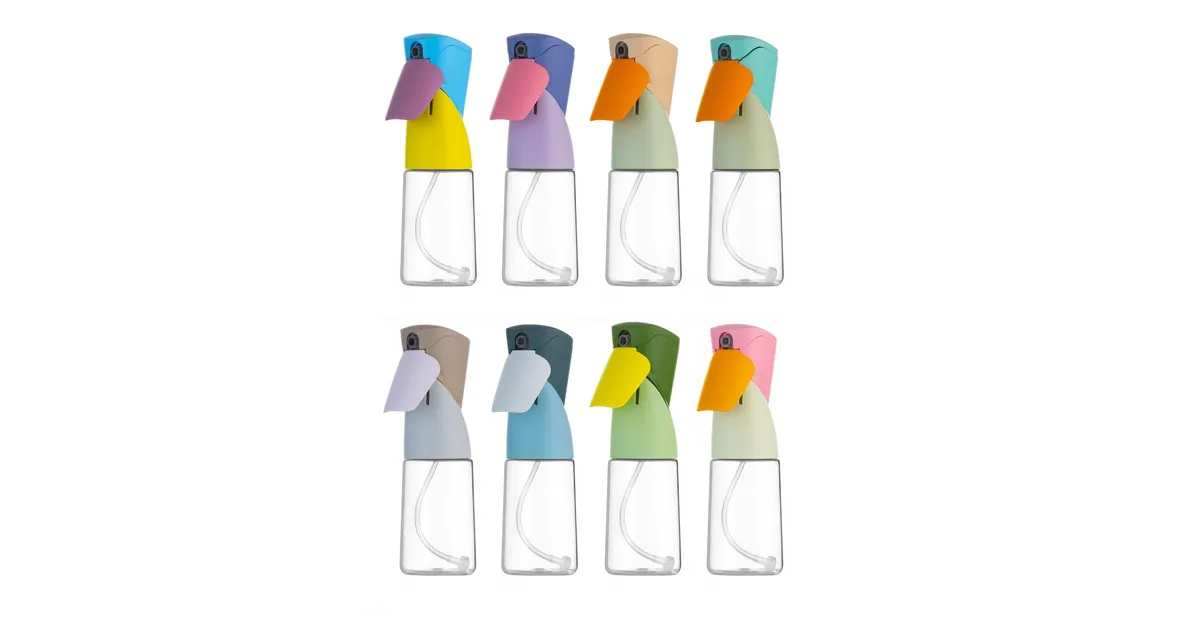
- 200ml Penguin Continuous Spray Bottle – Professional Edition
- 300ml Slim-Waist Continuous Spray Bottle – Ergonomic Design
Professional hair salons depend on reliable spray bottles for daily operations. Continuous mist spray technology—with proper material selection (chemical-resistant PET), precision nozzles (0.3mm), and tested durability—directly impacts salon efficiency and client satisfaction.
For salon owners making purchasing decisions:
- Start with 300ml continuous spray bottles as your workhorse (every station)
- Add 200ml bottles for precision work (color, perms)
- Source from manufacturers with salon-specific product lines (not consumer beauty channels)
- Plan for bulk orders (3,000+ units) to access wholesale pricing ($0.50–$0.75 per unit) and custom branding
- Budget 18–24 month replacement cycles (professional bottles outperform consumer bottles 2–3x in durability)
For distributors and salon supply chain partners:
- 200ml–300ml capacity dominates salon channel (70–80% of spray bottle demand)
- Continuous spray technology commands 40–60% price premium but justifies itself through operational efficiency
- Customization (color, branding) is a key differentiator—most professional salons prefer branded bottles
- MOQ 3,000+ makes sense for regional distributors serving 20–50 salons